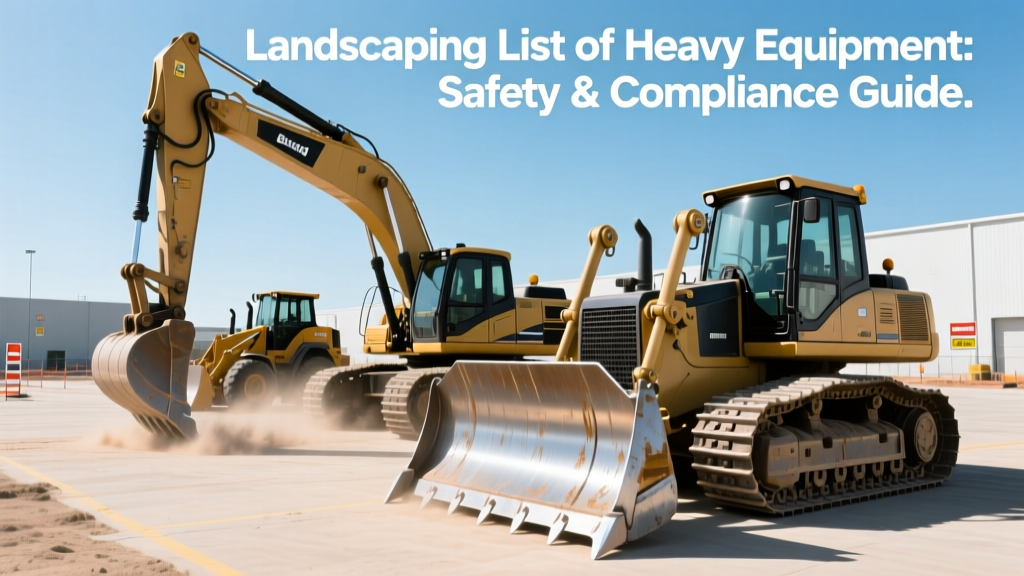
Landscaping List of Heavy Equipment: Safety & Compliance Guide
Explore our comprehensive landscaping list of heavy equipment. Learn essential OSHA safety standards, compliance rules, and operational best practices.
Navigating the list of heavy equipment required for commercial landscaping involves more than matching machine capabilities to terrain. For fleet managers and site supervisors, every piece of machinery on the list of heavy equipment must be evaluated against strict Occupational Safety and Health Administration (OSHA) compliance frameworks. Failure to adhere to these standards not only risks catastrophic rollover and struck-by incidents but also exposes companies to severe financial penalties, with serious OSHA violations now exceeding $16,000 per infraction.
⚠️ CRITICAL COMPLIANCE WARNING: According to the OSHA Heavy Equipment safety guidelines, the leading causes of fatalities in landscaping and earthmoving operations are rollovers, struck-by incidents, and trench collapses. Operating machinery without functional Roll-Over Protective Structures (ROPS) or bypassing seatbelt interlocks are among the most frequently cited willful violations in the sector.The Core Landscaping List of Heavy Equipment & Compliance Specs
When compiling your operational list of heavy equipment for landscaping, the following three machine categories dominate the sector. Each carries distinct regulatory requirements under OSHA 29 CFR 1926.
1. Skid Steer Loaders (SSLs)
Models like the Bobcat S650 (1,986 lb rated operating capacity) and Caterpillar 262D3 are landscaping staples for grading and material transport. Under OSHA 1926.600 (Equipment), all SSLs must be equipped with certified ROPS and FOPS (Falling Object Protective Structures). Furthermore, modern compliance mandates that the operator presence sensor (seat switch) be fully functional; bypassing this switch with a zip-tie or dummy plug to allow the machine to operate without an operator in the seat is an immediate citable offense.
2. Mini Excavators
Zero-tail-swing models like the Kubota U-17 and John Deere 50G are critical for tight-space trenching and irrigation installation. Compliance here shifts heavily toward OSHA 1926 Subpart P (Excavations). The primary compliance failure with mini excavators in landscaping is improper spoil pile management. OSHA strictly mandates that excavated soil (spoils) must be kept a minimum of 2 feet from the edge of the trench to prevent cave-ins and rolling debris hazards.
3. Compact Track Loaders (CTLs)
CTLs such as the Takeuchi TL6R offer superior flotation (often under 3.5 psi ground pressure) for working on wet, turf-sensitive landscaping sites. The primary safety concern with CTLs is slope operation. Because tracks provide a false sense of security regarding lateral stability, operators frequently exceed the manufacturer's maximum slope rating (typically 25 to 30 degrees for lateral travel), leading to catastrophic side-rollovers.
OSHA Safety Standards Matrix for Landscaping Machinery
Use this matrix to audit your current list of heavy equipment against baseline federal safety requirements.
| Equipment Category | Primary OSHA Standard | Critical Compliance Mandate | Common Citation Trigger |
|---|---|---|---|
| Skid Steer Loaders | 1926.600(a)(1) | ROPS/FOPS integrity and seatbelt interlocks. | Bypassed seat switches; missing backup alarms. |
| Mini Excavators | 1926 Subpart P | Spoil pile placement and trench shielding. | Spoils piled within 2 feet of trench edge. |
| Compact Track Loaders | 1926.600(a)(3) | Adherence to OEM slope and load limits. | Exceeding lateral slope grade limits with raised loads. |
| Wheel Loaders / Tractors | 1926.602(b) | Overhead canopy (FOPS) for falling branch hazards. | Operating in heavy timber clearing without FOPS. |
Pre-Operation Compliance: The 14-Point Daily Inspection Framework
OSHA requires documented daily inspections for all heavy machinery. A generic walk-around is insufficient. Implement this 14-point framework for every machine on your list of heavy equipment before the key is turned:
- ROPS/FOPS Welds: Visually inspect for micro-fractures or rust scaling at the cab mounting points.
- Seatbelt Interlock: Test the physical retractor and ensure the machine's hydraulics disable when unbuckled.
- Backup Alarm: Verify the audible alarm registers at least 15 decibels above ambient site noise.
- Hydraulic Hose Routing: Check for abrasion against the chassis, specifically at the boom pivot points.
- Cylinder Drift: Raise the boom/attachments 2 feet off the ground, shut off the engine, and measure for hydraulic drift over 5 minutes.
- Track/Tire Tension: Measure track sag (typically 1 to 1.5 inches at mid-span for CTLs) to prevent de-tracking on slopes.
- Swing Circle Gearbox: Check for metal shavings in the grease (excavators only).
- Quick-Coupler Locks: Verify manual or hydraulic locking pins fully engage and seat.
- Mirrors and Cameras: Clean and calibrate rear-view and side-view blind-spot monitors.
- Fire Extinguisher: Verify the 10-B:C rated extinguisher is charged and mounted in the cab.
- Lighting & Beacons: Test all LED work lights and the rotating amber strobe.
- Grounding Straps: Inspect static discharge straps if operating near fueling or volatile environments.
- Coolant & DEF Levels: Check for cross-contamination or leaks at the reservoir seams.
- Operator Manual: Ensure the OEM load chart and safety manual are physically present in the cab weatherbox.
Slope Operation & Rollover Prevention Dynamics
Data Highlight: Maximum Safe Operating Slopes
Manufacturers rate machines based on a static center of gravity. In landscaping, adding a fully loaded dirt bucket or a heavy hydraulic auger attachment drastically alters this metric.
- Skid Steers (Standard Tires): Max 20° lateral slope (reduced to 15° with raised loads).
- Compact Track Loaders: Max 30° lateral slope (tracks distribute weight but do not lower the center of gravity).
- Mini Excavators (Blade Downhill): Max 30° longitudinal slope (always keep the dozer blade pointing downhill and the counterweight uphill).
When an attachment like a 600-lb hydraulic breaker is mounted, the machine's center of gravity shifts forward and upward. Operators must recalculate the safe slope angle by reducing the OEM maximum rating by at least 20% when carrying heavy front-mounted landscaping attachments.
Attachment Safety & Hydraulic Quick-Coupler Standards
The landscaping sector frequently swaps attachments—moving from grading buckets to trenchers, augers, and grapples. This makes the quick-coupler one of the most critical safety components on your list of heavy equipment.
"Dropped attachments from unintentional quick-coupler releases account for a disproportionate number of struck-by fatalities in multi-attachment operations. Manual pin-lock verification is no longer considered best practice for high-frequency swap environments."
For fleet compliance, upgrade to automatic pin-locking hydraulic quick couplers (such as the Werk-Brau Pin Grabber or Bobcat Bob-Tach with hydraulic wedge locks). These systems utilize a secondary hydraulic wedge that physically binds the attachment pin, preventing drop-offs even if the primary spring tension fails or debris prevents full mechanical seating. Always require operators to perform the "curl and shake" test—curling the bucket to the dump position and aggressively shaking the boom to verify the lock before lifting the attachment more than 12 inches off the ground.
Operator Certification & Training Mandates
A common misconception in the landscaping industry is the existence of a universal "heavy equipment license." OSHA does not issue a generic license for skid steers or excavators. Instead, under 29 CFR 1926.21(b)(2), the employer is legally required to provide documented, machine-specific training.
This training must include:
- Classroom Instruction: Covering OEM load charts, soil mechanics, and OSHA regulations.
- Practical Evaluation: A supervised, graded operational test on the specific machine model (e.g., passing a test on a Cat 262D3 does not legally qualify an operator to run a Takeuchi TL6R without a separate sign-off).
- Annual Refresher: Mandatory re-evaluation every 12 months, or immediately following a near-miss incident or observed unsafe operation.
Maintaining a rigorous, documented training matrix for every operator against every machine on your list of heavy equipment is your primary legal defense in the event of a site incident or OSHA audit. Ensure all training records include the trainer's credentials, the specific machine serial numbers covered, and the operator's physical signature.