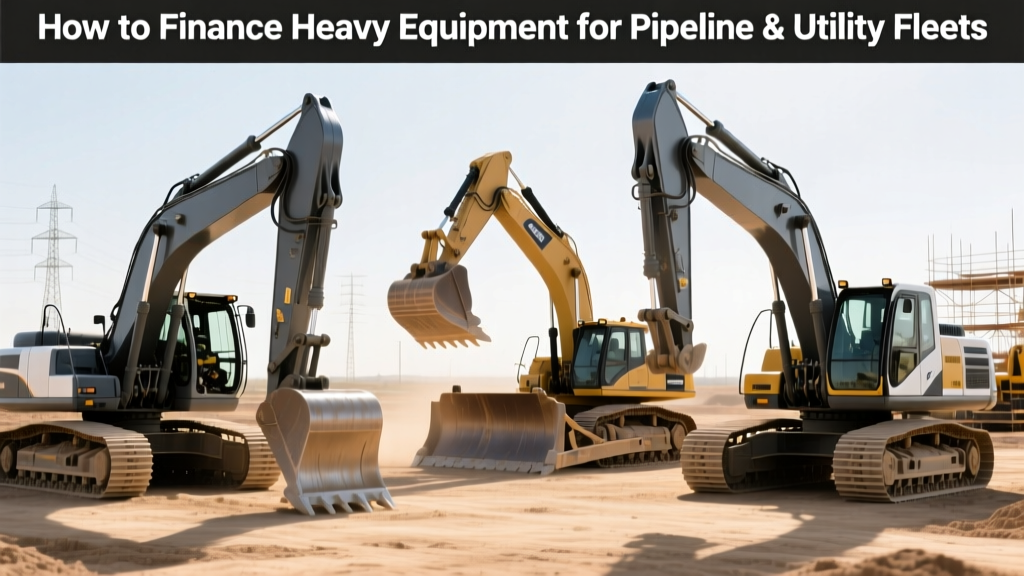
How to Finance Heavy Equipment for Pipeline & Utility Fleets
Learn how to finance heavy equipment for pipeline and utility projects. Compare loans, leases, and credit lines for HDDs, sidebooms, and trenchers.
Pipeline and utility construction demands highly specialized capital assets. Unlike standard earthmoving machinery, equipment like horizontal directional drills (HDDs), sideboom tractors, and hydrovac excavators operate under extreme mechanical stress, follow strict regulatory replacement cycles, and experience highly variable utilization rates depending on right-of-way access and project phases. Understanding how to finance heavy equipment for these specialized applications requires moving beyond generic dealership term sheets and aligning your capital strategy with the unique depreciation and wear curves of utility iron.
The Capital Reality of Pipeline and Utility Iron
The barrier to entry for utility and pipeline fleets is defined by extreme specialization and high baseline costs. A new Caterpillar PL83 sideboom pipelayer routinely exceeds $550,000, while a large-scale Vermeer D100x140 S3 Navigator HDD can command between $650,000 and $800,000 before tooling. Furthermore, pipeline contractors face intense margin pressure from mobilization costs and stringent safety mandates enforced by the Pipeline and Hazardous Materials Safety Administration (PHMSA), which often necessitates retiring or heavily refurbishing lifting and trenching gear earlier than standard construction equipment.
Because pipeline gear has a narrower secondary market than a standard 20-ton excavator, residual value predictions are more volatile. Lenders view this specialized risk differently, meaning your financing structure must mitigate both cash-flow drag during non-billing mobilization months and the rapid obsolescence of electronic guidance systems on trenchers and drills.
Financing Alternatives Matrix for Utility Fleets
Selecting the wrong capital structure can trap a utility contractor in negative equity or starve their cash flow during seasonal pipeline layoffs. Below is a comparison of the primary financing vehicles tailored to heavy utility assets.
| Financing Structure | Best Applied To | Tax & Accounting Treatment | Typical Term Length | End-of-Term Options |
|---|---|---|---|---|
| Equipment Term Loan | Sidebooms, large trenchers, bending machines with 10+ year lifecycles. | Asset on balance sheet; claim Section 179 and bonus depreciation. | 36 – 60 months | Own the asset outright; build equity. |
| FMV (Fair Market Value) Lease | HDDs, hydrovac excavators, and tech-heavy locating equipment. | 100% of payments deducted as operating expense; off-balance-sheet. | 24 – 48 months | Return, renew, or buy at Fair Market Value. |
| $1 Buyout Lease | Essential fleet core assets where ownership is required but cash preservation is priority. | Capital lease; asset on balance sheet, similar tax benefits to a loan. | 36 – 60 months | Automatic $1 purchase; guaranteed ownership. |
| Equipment Line of Credit (LOC) | Drill pipe, reamers, vacuum excavator booms, and consumable tooling. | Interest-only payments on drawn amounts; highly flexible. | Revolving (12-36 month renewal) | Pay down and redraw as tooling wears out. |
Asset-Specific Strategies: Matching Iron to Capital
A common mistake utility contractors make is applying a blanket 60-month term loan across their entire fleet. To maximize return on invested capital (ROIC), you must segment your fleet by its Utilization-to-Obsolescence (U2O) ratio.
Horizontal Directional Drills (HDDs) and Locating Tech
HDDs are the workhorses of modern utility installation, but they suffer from extreme vibration and fluid-induced wear. Furthermore, the onboard sonar and locating telemetry (e.g., DCI Falcon or Subsite systems) become obsolete within 3 to 5 years as software and signal-processing capabilities advance.
Strategic Play: Use an FMV Lease for mid-to-large HDD rigs (e.g., Ditch Witch JT40 to JT100). This allows you to upgrade to newer models with automated rod-loading and advanced fluid management systems every 36-48 months without absorbing the massive depreciation hit of trading in a used, high-hour drill.Sideboom Tractors and Pipelayers
Conversely, a Caterpillar PL83 or Liebherr PR 732 pipelayer is fundamentally a heavy steel tractor with a winch. The technology is mature, the mechanical lifecycle routinely exceeds 15,000 hours, and the secondary market for used pipelayers remains robust globally.
Strategic Play: Finance sidebooms via a 60-month Equipment Term Loan or a $1 Buyout Lease. You want to own this iron outright to capture the long tail of its depreciation curve and utilize it as collateral for future fleet expansion.
Hydrovac and Vacuum Excavators
Daylighting and trenching around existing utilities requires hydrovacs (e.g., Vac-Tron LP873 or Ditch Witch HT100). These trucks face severe regulatory scrutiny regarding boiler certifications, water pressure limits, and debris tank structural integrity.
Strategic Play: A 48-month FMV lease is optimal. When the unit approaches the 5-year mark, the cost of recertifying the high-pressure water pumps and vacuum blowers often exceeds the cost of upgrading to a newer, more fuel-efficient chassis with updated cyclonic filtration.
The Consumables Trap: Why Tooling Needs a Different Strategy
WARNING: Never finance HDD drill rods, reamers, and pulling heads on a 60-month equipment loan. Drill pipe for a mid-sized rig costs $15,000 to $30,000 per string and is considered a consumable. It will physically wear out or snap underground long before the loan term ends, leaving you paying monthly notes on mud and steel lost in a borehole.Instead, secure an Equipment Line of Credit (LOC) specifically earmarked for soft tooling and ground-engaging consumables. An LOC allows you to draw $40,000 in April to buy new Firestick drill pipe for a summer bore project, and pay it down in November when the project closes and the retainage is released. This aligns your debt service directly with the revenue generated by the consumable.
Navigating 2026 Tax Codes: Section 179 and Bonus Depreciation
When structuring your financing, the tax implications of the acquisition are just as critical as the interest rate. Under current tax codes, utility contractors must navigate the interaction between Section 179 expensing and the phase-down of Bonus Depreciation.
"For the 2026 tax year, bonus depreciation is scheduled to drop to 40% under the Tax Cuts and Jobs Act phase-down schedule, unless Congress intervenes. This makes maximizing Section 179 expensing on heavy pipeline gear more critical than ever to offset taxable income in the year of placement."
If you purchase a $750,000 trencher in 2026, you can likely use Section 179 to deduct the entire purchase price against your 2026 gross income (subject to the annual threshold limits, which exceed $1.2 million). However, if you use an FMV Lease, you cannot claim Section 179 or bonus depreciation; instead, you deduct the monthly lease payments as an operating expense. Contractors with high current-year tax liabilities should lean toward Term Loans or $1 Buyout Leases to trigger immediate depreciation shields.
Step-by-Step Approval Framework for Specialized Fleets
Lenders specializing in heavy equipment look closely at the 'Three Cs' of utility contracting: Contracts, Compliance, and Consumables. Follow this framework before submitting a credit application:
- Segregate Hard Iron from Soft Tooling: Strip all drill pipe, reamers, vacuum hoses, and boom attachments from the primary equipment invoice. Finance the base rig on a term loan/lease, and put the tooling on an LOC or pay cash.
- Document Utilization Metrics: Provide the lender with historical hour-meter data or bore-footage logs. Lenders will offer better rates (often 100-150 basis points lower) if you can prove the HDD or sideboom will operate 1,500+ hours annually on contracted pipeline right-of-ways.
- Verify PHMSA and DOT Compliance: Ensure all hydrovac and sideboom units have current DOT inspections and lifting certifications. Lenders will flag assets that are legally barred from operating on federal pipeline easements as high-risk collateral.
- Match Term to Asset Life, Not Cash Flow: Do not stretch a 5-year HDD lifecycle into a 7-year loan just to lower the monthly payment. You will end up underwater on the loan when the rig's hydraulic pumps and rotation motors require a $60,000 overhaul in year 5.
By treating your utility and pipeline fleet as a portfolio of distinct asset classes rather than a monolithic block of iron, you can drastically reduce your total cost of ownership and maintain the liquidity required to mobilize on the next major easement project.