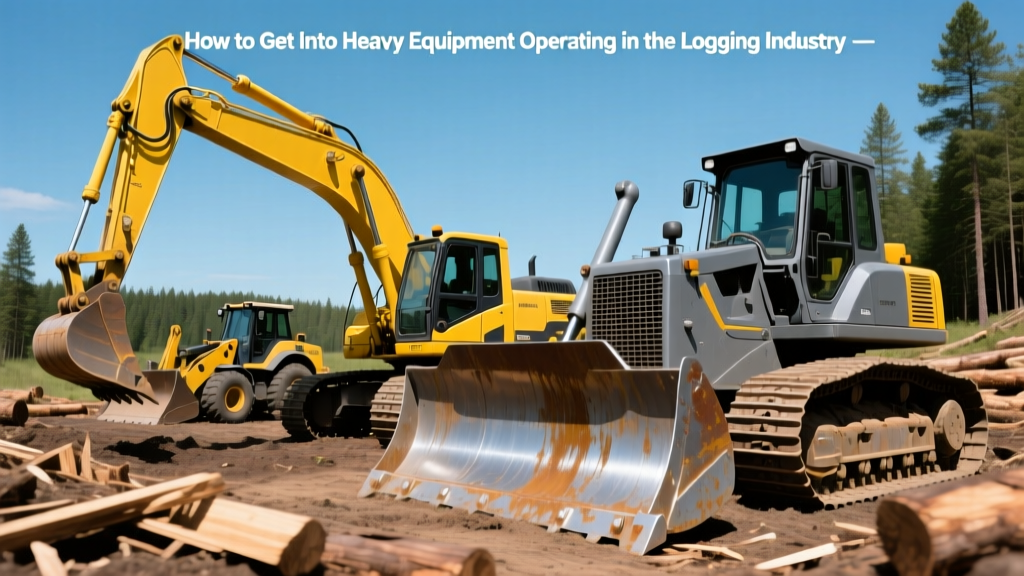
How to Get Into Heavy Equipment Operating in the Logging Industry
Learn how to get into heavy equipment operating in forestry. Discover training paths, top logging machines like Tigercat, and pro operating tips.
The High-Stakes World of Forestry Equipment Operation
The timber harvesting sector represents one of the most demanding, high-reward environments in the heavy machinery industry. If you are researching how to get into heavy equipment operating, the forestry sector offers a unique pathway characterized by rapid advancement, piece-rate earning potential, and highly specialized machinery that you will not find on a standard commercial construction site. Unlike general earthmoving, logging equipment operates in extreme topographical conditions, dealing with mud, steep inclines, and massive dynamic loads.
Breaking into the cab of a feller buncher or a forwarder requires more than a standard NCCER certification. It demands an understanding of forest ecology, wood fiber preservation, and extreme machine empathy. According to the American Loggers Council, the industry is currently facing a severe shortage of qualified heavy equipment operators, driving starting wages and production bonuses to historic highs in 2026.
The Iron: Core Forestry Machinery You Must Master
Before you can operate, you must understand the specific classes of timber harvesting machinery. Forestry is generally divided into 'tree-length' and 'cut-to-length' (CTL) systems, each requiring different equipment.
Feller Bunchers (Tree-Length Systems)
The feller buncher is the apex predator of the logging site. Machines like the Tigercat 822D or John Deere 843 feature a powerful hydraulic boom with a cutting head that shears the tree, strips the limbs, and holds multiple stems before dropping them into a pile. A new Tigercat 822D tracks between $650,000 and $850,000 depending on the head configuration. Operators must master boom swing momentum; swinging a 10,000-pound payload of timber too aggressively can overload the slew ring bearings and cause catastrophic cab instability on uneven terrain.
Forwarders and Harvesters (Cut-to-Length Systems)
In CTL operations, the work is split between the harvester and the forwarder. The harvester (e.g., Ponsse Scorpion) fells, delimits, and bucks the tree into precise log lengths right at the stump. The forwarder (e.g., John Deere 1510E, priced around $450,000) then navigates the forest to pick up the processed logs and carry them to the landing. Forwarder operators must be masters of the grapple crane, learning to 'feed' the bunk stakes smoothly without damaging the wood fiber or overstressing the crane's hydraulic cylinders.
WARNING: The Steep-Slope RealityOperating on slopes exceeding 30% requires specialized tethered or winch-assist track machines. If you are transitioning from wheeled machines to steep-slope track carriers, understand that the center of gravity shifts dynamically with every boom extension. Always keep the drive sprocket pointing uphill when traversing to maintain track tension and prevent 'de-tracking' under load.
The Roadmap: Pathways Into the Timber Cab
Understanding how to get into heavy equipment operating in forestry requires navigating an industry that heavily favors apprenticeship and internal promotion over traditional trade schools.
- The Simulator Phase (Months 1-2): Modern logging contractors utilize simulators like the John Deere TimberMatic training system. Expect to spend 40 to 80 hours in a virtual cab. Instructors will grade you on boom coordination, fuel efficiency, and cycle times before you ever touch a physical joystick.
- The Ground Crew Apprenticeship (Months 3-8):Almost no contractor will put a green operator in a $700,000 harvester. You will start as a swamper, choker setter, or landing deckhand. This phase is critical. You must learn how the operator thinks by watching how they drop trees, how they build landing piles, and how they manage the slash (debris). You will also learn how to perform daily undercarriage cleanouts and grease the slew ring—tasks that will eventually be your responsibility as an operator.
- The 'Ride-Along' and Supervised Cutting (Months 9-12):Once you demonstrate mechanical sympathy and situational awareness on the ground, a veteran operator will let you 'shadow' in the cab. You will start by operating the machine during low-stakes tasks, such as sorting logs on the landing deck or driving the forwarder on flat, established trails.
Pro-Level Operating Best Practices & Machine Preservation
Logging machinery operates in the harshest environments on earth. Mud, pine needles, and constant shock-loading destroy machines that are operated poorly. Below is a breakdown of common rookie mistakes versus the techniques used by veteran operators who keep their machines running for 15,000+ hours.
| System / Component | Rookie Mistake (High Wear) | Veteran Technique (Preservation) |
|---|---|---|
| Hydraulics | Running at max RPM constantly; ignoring fluid temp gauges. | Utilizing auto-idle features; keeping hydraulic fluid below 180°F (82°C) by matching engine RPM to pump demand, not just pinning the throttle. |
| Slew Ring / Turntable | Jerky, aggressive swings; stopping the boom abruptly using the swing brake. | Feathering the swing hydraulics to decelerate smoothly; allowing the momentum to carry the head to the drop zone to save the pinion gear. |
| Undercarriage (Tracks) | Packing the sprockets with mud; spinning tracks to gain traction. | Cleaning the roller frames daily; using 'low-speed, high-torque' travel modes to prevent track stretching and sprocket tooth wear. |
| Cutting Head / Saw | Pushing the saw bar into the dirt; ignoring chain tension. | Leaving a 4-inch 'hinge' stump; checking chain tension every time the cab is refueled to prevent bar scoring. |
Managing the Landing Deck
The landing (or log deck) is the central nervous system of the logging operation. A poor forwarder operator will dump logs haphazardly, forcing the loader operator to double-handle the timber, wasting fuel and time. A pro forwarder operator sorts the wood by species and grade (e.g., separating pine sawlogs from pulpwood) as they unload, building neat, stable stacks that allow the highway trucks to be loaded in under 12 minutes.
'In forestry, your cycle time means nothing if you are destroying the landing deck. The best operators I hire are the ones who realize that the forwarder and the knuckleboom loader are playing a synchronized game of Tetris. If you dump a load out of reach, you just cost the company 10 minutes of loading time.' — Regional Logging Superintendent, Pacific Northwest.
2026 Compensation and Piece-Rate Realities
When figuring out how to get into heavy equipment operating for a long-term career, compensation structure is vital. Unlike civil construction, which typically pays a flat hourly rate, forestry heavily relies on piece-rate (production) pay.
- Starting Hourly (Trainee): $22 to $28 per hour for the first 6 months while learning on the landing or operating older, secondary machines.
- Forwarder Operator (Piece-Rate): Often paid between $11 and $16 per ton of wood forwarded to the landing. A highly skilled operator moving 1,200 tons a week can gross $15,000 to $22,000+ per month during peak seasons.
- Feller Buncher / Harvester Operator: Usually the highest-paid position on the site. Paid by the ton or by the acre. Top-tier operators clearing 40+ acres a week in dense timber frequently exceed $250,000 annually, though this requires working 55 to 65-hour weeks and maintaining near-zero downtime.
Contractors are increasingly adopting John Deere's TimberMatic and Tigercat's RemoteLog telematics to track operator efficiency. These systems monitor fuel burn per ton, idle time, and hydraulic abuse. Your telematics data will directly influence your bonus structure and promotion timeline.
Safety and Regulatory Compliance
Forestry is statistically one of the most dangerous heavy equipment sectors. OSHA's logging safety standards mandate strict protocols regarding rollover protective structures (ROPS), falling object protective structures (FOPS), and daily brake testing. Operators must perform a documented pre-shift inspection focusing on the ROPS mounting bolts, fire suppression system pressure, and the condition of the Lexan polycarbonate cab glass, which degrades from UV exposure and flying wood chips. Never bypass the cab door interlock switch; a swinging 8,000-pound log can crush an open cab door in a fraction of a second.
Final Operational Advice
Getting into the cab is only the first step. True mastery of forestry heavy equipment comes from anticipating the machine's mechanical limits before they fail. Listen to the pitch of the hydraulic pumps, watch the ground conditions for track slip, and treat the wood fiber with respect. The operators who last 20 years in this industry are the ones who realize that they are not just driving a machine; they are managing a complex, mobile manufacturing plant in the middle of the woods.