Moving Heavy Objects Equipment: Airport GSE Specs & Mechanics
Technical specifications and mechanics of airport moving heavy objects equipment, including towbarless tugs, cargo loaders, and hydraulic interlocks.
The Physics of Aviation Ground Support Equipment
When evaluating moving heavy objects equipment for aviation environments, standard construction machinery metrics fall short. Airport Ground Support Equipment (GSE) must maneuver multi-million-dollar aircraft weighing up to 600 metric tons and transport dense Unit Load Devices (ULDs) with millimeter precision. Unlike off-highway dump trucks or standard forklifts, aviation GSE operates under strict FAA apron clearance regulations and must exert massive force without damaging delicate aircraft landing gear.
This technical breakdown examines the mechanical specifications, hydraulic architectures, and load-sensing interlocks of the heavy equipment responsible for airport logistics.
Aircraft Pushback Tractors: Drawbar Pull and Towing Mechanics
The primary metric for any aircraft tug is drawbar pull—the horizontal force the machine can exert at the hitch point. To move a fully loaded Boeing 777-300ER (Maximum Takeoff Weight of 351,500 kg), the equipment must overcome both rolling resistance and grade resistance.
Calculating Required Drawbar Pull
The rolling resistance coefficient for aircraft pneumatic tires on concrete is approximately 0.02. For a 351,500 kg aircraft, the base rolling resistance is roughly 69,000 Newtons (15,500 lbf). If the taxiway features a 1.5% upward grade, an additional 51,700 Newtons of force is required. Therefore, the tug must generate a minimum continuous drawbar pull of 120 kN (27,000 lbf) to initiate and sustain movement safely.
Conventional vs. Towbarless (TBL) Configurations
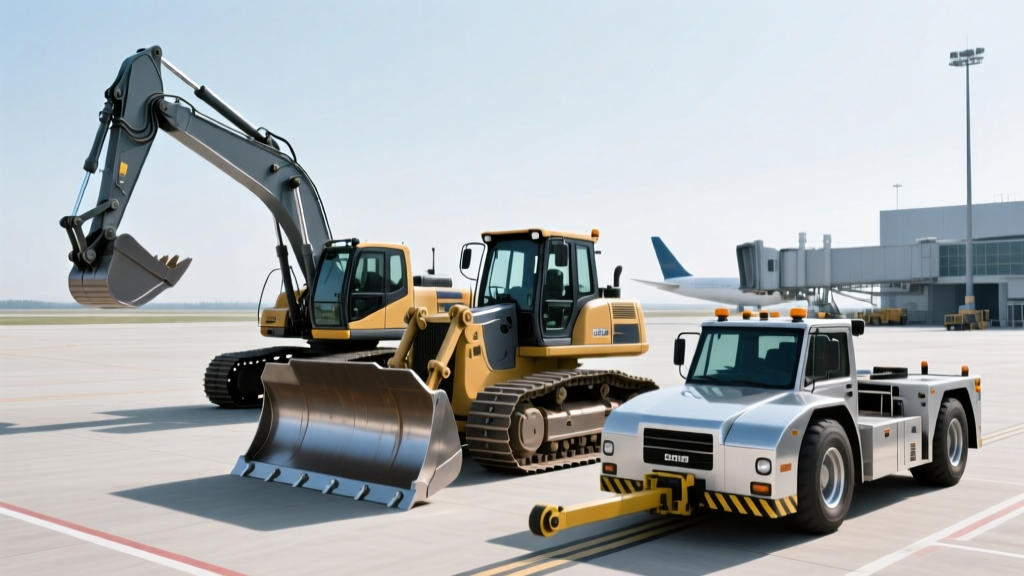
Conventional tugs use a physical towbar connected to the aircraft's nose landing gear shear pin. Towbarless (TBL) tugs, however, hydraulically lift the nose gear directly into a cradle, transferring the aircraft's weight onto the tug's drive axles to maximize traction.
| Specification | Eagle Tugs EP-12 (Conventional) | Goldhofer AST-1X (Towbarless) |
|---|---|---|
| Max Aircraft Weight | 195,000 kg (B757 / A321) | 600,000 kg (A380 / B747-8) |
| Drawbar Pull | 53.4 kN (12,000 lbf) | 267 kN (60,000 lbf) |
| Powertrain (2026 Std) | 800V Lithium-Ion Electric | Dual Electric Motors / Hydrostatic |
| Approx. Base Price | $285,000 - $340,000 | $650,000 - $820,000 |
High-Reach Cargo Loaders: Hydraulics and Scissor Lifts
Moving heavy freight requires specialized high-reach loaders capable of elevating 6,800 kg (15,000 lb) ULDs to the main deck of freighters like the Boeing 777F. The main deck door sill sits at approximately 8.4 meters (27.5 feet) above the tarmac. Standard forklifts cannot achieve this height while maintaining the necessary forward reach and stability.
The Dual-Stage Scissor Lift Architecture
Equipment such as the JBT Commander 15i utilizes a dual-stage, heavy-duty scissor lift mechanism. To prevent platform racking (twisting under uneven loads), modern loaders employ synchronized hydraulic cylinders with mechanical flow dividers.
- Operating Pressure: Hydraulic systems typically operate at 3,000 PSI (206 bar), utilizing synthetic, fire-resistant hydraulic fluids (e.g., Skydrol) to comply with aviation safety mandates.
- Roller Bed Deck: The platform features a motorized roller bed with 360-degree omni-directional casters. This allows a single operator to laterally shift a 6,800 kg ULD using less than 45 Newtons (10 lbf) of manual force.
- Bridge Plate Interlock: The deployable bridge plate features a mechanical lock that prevents the loader from driving away while the plate is engaged with the aircraft fuselage, eliminating catastrophic shear damage to the aircraft door sill.
Load Cell Calibration and Shear Pin Protection
The nose landing gear of a commercial jet is engineered to withstand vertical loads during landing, but it is highly vulnerable to lateral torsional stress during towing. According to IATA Ground Operations guidelines, exceeding the lateral torque limit of the nose gear can result in structural failure requiring millions in repairs.
Critical Warning: Shear Pin Bypassing
Conventional towbars are equipped with a calibrated steel shear pin designed to snap at exactly 110% of the aircraft's certified towing limit. Ground crews must never weld or replace a broken shear pin with higher-grade steel. Doing so transfers the breaking point to the aircraft's internal steering collar, turning a $500 towbar repair into a $2.5 million landing gear overhaul.
Modern towbarless equipment circumvents the shear pin issue entirely by utilizing strain gauge load cells integrated directly into the cradle arms. If the tug encounters an obstacle (such as a locked aircraft brake or a chock left in place), the load cells detect the torque spike in milliseconds. The GSE's programmable logic controller (PLC) instantly cuts power to the drive motors before the lateral force exceeds the aircraft manufacturer's structural threshold.
2026 Powertrain Mandates: Electrification of Heavy GSE
The transition from diesel to electric powertrains in heavy airport equipment has fundamentally altered machine weight distribution and torque delivery. Lead-acid batteries, historically used in older GSE, required massive physical footprints and suffered from voltage sag under heavy drawbar pull demands.
Current heavy movers utilize high-voltage (800V) Lithium Iron Phosphate (LFP) battery architectures. LFP chemistry is preferred over NMC (Nickel Manganese Cobalt) for GSE due to its superior thermal stability and ability to withstand 4,000+ deep discharge cycles in extreme tarmac temperatures.
"The instant torque delivery of 800V electric drivetrains provides a 22% improvement in initial breakaway drawbar pull compared to Tier 4 diesel equivalents, crucial for moving heavy objects equipment on wet or icy aprons." — Aviation Ground Equipment Engineering Report, 2025.
Regenerative Braking in Pushback Operations
When pushing back a 400-ton aircraft, the tug must control the descent on sloped taxiways. Electric GSE utilizes regenerative braking systems that feed kinetic energy back into the LFP banks. This not only extends operational shifts by 15-18% but eliminates the brake fade associated with traditional wet-disc hydraulic brakes during continuous heavy-load operations.
Equipment Selection Framework for Fleet Managers
Procuring moving heavy objects equipment for airport operations requires matching specific aircraft fleet profiles to machine capabilities. Use the following decision matrix to specify GSE requirements:
- Narrowbody Dominance (A320/B737): Specify 100 kN drawbar pull conventional tugs. The capital expenditure is lower, and towbar standardization across the fleet minimizes ground crew training time.
- Widebody / Heavy Freight (B777/A350): Mandate Towbarless (TBL) electric tugs with a minimum 180 kN drawbar pull. The elimination of the towbar reduces pushback time by an average of 90 seconds per cycle, critical for maintaining slot times at congested hubs.
- Main Deck Freighters: Require high-reach loaders with dual independent platforms. The ability to lift the operator cab separately from the cargo deck allows for simultaneous visual alignment and cargo transfer, reducing turnaround times by 25%.