Logging Cabins & Heavy Duty Exercise Equipment Mats: Vibration Specs
Analyzing WBV dampening in forestry machinery, comparing OEM cabin flooring to heavy duty exercise equipment mats, and detailing ISO 2631-1 specs.
The Biomechanics of Whole-Body Vibration in Forestry Machinery
Operating a feller buncher or a wheeled harvester on a 30% incline generates severe kinetic shock. When a machine like the Tigercat 880E Track Carrier traverses uneven, stump-laden terrain, the cab is subjected to vertical and lateral accelerations that frequently exceed 4G. According to the National Institute for Occupational Safety and Health (NIOSH), prolonged exposure to this Whole-Body Vibration (WBV) directly correlates with lumbar spine degeneration and operator fatigue.
To mitigate this, modern forestry OEMs engineer cabin floors using advanced elastomeric dampening systems. However, a dangerous trend has emerged in aftermarket maintenance: fleet mechanics and camp managers attempting to replace worn cabin flooring with commercial heavy duty exercise equipment mats. While these mats share a superficial visual resemblance to industrial rubber flooring, their polymer chemistry and compression mechanics make them fundamentally unsuited for heavy machinery cabs—and in some cases, actively hazardous.
⚠️ SAFETY WARNING: Pedal Interference HazardsStandard 3/4-inch heavy duty exercise equipment mats exhibit a high compression set under sustained point loads (e.g., steel-toe boots resting on pedals). In a skidder cab, this unpredictable compression can reduce brake and accelerator pedal travel by up to 15%, leading to delayed stopping times on steep declines. Never substitute OEM-spec cabin flooring with commercial gym mats.
Polymer Breakdown: OEM Elastomers vs. Commercial Gym Mats
Understanding why heavy duty exercise equipment mats fail in a logging cab requires examining the material science at the molecular level. Commercial gym mats are typically manufactured from recycled Styrene-Butadiene Rubber (SBR) bound with polyurethane adhesives and flecked with EPDM color chips. They are designed for impact absorption (dropping weights) and high traction, not for continuous low-frequency vibration isolation.
Technical Specification Comparison
| Metric | OEM Forestry Cabin Mat (Viscoelastic) | Heavy Duty Exercise Equipment Mat (Recycled SBR) |
|---|---|---|
| Shore A Durometer | 60A - 65A (Soft, isolating) | 80A - 85A (Hard, impact-resistant) |
| Density | 45 lbs / cubic foot | 65 lbs / cubic foot |
| Compression Set (22h @ 70°C) | < 15% (Returns to original thickness) | > 45% (Permanently deforms) |
| Hydraulic Fluid Resistance | High (Closed-cell polyurethane) | Low (Porous SBR absorbs fluids) |
| Average Cost (per sq. ft.) | $18.00 - $24.00 | $2.50 - $4.50 |
As outlined by the UK Health and Safety Executive (HSE), effective WBV isolation requires materials that can decouple the operator from frequencies between 2 Hz and 20 Hz. The 80A durometer of a standard heavy duty exercise equipment mat is simply too rigid to absorb these low-frequency harmonic waves; instead, it transmits them directly through the operator's skeletal structure.
How Constrained Layer Damping (CLD) Works in Feller Bunchers
OEM forestry mats do not rely on simple rubber thickness. They utilize Constrained Layer Damping (CLD), a multi-tiered engineering approach designed to convert kinetic energy into negligible amounts of thermal energy.
- Base Layer (Structural Anchor): A dense, oil-resistant nitrile rubber that bonds directly to the steel cab floor, preventing fluid ingress and providing a stable anchor.
- Viscoelastic Core (The Damper): A 12mm to 18mm layer of specialized polyurethane. When the cab vibrates, this layer undergoes shear deformation. The internal friction of the polymer chains rubbing against one another dissipates the vibrational energy as low-level heat.
- Wear Layer (Traction): A 3mm diamond-tread vulcanized top layer with a Shore A hardness of 75, providing slip resistance for muddy caulk boots without compromising the shear movement of the core layer beneath it.
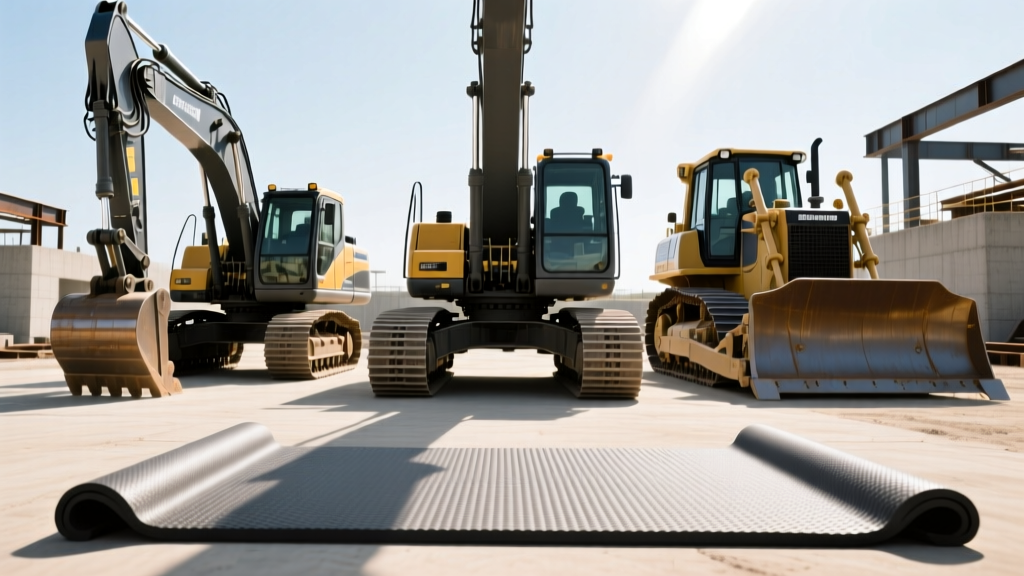
If a mechanic installs a single-layer heavy duty exercise equipment mat, the CLD shear mechanism is entirely absent. The mat merely acts as a rigid spacer, offering zero vibrational isolation and violating ISO 2631-1 compliance standards for heavy machinery ergonomics.
Remote Logging Camps: The Correct Application for Gym Mats
This is not to say that heavy duty exercise equipment mats have no place in the forestry sector. As of 2026, remote logging camps in the Pacific Northwest and British Columbia are heavily investing in on-site fitness infrastructure to improve operator retention and mental health during long rotational shifts.
"We outfit every 50-man camp with a dedicated fitness trailer. The flooring takes a massive beating from spiked logging boots, dropped iron, and extreme temperature fluctuations. Heavy duty exercise equipment mats—specifically 15mm vulcanized rubber rolls—are the only material that survives a two-year rotation without delaminating or harboring mold from tracked-in snow and mud."
— Facilities Director, Coastal BC Timber Operations
In the camp gym environment, the exact properties that make these mats dangerous in a skidder cab (high density, rigid impact resistance, heavy weight) become their greatest assets. They protect the structural plywood and steel floors of modular camp buildings from the catastrophic impact of dropped 100-lb dumbbells and kettlebells.
Procurement Framework for Fleet & Camp Managers
To maintain safety compliance and operational efficiency, procurement teams must strictly separate cabin ergonomics from camp infrastructure. Use the following decision matrix when sourcing rubber flooring for your logging operations:
For Machinery Cabins (Harvesters, Skidders, Forwarders)
- Requirement: Multi-layer CLD mats, closed-cell viscoelastic core.
- Specification: Shore A 60-65 (core), ISO 2631-1 tested, hydraulic fluid impermeable.
- Action: Order exclusively through OEM dealerships (e.g., John Deere, Tigercat, Ponsse) or certified aftermarket ergonomics suppliers like Trelleborg Industrial AV.
- Budget Expectation: $450 to $850 per cab installation.
For Remote Camp Fitness & Locker Rooms
- Requirement: High-impact resistance, moisture barrier, heavy point-load tolerance.
- Specification: 15mm (5/8") thick, 100% vulcanized recycled rubber with EPDM fleck, Shore A 82+.
- Action: Source commercial heavy duty exercise equipment mats in 4ft x 10ft interlocking rolls. Ensure edges are sealed with industrial polyurethane caulk to prevent pine pitch and mud from accumulating in the seams.
- Budget Expectation: $2.50 to $4.50 per square foot.
By respecting the distinct material science behind these two categories of rubber flooring, forestry operations can simultaneously protect the spinal health of their machine operators and build durable, high-quality retention amenities in their remote camps.