Maintaining Solid Rubber Tires for Heavy Equipment in Marine Ports
Optimize port operations with precise maintenance schedules for solid rubber tires for heavy equipment. Learn rotation, inspection, and replacement metrics.
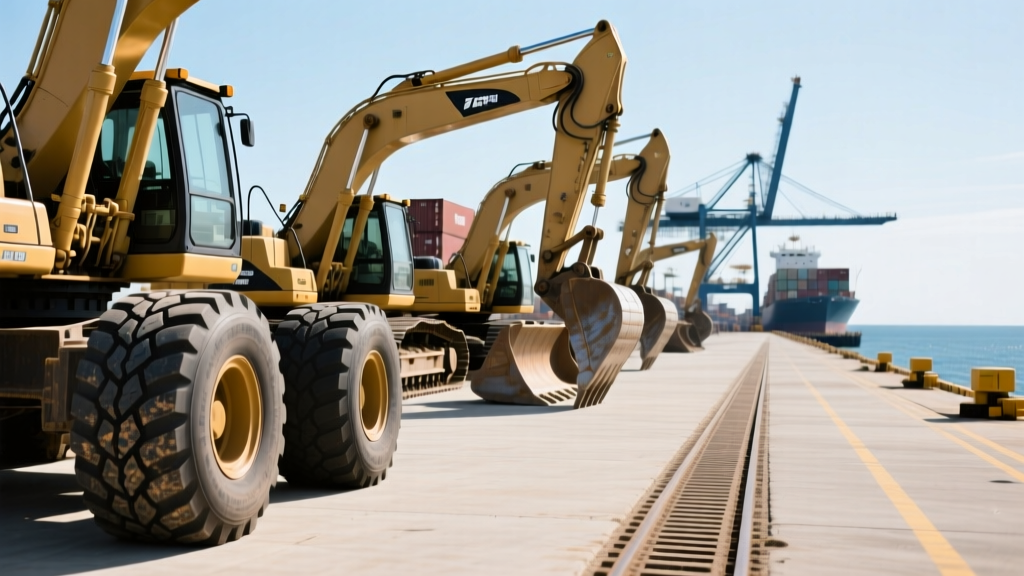
Marine terminals subject heavy machinery to some of the most abrasive and corrosive operating environments in the industrial sector. Between the micro-abrasions of reinforced concrete aprons, the corrosive effects of salt spray, and the immense static loads of stacked shipping containers, port machinery requires rigorous upkeep. When specifying and maintaining solid rubber tires for heavy equipment in these coastal zones, standard construction-site maintenance protocols are insufficient. Terminal operators must adopt specialized service schedules that account for high-torque steering, continuous 24/7 shift cycles, and severe environmental degradation.
Marine Terminal Degradation Factors
Unlike pneumatic tires, solid elastomer compounds do not suffer from puncture failures, but they are highly susceptible to environmental and mechanical degradation specific to port operations. Understanding these failure vectors is the first step in building an effective maintenance schedule.
⚠️ Warning: Salt Spray and Rim SlippageSaltwater intrusion between the rubber compound and the steel rim band is a primary cause of catastrophic failure in marine ports. As salt crystallizes, it breaks the chemical bond of the press-on band (POB), leading to rim slippage under heavy braking or high-torque steering. Always specify marine-grade anti-corrosive rim treatments when ordering replacements.
Furthermore, UV radiation from unshaded container yards accelerates the oxidation of the rubber surface, leading to micro-cracking (dry rot) that compromises the structural integrity of the tire's outer lug. According to Trelleborg's port handling technical guidelines, selecting compounds with high concentrations of carbon black and specialized UV inhibitors is critical for extending service life in exposed coastal yards.
Preventative Maintenance Calendar
A reactive approach to port tire maintenance results in unplanned downtime that can bottleneck vessel loading and unloading operations. Implementing a strict, interval-based calendar ensures optimal footprint contact and load distribution.
| Interval | Inspection Action | Acceptable Parameters |
|---|---|---|
| Daily (Pre-Shift) | Visual check for chunking, embedded debris, and rim slippage marks. | No exposed steel bands; alignment marks on rim and rubber must match. |
| Weekly | Clear embedded steel banding wires and twist-lock debris from tread grooves. | Grooves must be 100% clear to prevent hydroplaning on wet terminal aprons. |
| 250-Hour | Shore A Durometer hardness testing and wear-bar measurement. | Hardness must remain between 68A and 75A. Wear must not exceed the 60mm safety line. |
| 1,000-Hour | Full axle removal, rim inspection for pitting/corrosion, and tire rotation. | Rim flange thickness must meet OEM minimums; apply marine-grade anti-seize. |
Compliance with rigorous inspection routines not only preserves equipment but also aligns with OSHA maritime terminal safety standards, which mandate that all cargo-handling equipment be maintained in safe working order to prevent load-shifting accidents caused by uneven tire wear.
Equipment-Specific Rotation Protocols
Rotation schedules cannot be standardized across all port machinery. The steering geometry and load distribution of a straddle carrier differ vastly from a RoRo terminal tractor, necessitating tailored rotation matrices.
Straddle Carriers (8-Wheel Configurations)
Straddle carriers (such as the Kalmar ESC series) utilize an 8-wheel layout where the inner and outer tires on each bogie experience vastly different scrubbing forces during 90-degree crab steering maneuvers.
- 500-Hour Mark: Swap the inner and outer tires on the same bogie axle to equalize the scrubbing wear caused by differential steering radii.
- 1,000-Hour Mark: Rotate the front bogie assemblies to the rear, and rear to the front. The front bogies endure up to 35% more wear due to the weight transfer during acceleration and the primary steering load.
RoRo Terminal Tractors (4x2 Configurations)
Terminal tractors (like the Kalmar Ottawa T2) spend their operational lives pushing and pulling gooseneck trailers. The rear drive axle bears the brunt of the traction and braking forces.
- Cross-Rotate Rear Axles: Every 750 hours, move the rear left drive tire to the rear right position, and vice versa. This counteracts the camber wear induced by the constant heavy tongue-weight of loaded chassis.
- Steer Axle to Drive Axle: Move the front steer tires to the rear drive position at 1,200 hours. Steer tires develop rib-depression wear patterns that are detrimental to traction but perfectly acceptable for continued rear-axle service.
Symptom-Cause-Fix Troubleshooting Matrix
When anomalies appear during the daily pre-shift inspection, maintenance teams must rapidly diagnose the root cause to prevent cascading drivetrain damage. Use the following matrix for solid rubber tire diagnostics in marine environments.
| Symptom | Root Cause in Port Environment | Corrective Action |
|---|---|---|
| Radial Cracking at Hub | Ozone and UV degradation combined with high static loads (e.g., parked under a loaded 4-high stack). | Replace tire. Mandate that operators 'walk' the equipment 10 feet every 48 hours if parked in static positions to prevent flat-spotting and stress cracking. |
| Asymmetric Lug Wear | Misaligned steer axles or worn kingpins on terminal tractors causing lateral drag on abrasive concrete. | Perform laser axle alignment. Check steering cylinder tie-rods for play before rotating tires. |
| Chunking / Tearing | Running over metal debris (twist-locks, broken banding straps) common in container staging areas. | Route sweepers must clear staging lanes daily. Switch to a high-durometer (75A+) cut-resistant compound if chunking persists. |
| Rim Slippage Marks | Salt corrosion breaking the POB bond, or operator applying excessive braking torque on wet steel dock plates. | Press the tire off, sandblast the rim, apply marine epoxy primer, and re-press with a heated band. Check brake calibration. |
Replacement Thresholds and Economic Metrics
Determining the exact moment to replace solid rubber tires for heavy equipment is a balance between capital expenditure and operational efficiency. Running a tire past its safe wear limit increases rolling resistance, which directly impacts the fuel consumption of diesel terminal tractors and the battery drain of electric straddle carriers.
Economic Benchmark: A standard 21x8-9 solid press-on band tire for a reach stacker currently costs between $1,200 and $1,800 depending on the compound (non-marking vs. standard carbon black). However, running a tire 15% past its wear-bar limit can increase rolling resistance by up to 22%, costing an additional $4,500 annually in wasted diesel fuel per machine.
The Durometer Testing Protocol
Visual wear bars are insufficient for marine port applications. The internal structural integrity of the elastomer must be verified using a Shore A Durometer. Maintenance technicians should test the tire at three points: the center tread, the inner shoulder, and the outer shoulder.
- New Baseline: Typically 68A to 72A for standard port compounds.
- Warning Threshold: If the outer shoulder reads above 80A, the rubber has heat-cycled and hardened due to continuous high-speed transit across the terminal. Hardened tires lose their shock-absorption properties, transferring destructive harmonic vibrations into the equipment's axle bearings and differential housings.
- Condemn Limit: Any reading above 85A, or any variance greater than 6 points between the inner and outer shoulders, requires immediate replacement.
Press-On Band (POB) vs. Standard Solid Sizing
When ordering replacements, port procurement teams must accurately distinguish between standard solid tires (which require a hydraulic press to mount onto a specialized locking-ring rim) and Press-On Band (POB) tires. POB tires feature a steel band molded directly into the rubber base and are pressed onto a smooth, flangeless rim. Mixing up these specifications leads to severe mounting delays. Always verify the rim profile and the exact nominal diameter (e.g., 18x7-8 vs 18x7x12 1/8) before issuing purchase orders, as the marine logistics supply chain can take 6 to 12 weeks to deliver specialized non-marking port compounds.
By adhering to these specialized maintenance schedules, rotation matrices, and durometer testing protocols, marine terminal operators can maximize the lifespan of their tire assets, protect sensitive drivetrain components, and ensure uninterrupted cargo flow across the dock.