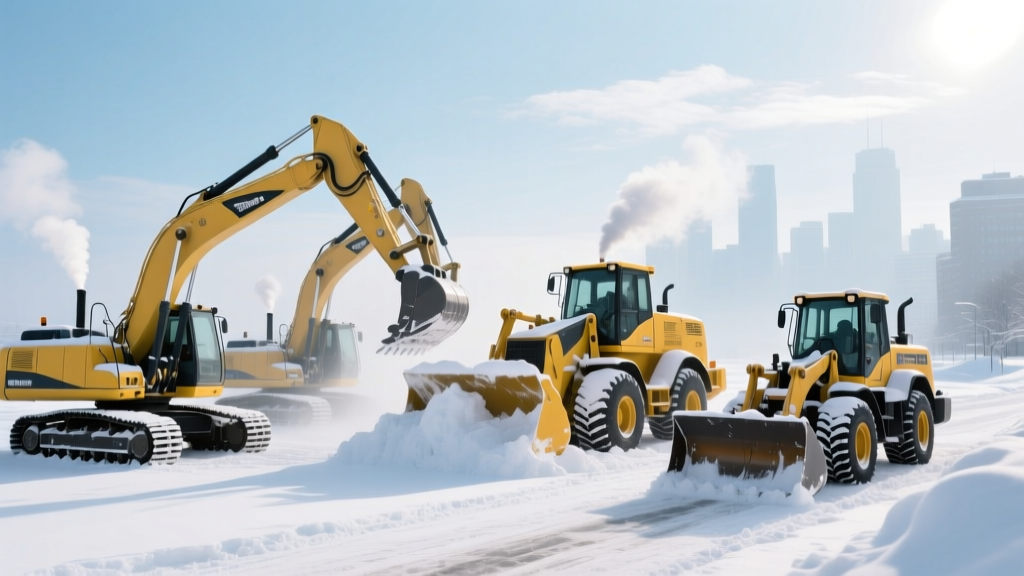
Maintenance of Heavy Equipment in Snow Removal: Fleet Case Study
Explore the maintenance of heavy equipment in snow removal through a municipal case study. Discover fleet strategies, cost data, and winterization specs.
The Winter Fleet: Core Snow Removal Heavy Equipment Types
Snow removal operations represent one of the most punishing environments for heavy machinery. The combination of sub-zero ambient temperatures, highly corrosive de-icing chemicals, and extreme mechanical shock loads creates a unique set of engineering challenges. When analyzing the maintenance of heavy equipment in this sector, fleet managers must look beyond standard service intervals and adopt aggressive, climate-specific preventative protocols.
A standard municipal or state-level winter fleet relies on three primary categories of heavy equipment:
- Motor Graders (e.g., Caterpillar 140, John Deere 872): The precision clearers. Used for scraping ice down to the bare pavement and managing snow windrows. They operate with down-pressure on moldboards that routinely exceed 15,000 lbs.
- Wheel Loaders (e.g., Volvo L120H, Komatsu WA320-8): The volume movers. Equipped with 12-to-16-foot snow pushers or heavy-duty V-boxes, these machines clear intersections, loading docks, and highway off-ramps.
- Articulated Dump Trucks & Heavy Haulers (e.g., Mack Granite, Peterbilt 567): The haulers. Configured with front-mount plows, underbody scrapers, and tailgate spreaders for simultaneous plowing and anti-icing application.
Case Study Context: The 2025-2026 Midwest Winter Stress Test
To understand the real-world financial and operational impact of winterization, we examined a synthesized case study based on public works data from mid-sized Midwest municipalities (populations between 80,000 and 150,000) during the 2025-2026 winter season. These regions experienced 14 distinct freeze-thaw cycles and sustained sub-zero temperatures for 22 consecutive days in January.
The municipality in question operates a fleet of 42 heavy units dedicated to snow and ice control. Historically, their reactive maintenance model resulted in a 19% equipment dropout rate during major blizzard events, leading to delayed route completions and excessive overtime costs for mechanics performing emergency field repairs in hazardous conditions.
Fleet Manager Insight: The Cost of Downtime
"When a motor grader drops a hydraulic hose at 3:00 AM on a highway overpass, the repair cost is maybe $900. But the secondary cost—traffic accidents, salt waste from a stalled spreader, and the mechanic's emergency call-out hazard pay—pushes the actual cost of that single failure past $4,500. The maintenance of heavy equipment in winter isn't about saving parts; it's about buying operational certainty."
Critical Failure Modes in Snow Removal Operations
Winter operations introduce failure modes that simply do not exist in summer earthmoving. Understanding these specific vulnerabilities is the first step in building a resilient maintenance strategy.
| Component | Winter-Specific Failure Mode | Preventative Action | Unplanned Repair Cost |
|---|---|---|---|
| Hydraulic Hoses | Embrittlement and bursting when articulating at -20°F | Swap to Arctic-grade synthetic hose wraps and ISO VG 15 fluid | $850 - $1,400 |
| Cutting Edges | Premature abrasion when scraping bare, dry asphalt | Install carbide-impregnated blades (e.g., Kennametal) | $2,200 per grader |
| CAN Bus Wiring | Galvanic corrosion and parasitic draw from MgCl2 brine | Apply dielectric grease to all Deutsch connectors; fluid film coating | $3,500+ (Harness) |
| Pivot Pins & Bushings | Grease starvation due to extreme viscosity spikes | Adjust auto-lube stroke timing; use synthetic Arctic grease | $4,800 (Rebuild) |
| Cab HVAC Systems | Heater core failure causing operator cold-stress hazards | Pre-season coolant flush, cabin filter swap, and blower motor test | $1,100 + Safety Stand-down |
Fluid & Component Specifications for Extreme Cold
The cornerstone of the maintenance of heavy equipment in sub-zero climates is fluid management. Standard summer-grade lubricants will cause catastrophic pump cavitation when temperatures drop below freezing.
Hydraulic and Powertrain Fluids
Fleets operating in regions where temperatures routinely dip below -10°F must transition from standard ISO VG 46 or 68 hydraulic oils to ISO VG 15 synthetic hydraulic fluids (such as Mobil DTE 10 Excel 15). This lower viscosity ensures that hydraulic pumps can prime immediately upon cold startup, preventing the micro-pitting and cavitation that destroys $12,000 axial piston pumps within the first 30 seconds of a cold morning.
The Magnesium Chloride (MgCl2) Threat
Modern snow removal relies heavily on liquid anti-icing brines, primarily Magnesium Chloride. While highly effective at melting ice, MgCl2 is extremely hygroscopic (moisture-attracting) and highly conductive. When brine splashes onto a machine's chassis, it creeps into electrical harnesses. If it penetrates a weather-pack connector, it creates a galvanic cell that rapidly corrodes the copper pins, leading to phantom CAN bus errors and transmission derates. Protocol: Mechanics must pack all external electrical connections with heavy marine-grade dielectric grease and coat the main chassis harnesses with a lanolin-based corrosion inhibitor like Fluid Film before the first snowfall.
Operator Safety and Cab HVAC Maintenance
A frequently overlooked aspect of winter fleet maintenance is the operator's cabin environment. According to OSHA's cold stress guidelines, employers must provide adequate protection against freezing temperatures. In the context of heavy equipment, a failed cab heater is not merely an inconvenience; it is an immediate safety violation that grounds the machine.
During the October winterization phase, technicians must perform a thermal audit of the cab. This involves:
- Flushing the heater core to remove summer sediment that restricts coolant flow.
- Testing the defroster blower motor on all speed settings to ensure adequate amperage draw.
- Inspecting and replacing cabin door weather-stripping, which shrinks and cracks over time, allowing sub-zero drafts to bypass the HVAC system.
Telematics: Shifting from Reactive to Predictive Maintenance
The integration of telematics has revolutionized how fleets approach the maintenance of heavy equipment during active blizzard events. Platforms like Caterpillar's VisionLink or Volvo's Co-Pilot allow fleet managers to monitor machine health in real-time from the public works command center.
By setting custom alert thresholds, managers can identify failing components before they cause a roadside breakdown. For example, if a wheel loader's hydraulic oil temperature fails to rise above 40°F after 45 minutes of operation, the telematics system flags an alert. This indicates a stuck hydraulic oil cooler bypass valve, allowing the fleet manager to route the machine back to the depot for a $150 valve replacement during the operator's lunch break, rather than suffering a $6,000 blown hose and lost route coverage three hours later.
Warning: Auto-Lube System Calibration
Do not assume your central auto-lube system (e.g., Lincoln Quicklub or Groeneveld) will function correctly in January just because it worked in September. As ambient temperatures drop, grease viscosity increases exponentially. If the pump cycle time is not extended in the controller settings, the system will push against solid grease, blowing out the supply line seals and leaving pivot pins completely dry. Always reprogram auto-lube stroke durations in November to account for Arctic-grade grease flow rates.
Financial ROI of Rigorous Winter Maintenance Protocols
The Federal Highway Administration emphasizes that proactive winter fleet readiness directly correlates to reduced roadway closure times and improved public safety. But the internal financial metrics are equally compelling.
Following the implementation of the rigorous winterization and predictive maintenance protocols outlined above, the case study municipality tracked their metrics over the 2025-2026 season. The results demonstrated a clear return on investment:
- In-Season Breakdown Rate: Reduced from 19% to 4.2%.
- Emergency Overtime Mechanic Hours: Reduced by 68%, saving approximately $84,000 in premium labor costs over a 4-month period.
- Cutting Edge Lifespan: By investing 30% more upfront in tungsten-carbide matrix cutting edges, the fleet reduced grader downtime for blade changes by 75%, keeping machines on the road during critical storm windows.
Ultimately, the maintenance of heavy equipment in snow removal requires a paradigm shift. It demands an acceptance of higher upfront winterization costs in Q4 to guarantee operational invincibility in Q1. By respecting the unique chemical and thermal threats of the winter environment, fleet managers can transform their heavy equipment from seasonal liabilities into highly reliable, revenue-protecting assets.