What Should You Do If You Are Operating Heavy Equipment in Smart Forestry?
Discover what you should do if you are operating heavy equipment in modern forestry. Learn AI, LiDAR, and telematics protocols for next-gen harvesters.
The Digital Canopy: Heavy Equipment in Modern Forestry
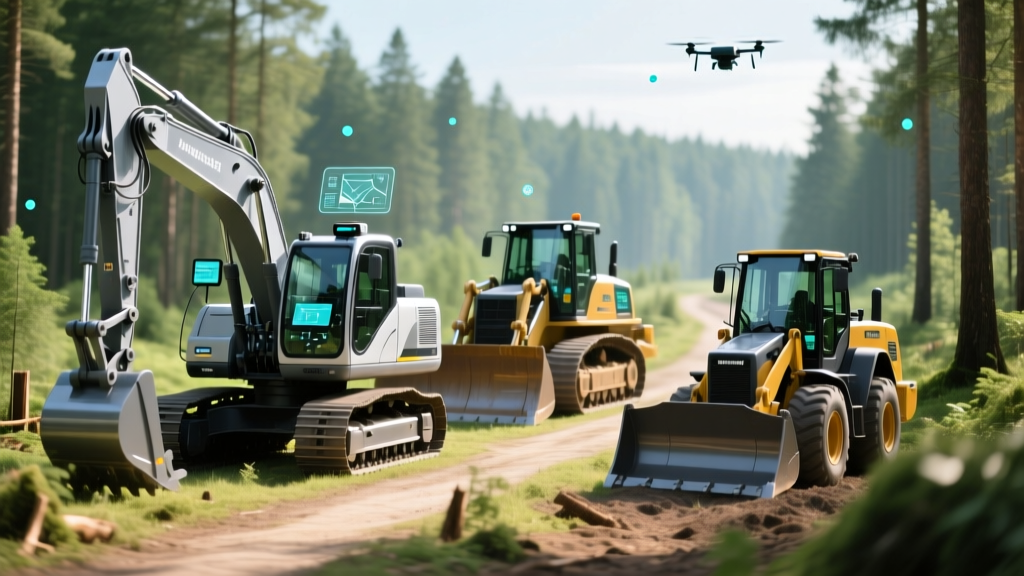
Forestry and logging machinery have evolved from purely mechanical beasts into highly sophisticated, sensor-driven data centers. Modern harvesters like the John Deere 1270G (priced between $650,000 and $780,000) and the Ponsse ScorpionKing (exceeding $700,000) are equipped with RTK GPS, LiDAR scanning, and AI-assisted harvester heads. When stepping into these glass-enclosed command centers, the fundamental question shifts: what should you do if you are operating heavy equipment that processes thousands of data points per second while navigating uneven, unpredictable terrain?
This guide details the exact operational protocols, calibration routines, and troubleshooting frameworks required for next-generation logging machinery, moving beyond basic lever operation into digital fleet management.
📊 Fleet Tech Snapshot (2026 Baseline)• Harvester Head: Waratah H225 with multi-tree processing and auto-stem sizing.
• Telematics: TimberMatic H-16 or Ponsse Opti4G cloud sync.
• Positioning: Dual-antenna RTK GPS (2–4 cm accuracy).
• Canopy Mapping: Drone-deployed LiDAR point clouds ($1,200–$1,800 per 100 acres).
Pre-Operation: Sensor Calibration and IMU Alignment
Before engaging the throttle, operators must verify the integrity of the machine's spatial awareness systems. If you are operating heavy equipment with integrated boom-tip LiDAR or stereo cameras, skipping the Inertial Measurement Unit (IMU) calibration will result in severe volumetric miscalculations and potential collision hazards.
The 10-Minute Boot Sequence
- Level the Carrier: Park the harvester on a gradient of less than 5 degrees. The system's internal inclinometers require a stable baseline to calculate boom reach and lifting capacity accurately.
- LiDAR Dome Inspection: Wipe the protective polycarbonate domes with a microfiber cloth and isopropyl alcohol. Mud or sap residue will scatter the 905nm laser pulses, creating 'ghost' obstacles in the software that cause erratic boom movements.
- RTK Initialization: Connect to the local NTRIP (Networked Transport of RTCM via Internet Protocol) caster. Wait for a 'Fixed' solution status on the TimberMatic display. A 'Float' status means your accuracy is degraded to 1–2 meters, which is unacceptable for precision felling near protected riparian zones or property boundaries.
In-Cabin Protocols: Managing AI Assist and Telematics
Modern logging software doesn't just measure timber; it dictates the cut. Systems like Ponsse Opti4G use stem profiles to calculate the most profitable bucking solution in milliseconds. However, the operator remains the final fail-safe. Understanding what should you do if you are operating heavy equipment when the AI makes a flawed assumption is critical for preventing catastrophic equipment damage and lost revenue.
| Telematics Alert / Symptom | Root Cause | Immediate Operator Action |
|---|---|---|
| Harvester Head Feed Roller Slip | Bark buildup or incorrect tensioning for wet pine. | Reduce feed speed by 20%. Engage the multi-tree accumulator to clear debris. Recalibrate grip pressure via the H-16 menu. |
| RTK GPS Signal Loss (Canopy Drop) | Dense coniferous canopy blocking satellite constellations. | Switch to dead-reckoning mode (IMU tracking). Do not rely on automated boundary fencing until 'Fixed' status returns. |
| Hydraulic Oil Temp Warning (>85°C) | Continuous heavy lifting or blocked cooler fins. | Idle the engine at 1,200 RPM for 3 minutes. Engage the reversible cooling fan to blow out chaff and sawdust from the radiator matrix. |
Edge Cases: Sensor Blindness and Weather Degradation
Technology excels in controlled environments, but the forest is inherently chaotic. Heavy fog, torrential rain, and airborne sawdust can blind optical sensors and degrade LiDAR returns. When environmental conditions compromise your machine's digital eyes, you must transition from a system supervisor to a manual heavy equipment operator.
'The most dangerous moment in modern logging is when an operator trusts the screen more than the windshield. When LiDAR point clouds degrade in heavy rain, the operator must immediately disable auto-leveling and manual-override the felling grapple.' — Forestry Automation Safety Report
The Weather Degradation Protocol
- Visibility < 50 Meters: Disable automated boom-swing collision avoidance. The system may register rain droplets or fog banks as solid obstacles, causing erratic hydraulic jerking and potential structural stress on the boom pivot.
- Heavy Mud/Snow on Carrier: The machine's load-sensing hydraulics will miscalculate the center of gravity. Manually adjust the tilt-sensor offset in the cab settings to compensate for tracks caked with 400+ lbs of mud.
- Sub-Zero Operations: Grease viscosity increases, slowing feed rollers. Pre-heat the harvester head hydraulic block using the auxiliary engine heater for at least 45 minutes before processing the first stem to prevent seal blowouts.
Mechanical Synergy: Protecting Sensors in High-Debris Zones
A $40,000 LiDAR array is useless if it is smashed by a falling hemlock branch. Modern forestry requires a synergy between digital tech and physical armor. Operators must inspect the polyurethane deflector shields mounted above the cab and boom pivot points daily. Furthermore, hydraulic hose routing on the boom must be verified; hoses should be routed internally or shielded by steel conduit to prevent snapping when the boom drags through dense underbrush. If a stereo-camera housing is cracked, moisture ingress will short the PCB within 48 hours, resulting in a $12,000 replacement bill and three days of downtime.
Safety and Ergonomics in the Glass Office
Operating a $750,000 harvester for 12-hour shifts introduces severe cognitive and physical fatigue. According to the CDC National Institute for Occupational Safety and Health (NIOSH), logging remains one of the most hazardous occupations, and the introduction of complex UI screens has shifted the risk profile from purely physical trauma to cognitive overload and distraction.
To mitigate this, top-tier contractors enforce strict ergonomic protocols:
- Active Seat Calibration: Ensure the air-suspension seat (e.g., Sears Atlas or Grammer MSG95) is tuned to the operator's exact weight. Improper damping transfers low-frequency forest terrain vibrations directly into the lumbar spine, leading to chronic fatigue.
- UI Simplification: During active felling, lock out non-essential telematics screens. The TimberMatic display should only show the stem profile, grapple pressure, and boundary lines. Fleet-chat notifications must be routed to a secondary tablet to prevent screen-fixation.
- Micro-Breaks: Implement a 5-minute cab-departure rule every 2 hours. The sealed, climate-controlled environment masks dehydration and drops in blood oxygen levels.
Future-Proofing: Drone Integration and Fleet Telematics
The future of forestry equipment isn't just about the machine itself; it's about the ecosystem it operates within. Forward-looking logging firms are integrating drone-captured LiDAR point clouds directly into the harvester's routing software. By spending roughly $1,500 per 100 acres on pre-harvest drone mapping, operators receive a 3D topographical map on their cab display, highlighting soft soil zones, hidden ravines, and optimal skid trails before the first tree is felled.
As noted by the Food and Agriculture Organization of the United Nations (FAO), sustainable forest management increasingly relies on precision forestry techniques to minimize soil compaction and protect biodiversity. By utilizing the exact GPS coordinates provided by drone mapping, operators can restrict their 30-ton forwarders to designated trails, reducing soil disturbance by up to 40% compared to traditional free-roaming extraction.
✅ Summary Checklist for Next-Gen Forestry Operators1. Verify RTK 'Fixed' status before crossing property boundaries.
2. Clean LiDAR domes and stereo cameras every 4 hours with isopropyl alcohol.
3. Manually override AI bucking if stem rot or sweep is detected visually but missed by sensors.
4. Re-calibrate tilt sensors if track mud buildup exceeds 2 inches.
5. Monitor hydraulic oil temps and engage reversible fans proactively.
Frequently Asked Questions
Can autonomous harvesters completely replace human operators?
As of 2026, fully autonomous commercial tree-length harvesters do not exist in widespread production. While remote-controlled and tele-operated systems (like those tested by Tigercat and Komatsu) exist for steep-slope and high-risk environments, the unpredictable nature of forest terrain, hidden hazards, and complex stem defects still requires a human operator in the cab or immediate control loop to make real-time silvicultural and safety decisions.
How much does a modern telemetry subscription cost for logging fleets?
Cloud-based fleet management and timber optimization software (such as John Deere Operations Center or Ponsse Opti) typically costs between $250 and $450 per machine, per month. This includes cellular data transmission, RTK correction network access, and automated daily harvest volume reporting to the central dispatch office.