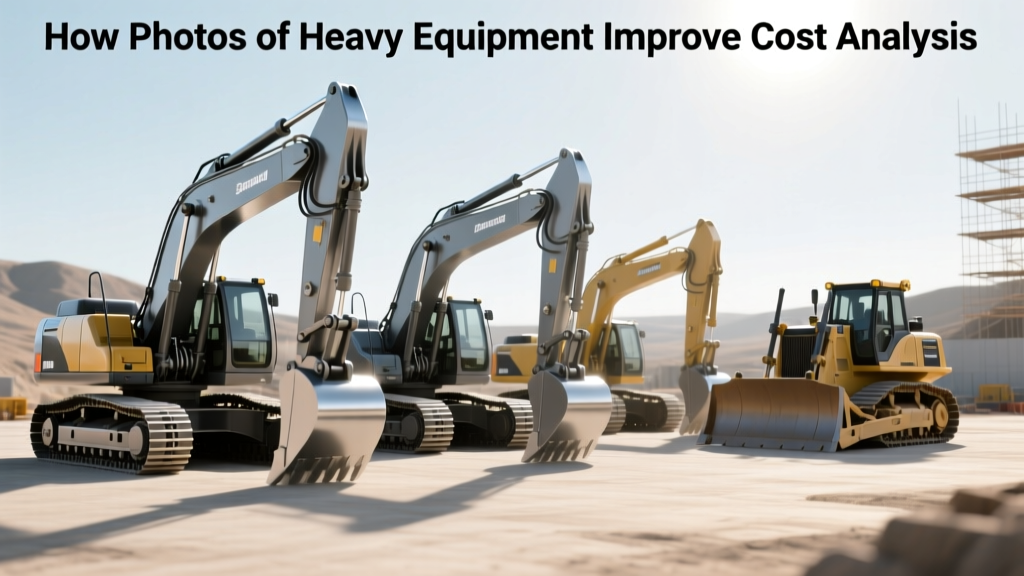
How Photos of Heavy Equipment Improve Cost Analysis
Learn how analyzing photos of heavy equipment improves cost analysis and budget planning for earthmoving fleets with specific 2026 repair pricing.
The Financial Value of Visual Equipment Audits
When procuring, bidding, or managing an earthmoving fleet, relying solely on spec sheets and hour meters leads to severe budget variances. Analyzing photos of heavy equipment provides critical, quantifiable data for cost analysis and budget planning. Visual audits allow estimators and fleet managers to identify deferred maintenance, verify exact machine configurations, and forecast imminent capital expenditures before a single dollar is committed. According to fleet management benchmarks highlighted by the Associated General Contractors of America (AGC), inaccurate equipment condition assessments are a primary driver of project cost overruns in the earthmoving sector.
Auditor's Rule for Field Photos: To extract accurate cost data, photos must be taken at eye level in direct sunlight. Shadows hide hydraulic cylinder scoring, while low-angle shots distort track sag measurements. Always require a standard reference object (like a tape measure or a standard 12-inch wrench) in the frame when capturing wear components like bucket teeth or sprockets.Earthmoving Machine Identification: Beyond the Spec Sheet
Earthmoving equipment encompasses a wide variety of machine types, each with distinct cost centers that are highly visible in photographs. Accurately identifying these visual cues allows for precise budget allocation.
Excavators: Boom Configurations and Undercarriage Wear
The undercarriage of a track-type excavator accounts for up to 50% of total machine maintenance costs over its lifespan. When reviewing photos of a 20-ton class machine like the Caterpillar 320 or Komatsu PC210LC, estimators must look closely at the track chain and sprockets.
- Track Sag: A photo showing excessive track sag (greater than 2 inches between the track shoe and the front idler when measured at the center roller) indicates internal pin and bushing wear. Budget $18,000 to $24,000 for a complete chain and sprocket replacement in 2026.
- Roller Flanges: If photos reveal the carrier roller flanges are worn to a sharp point, the machine has likely been operated extensively in abrasive, sandy conditions. This accelerates final drive wear, requiring an immediate $6,500 budget allocation per side for seal and bearing inspection.
- Boom Configuration: Visual identification of a Mass Excavation (ME) boom versus a standard boom changes the machine's transport weight and fuel consumption profile. An ME boom on a Cat 320 increases fuel burn by roughly 8-12% under heavy load, directly impacting the project's Cost Per Hour (CPH) forecast.
Wheel Loaders: Tire Compounds and Drivetrain Stress
Wheel loaders, such as the John Deere 824L or Volvo L120H, are highly sensitive to ground engaging conditions. Tires represent one of the largest single-line consumable costs in earthmoving.
High-resolution photos of the tire sidewalls and tread are mandatory for accurate budgeting. A set of four 26.5R25 L5 (deep tread rock) tires costs approximately $28,500 in early 2026. If photos show deep sidewall cuts or chunking on an L3 (standard rock) tire, the fleet manager must budget for an immediate upgrade to L5 or L4 compounds, or allocate funds for tire chains ($4,200 per set) to prevent catastrophic blowouts on site.
Motor Graders: Circle Turn and Moldboard Wear
For motor graders like the Cat 14M or John Deere 872GP, the circle and drawbar assembly is the critical cost center. Photos taken from directly beneath the blade can reveal the thickness of the circle wear strips. If the wear strips are flush with the mounting bolts, budget $4,200 for parts and 16 hours of labor to replace them. Ignoring this visual cue leads to scoring on the main circle gear, transforming a $5,000 maintenance task into a $22,000 rebuild.
Visual Wear Indicators vs. Budget Impact Matrix
The following matrix translates specific visual cues found in equipment photos into actionable 2026 budget forecasts for standard earthmoving fleets.
| Equipment Type | Visual Cue in Photo | Estimated 2026 Cost | Budget Action Required |
|---|---|---|---|
| Track Excavator (20t) | Sprocket teeth worn to a point (hooked) | $18,000 - $24,000 | Replace full undercarriage chain/sprockets immediately. |
| Wheel Loader (4-5 yd³) | Articulation pivot pin grease purging/scoring | $8,500 - $11,000 | Schedule pin and bushing rebuild during next PM interval. |
| Motor Grader | Moldboard cutting edge worn past bolt line | $1,800 - $2,400 | Order replacement carbide-tipped edge; swap within 48 hours. |
| Dozer (D65 class) | Hydraulic cylinder chrome flaking/pitting | $4,500 - $6,000 | Re-chrome or replace rod; budget for seal kit to prevent pump contamination. |
Calculating True Cost Per Hour (CPH) from Field Photos
Standard OEM Cost Per Hour (CPH) calculators assume optimal operating conditions and strict adherence to preventive maintenance (PM) schedules. Field photos frequently reveal a different reality. To adjust your budget planning, follow this step-by-step visual extrapolation framework:
- Establish the Baseline CPH: Start with the OEM's standard CPH for the specific model and application (e.g., $65/hour for a Cat D6 dozer in moderate abrasive soil).
- Apply the Deferred Maintenance Multiplier: Review photos of the engine bay and hydraulic valves. Visible oil weeping or clogged air intake pre-cleaners indicate skipped PM intervals. Add a 12-15% risk premium to the baseline CPH to account for accelerated component degradation.
- Factor in Ground Engaging Tool (G.E.T.) Depletion: Zoom in on bucket teeth and side cutters. If photos show 70% wear, calculate the exact cost of the replacement G.E.T. package and divide by the estimated hours remaining before failure. Add this specific dollar amount to your hourly operating budget.
- Adjust for Environmental Mismatch: If photos show a machine equipped with standard cooling packages operating in a high-debris environment (visible clogging on the radiator core), budget for the installation of a heavy-duty debris screen ($1,200) and increase daily labor costs by 0.5 hours for mandatory blow-outs.
Attachment Verification and Hidden Budget Traps
Earthmoving applications rely heavily on attachments, which are often glossed over in initial budget planning. Photos of heavy equipment must explicitly include the quick coupler, hydraulic thumb, and bucket linkage.
"A mismatched quick coupler is a silent budget killer. If the photo shows a manual pin-grabber coupler on a machine scheduled for high-volume trenching, the labor cost of manual attachment swaps will destroy your daily production targets. Always verify the coupler type visually and budget $8,000 to $12,000 for a hydraulic tilt-rotator or automatic quick coupler upgrade if the application demands it."
— Fleet Procurement Analyst, Equipment World Contributor Insights
Furthermore, inspect the hydraulic hoses routing to the attachment. Photos showing hoses routed outside the boom's protective guards, or hoses with visible abrasion on the outer jacket, require an immediate $800-$1,200 budget allocation for custom hose replacement before the machine is deployed to the site. A blown attachment hose on day one of a project causes fluid spill remediation costs that far exceed the price of the hose itself.
Frequently Asked Questions (FAQ)
What is the most critical photo angle for evaluating track-type earthmoving equipment?
The most critical angle is a direct, eye-level profile shot of the undercarriage, taken while the machine is parked on a flat, level surface. This angle allows estimators to measure track sag, assess the wear profile of the sprocket teeth, and check for missing or damaged track shoes. A secondary shot from directly behind the machine is also required to evaluate the wear on the track chain links and pad edges.
Can photos accurately predict hydraulic pump failure?
While photos cannot see inside a hydraulic pump, they can reveal the precursor signs of failure. Look for heavy oil accumulation around the main hydraulic pump housing, scored hydraulic cylinder rods (which introduce metal particulates into the system), and dark, degraded hydraulic fluid visible in the sight glass. If these visual cues are present, budget $3,500 for immediate hydraulic oil and filter analysis, and hold a $15,000 contingency for a potential pump reseal or replacement.
How should I handle photos that show modified or welded machine structures?
Any visible aftermarket welding on the boom, stick, or mainframe should be treated as a major red flag for budget planning. Unauthorized welding compromises the metallurgical integrity of the machine and typically voids the OEM structural warranty. Budget planners should either reject the machine for acquisition or allocate funds for a certified non-destructive testing (NDT) inspection, such as magnetic particle inspection, which costs roughly $1,500 to $2,500 depending on the machine size.