Decoding Videos of Heavy Equipment: Ag vs Construction Specs
Compare agricultural and construction heavy equipment technical specs, from hydraulic flow and CVT transmissions to ground pressure and emissions tuning.
When reviewing operational and training videos of heavy equipment, the visual contrast between a 400-horsepower row-crop tractor and a similarly sized wheel loader is immediate. Yet, the most critical engineering divergences between agricultural and construction machinery remain hidden beneath the sheet metal. While both sectors rely on high-displacement diesel engines, their power delivery, hydraulic architectures, and structural load paths are optimized for fundamentally different physics. Understanding these technical specifications is vital for fleet managers, equipment engineers, and heavy machinery operators to prevent catastrophic cross-application misuse and optimize total cost of ownership.
Powertrain Architecture: CVT vs. Powershift and Torque Converters
The most profound mechanical difference lies in how engine power is translated to the ground and to auxiliary implements. Agricultural tractors prioritize constant power take-off (PTO) speeds, while construction equipment prioritizes high stall torque and rapid directional changes.
Agricultural: Infinitely Variable Transmissions (IVT/CVT)
Modern high-horsepower agricultural tractors, such as the John Deere 8R 410 or Fendt 1000 Vario, utilize hydro-mechanical continuously variable transmissions (CVT). These systems use a power-split architecture, blending mechanical gear drives with hydrostatic pump/motor units. This allows the operator to set the engine at the exact RPM required to maintain a 1,000 or 540 RPM PTO speed for implements like forage harvesters, while independently varying ground speed from 0 to 25 mph without clutching. The primary engineering goal is fuel efficiency and steady-state power delivery.
Construction: Powershift and Hydrostatic Drives
Conversely, construction machinery like the Caterpillar 980M Wheel Loader relies on heavy-duty powershift transmissions with torque converters, or fully hydrostatic drives for excavators. A torque converter multiplies engine torque by up to 2.5 times at stall, which is essential for breaking into compacted dirt piles or pushing heavy scraper loads. Construction powertrains are built to absorb massive transient shock loads and handle frequent, aggressive forward-to-reverse shuttling, a duty cycle that would rapidly overheat and destroy an agricultural CVT.
Hydraulic Architecture and Flow Dynamics
While both machine types use hydraulic fluid to actuate cylinders and motors, their system architectures, operating pressures, and flow priorities differ drastically. Agricultural systems are designed to supply external implements via rear remotes, whereas construction systems are closed-loop ecosystems designed to power internal boom, stick, and bucket cylinders simultaneously.
| Specification | Ag Tractor (e.g., JD 8R 410) | Construction Excavator (e.g., Cat 330) |
|---|---|---|
| System Architecture | Closed-Center Load Sensing (LS) | Closed-Center Variable Displacement |
| Primary Pump Type | Axial Piston (Single/Dual) | Tandem Axial Piston |
| Maximum Implement Flow | 154 GPM (583 L/min) | 138 GPM (522 L/min) per pump |
| System Relief Pressure | 3,600 PSI (248 bar) | 5,076 PSI (350 bar) standard |
| Primary Design Focus | High flow for external hydraulic motors (planters, balers) | High pressure for massive breakout force and multi-functioning |
Construction hydraulics operate at significantly higher relief pressures (often exceeding 5,000 PSI) to generate the immense breakout forces required for trenching and rock excavation. Agricultural hydraulics prioritize high volume (GPM) over extreme pressure, as they are frequently tasked with driving continuous-rotation hydraulic motors on seeding and planting attachments at lower pressures. For deeper insights into modern agricultural hydraulic efficiency, engineers often reference precision ag technology frameworks that integrate hydraulic flow with GPS-driven implement control.
Undercarriage, Flotation, and Ground Pressure Dynamics
The interface between the machine and the terrain represents a major divergence in engineering priorities. Agricultural equipment must minimize soil compaction to protect crop yields, while construction equipment must maximize traction and load-bearing stability on uneven, unyielding surfaces.
Data Highlight: Ground Pressure MetricsA modern high-horsepower ag tractor equipped with VF (Very High Flexion) radial tires operates at a ground pressure of 6 to 12 PSI. In stark contrast, a mid-size construction excavator on standard steel tracks exerts 18 to 25 PSI, while a fully loaded rigid-frame haul truck on bias-ply tires can exceed 45 PSI at the contact patch.
Agricultural Flotation Engineering
To achieve ultra-low ground pressure, agricultural machinery utilizes IF (Increased Flexion) and VF tire technologies. These tires feature highly flexible sidewalls that allow them to operate at pressures as low as 8 PSI while carrying the same load as a standard tire at 20 PSI. This creates a massive, elongated contact patch that distributes the machine's weight, preventing the destruction of soil macropores and maintaining water infiltration rates.
Construction Traction and Stability
Construction undercarriages are built for abuse. Excavators and dozers utilize heavy-duty steel tracks with grease-lubricated or sealed pins and bushings. The track shoes feature aggressive grousers (cleats) designed to penetrate compacted soil and rock. The roller frames are rigidly mounted or equipped with heavy-duty oscillating pads to absorb the extreme shock loads of trenching and dozing, prioritizing machine stability over terrain preservation.
Emissions Calibration and Transient Response
As manufacturers finalize Stage VI and Tier 5 prototype testing in 2026, the calibration differences between ag and construction engines remain pronounced, even when utilizing the same base engine blocks (e.g., a 9.0L or 13.5L inline-six diesel).
Agricultural engines are heavily optimized for steady-state operations. A tractor running a PTO-driven liquid manure spreader might hold a constant 1,800 RPM for six hours straight. The engine control module (ECM) and exhaust aftertreatment system (SCR and DPF) are tuned for maximum thermal efficiency and fuel economy at these fixed load points. According to the EPA nonroad diesel engine standards, maintaining optimal exhaust gas temperatures is critical for passive DPF regeneration, which is easily achieved in steady-state ag applications.
Construction engines, however, must handle violent transient load acceptance. An excavator digging a trench goes from near-zero load to maximum hydraulic stall in a fraction of a second, causing the engine RPM to drop abruptly before the turbocharger can spool up. Construction ECM calibrations feature aggressive fuel-mapping spikes to prevent engine stall during these transient events, and their aftertreatment systems often rely more heavily on active DPF regeneration due to the highly variable duty cycles.
Cross-Application Failure Modes: The Cost of Misuse
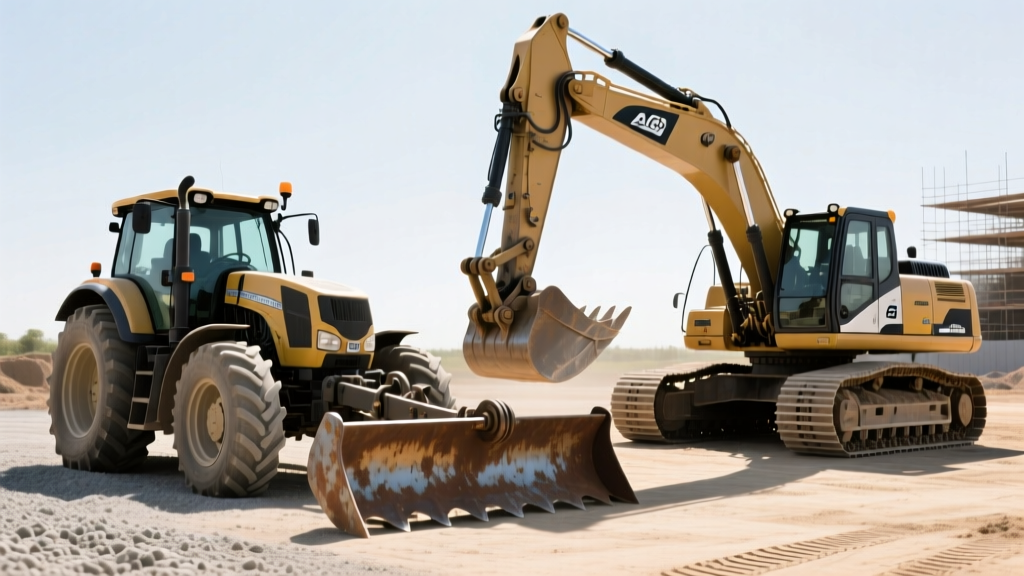
A common, costly mistake in rural contracting is utilizing agricultural tractors with front-end loaders for light construction dozing or site clearing. While the horsepower may be sufficient, the structural and mechanical limitations of ag equipment lead to predictable, catastrophic failure modes.
- Final Drive Spalling: Agricultural planetary final drives are designed for smooth, continuous rolling resistance. When subjected to the sudden shock loads of pushing dirt or striking buried rocks with a loader bucket, the planetary gears and bearings experience spalling and premature shear failures.
- Axle Housing Fractures: Construction wheel loaders feature reinforced, heavy-cast axle housings and massive center-pivot articulation points designed to handle twisting torsional stress. Ag tractor front axles, designed primarily for steering and carrying lighter loader loads, will crack at the mounting flanges when subjected to construction-grade twisting forces.
- Cooling System Overload: Dozing requires continuous high-torque, low-speed operation. Ag tractors rely on ground speed and PTO-driven fans for cooling. When stalled against a dirt pile at high RPM, the ag cooling package (designed for high-speed roading and field work) will rapidly overheat the transmission and hydraulic fluids.
Expert Insight: 'Fleet managers must evaluate the duty cycle, not just the peak horsepower. A 300 HP wheel loader will outlast a 300 HP ag tractor by a factor of three in a site-clearing application because every component—from the torque converter to the Z-bar linkage—is metallurgically and geometrically optimized for shock absorption.'
Summary Matrix: Selecting the Right Platform
Choosing between agricultural and construction platforms requires a strict adherence to the primary operational physics of your job site. Use the following decision framework to guide capital expenditures:
- If the primary task involves PTO-driven continuous rotation (e.g., milling, pumping, baling) and requires low soil compaction, specify an agricultural tractor with an IVT/CVT transmission and VF radial tires.
- If the primary task involves high-impact earthmoving (e.g., dozing, trenching, loading blasted rock) and requires high stall torque, specify construction equipment with a powershift/hydrostatic drivetrain, high-pressure closed-center hydraulics, and reinforced structural linkages.
- If the application is hybrid (e.g., rural road maintenance, snow removal), evaluate dedicated multi-purpose machines like articulated wheel loaders or telehandlers, which bridge the gap with higher travel speeds than excavators and heavier structural builds than ag tractors.
By looking past the superficial similarities often depicted in generic videos of heavy equipment and focusing on the underlying technical specifications, operators and fleet managers can drastically reduce unplanned downtime, prevent catastrophic mechanical failures, and maximize the return on heavy machinery investments.