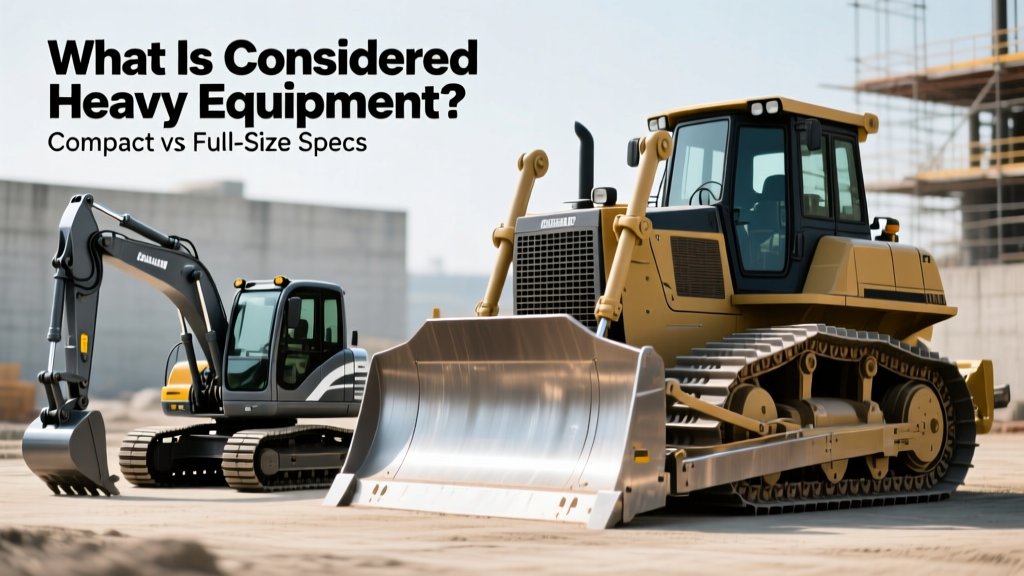
What Is Considered Heavy Equipment? Compact vs Full-Size Specs
Discover what is considered heavy equipment by comparing compact and full-size construction machinery specs, hydraulic flows, and selection frameworks.
Defining the Threshold: What Is Considered Heavy Equipment?
The construction and earthmoving industries rely on precise terminology to classify machinery, but the exact definition often blurs on the job site. Technically, what is considered heavy equipment encompasses any motorized, heavy-duty vehicle engineered for earthwork, material handling, or structural lifting, characterized by a high-torque diesel powertrain, specialized hydraulic actuation, and an operating weight typically exceeding 5,000 pounds. According to guidelines referenced by the Association of Equipment Manufacturers (AEM), the transition from 'compact' to 'standard' or 'full-size' heavy equipment is not merely a matter of physical footprint; it represents a fundamental shift in powertrain architecture, hydraulic circuit design, and structural load-bearing capabilities.
Understanding this demarcation is critical for fleet managers and site superintendents. Selecting a machine based solely on its physical size often leads to severe production bottlenecks or unnecessary capital expenditure. The true distinction lies in the engineering thresholds—specifically, hydraulic flow rates, system operating pressures, and the implementation of load-sensing technologies. This guide dissects the technical specifications that separate compact construction equipment from full-size heavy machinery, providing a data-driven framework for equipment selection in 2026.
Hydraulic Architecture: The Core Engineering Divide
The most significant mechanical difference between compact and full-size heavy equipment is the hydraulic system architecture. This is where the 'how it works' aspect of heavy machinery diverges sharply between the two classes.
Compact Class: Fixed-Displacement Gear Pumps
Compact equipment, such as the Kubota KX040-4 or Bobcat E35, predominantly utilizes fixed-displacement gear pumps. In this setup, the hydraulic pump moves a constant volume of fluid per revolution. If the operator is not utilizing the full flow (for example, performing a delicate grading operation rather than a high-speed trenching cycle), the excess hydraulic fluid is bypassed through a relief valve. This parasitic loss generates excess heat and wastes engine horsepower, resulting in lower overall fuel efficiency. However, gear pumps are highly resistant to contamination, cheaper to manufacture, and easier to maintain, making them ideal for the rigorous, debris-heavy environments where compact machines typically operate.
Full-Size Class: Variable-Displacement Axial Piston Pumps
Full-size heavy equipment, such as the Caterpillar 320 or Volvo EC220, relies on variable-displacement axial piston pumps paired with advanced load-sensing valves. According to technical literature from ForConstructionPros, load-sensing hydraulics continuously monitor the pressure demands of the actuators (boom, stick, and bucket cylinders). The pump's swashplate angle adjusts dynamically, delivering only the exact volume of hydraulic fluid required at any given millisecond. This eliminates bypass losses, reduces fuel consumption by 15% to 22%, and allows for multi-functioning (e.g., swinging the boom while simultaneously curling the bucket) without the hydraulic stutter common in lower-tier systems.
Technical Specification Matrix: Compact vs. Full-Size
To quantify the differences, we must look at exact engineering metrics. The following matrix compares a standard compact excavator against a baseline full-size heavy excavator, reflecting current 2026 production models and MSRP estimates.
| Specification Metric | Compact Class (e.g., Kubota KX040-4) | Full-Size Class (e.g., Caterpillar 320) |
|---|---|---|
| Operating Weight | 8,500 lbs (3.85 metric tons) | 44,000 lbs (20 metric tons) |
| Engine Output (Net) | 24.8 hp (18.5 kW) | 162 hp (121 kW) |
| Hydraulic Pump Type | Fixed-Displacement Gear | Variable-Displacement Axial Piston |
| Max Hydraulic Flow | 17.4 gpm (66 L/min) | 116 gpm (440 L/min) |
| System Relief Pressure | 3,560 psi (24.5 MPa) | 5,075 psi (35 MPa) |
| Bucket Breakout Force | 8,100 lbf (36 kN) | 33,500 lbf (149 kN) |
| 2026 Base MSRP Range | $65,000 - $78,000 | $240,000 - $285,000 |
Powertrain and Emissions Compliance
Both classes of equipment must adhere to stringent EPA Tier 4 Final and EU Stage V emissions standards, but the engineering solutions used to achieve compliance differ vastly due to spatial constraints. Full-size heavy equipment utilizes massive engine bays that accommodate complex Selective Catalytic Reduction (SCR) systems, Diesel Exhaust Fluid (DEF) dosing modules, and large diesel particulate filters (DPF). These systems allow the engine to be tuned for maximum low-end torque, which is critical for high-drawbar-pull applications like pushing scrapers or climbing steep quarry grades.
Compact equipment lacks the physical envelope for bulky SCR and DPF arrays. Instead, manufacturers rely on advanced common-rail fuel injection, exhaust gas recirculation (EGR), and highly optimized combustion chamber geometries to meet Tier 4 Final standards without requiring DEF. While this simplifies the daily maintenance routine (no DEF refilling), it limits the maximum horsepower ceiling and requires the engine to operate at higher RPMs to maintain hydraulic flow, increasing acoustic output and component wear over extended shifts.
Logistics and Transport Framework
When evaluating what is considered heavy equipment for a specific project, transport logistics often dictate the final selection. The legal and financial implications of moving machinery between job sites are governed by Department of Transportation (DOT) weight limits and Commercial Driver's License (CDL) requirements, as outlined by OSHA construction safety and transport guidelines.
Transport Decision Rule:- Under 26,000 lbs GCWR: A compact excavator (8,500 lbs) paired with a 14,000-lb GVWR equipment trailer and a heavy-duty pickup (e.g., Ford F-350) falls under the 26,000 lbs Gross Combination Weight Rating threshold. This allows non-CDL operators to transport the machine, drastically reducing labor costs and dispatch friction.
- Over 26,000 lbs GCWR: Moving a 44,000-lb full-size excavator requires a Class 8 semi-truck, a multi-axle lowboy trailer, and a CDL-A holder with specialized heavy-haul endorsements. Furthermore, route planning must account for bridge weight limits and permitting for oversized loads, adding $300 to $800 per mobilization in logistical overhead.
Application Decision Tree: Selecting the Right Class
Do not default to full-size heavy equipment simply because the budget allows for it. The correct selection relies on matching the machine's technical capabilities to the geotechnical and spatial realities of the site.
Scenario A: Urban Utility Trenching and Infill
Requirement: Digging 6-foot deep trenches for water mains in a confined suburban right-of-way with high soil shear strength (e.g., compacted clay).
Selection: Compact Class. While the full-size machine has higher breakout force, its 10-foot width and 30-ton footprint will destroy existing asphalt, require expensive steel road plates, and block traffic. A compact machine with a hydraulic thumb and a tilt-rotator attachment can achieve the required depth while maintaining a 6-foot footprint, minimizing site restoration costs.
Scenario B: Mass Earthmoving and Quarry Production
Requirement: Loading 40-ton articulated dump trucks (ADTs) with blasted shot-rock in a high-production quarry.
Selection: Full-Size Class. A compact excavator's 0.25-cubic-yard bucket and 17-gpm hydraulic flow would require over 150 cycles to load a single ADT, resulting in catastrophic truck wait times and fuel burn. The full-size excavator's 3.5-cubic-yard bucket and 116-gpm flow can load the same truck in 6 to 8 cycles, optimizing the site's overall ton-per-hour metric.
'Fleet optimization is not about buying the largest machine available; it is about aligning the machine's hydraulic cycle time and transport logistics with the specific bottleneck of the job site.' - Heavy Equipment Fleet Management Principles, 2026.
Final Technical Considerations
Understanding what is considered heavy equipment requires looking past the exterior sheet metal and evaluating the hydraulic circuits, powertrain tuning, and transport logistics. Compact equipment excels in spatial agility, low-impact transport, and localized utility work, leveraging robust gear-pump hydraulics. Full-size heavy equipment dominates in high-production mass earthmoving, utilizing load-sensing axial piston systems and massive breakout forces to move thousands of tons of material daily. By applying the technical thresholds and decision frameworks outlined above, site managers can eliminate guesswork and deploy the exact engineering solution required for the task at hand.