Heavy Equipment Machine Selection: Compact vs Full-Size Safety
Navigate OSHA compliance when selecting a heavy equipment machine. Compare compact and full-size models for site-specific hazard management and safety.
The Compliance Divide: Why Size Dictates Safety Protocols
Selecting the correct heavy equipment machine is fundamentally a risk management exercise governed by strict federal and international safety frameworks. While production metrics and digging depth often dominate procurement discussions, site safety officers and project managers must prioritize compliance profiles. The physical footprint, kinetic energy output, and blind spot geometry of a machine dictate which Occupational Safety and Health Administration (OSHA) standards apply to your specific job site.
Under OSHA 29 CFR 1926.602, material handling equipment mandates shift dramatically based on machine weight class and swing radius. Choosing between a compact track loader and a 36-ton excavator is not merely a question of earthmoving capacity; it is a decision that alters your site's required barricade footprint, operator certification tiers, and mandatory proximity sensor arrays.
⚠️ OSHA Compliance Warning: Deploying a conventional tail-swing heavy equipment machine in a confined right-of-way without establishing a physical barricade equal to the machine's maximum swing radius plus a 3-foot buffer is a direct violation of Subpart O. Fines for willful swing-radius violations routinely exceed $15,000 per instance.Compact Heavy Equipment Machine Profiles: Navigating Tight Quotients
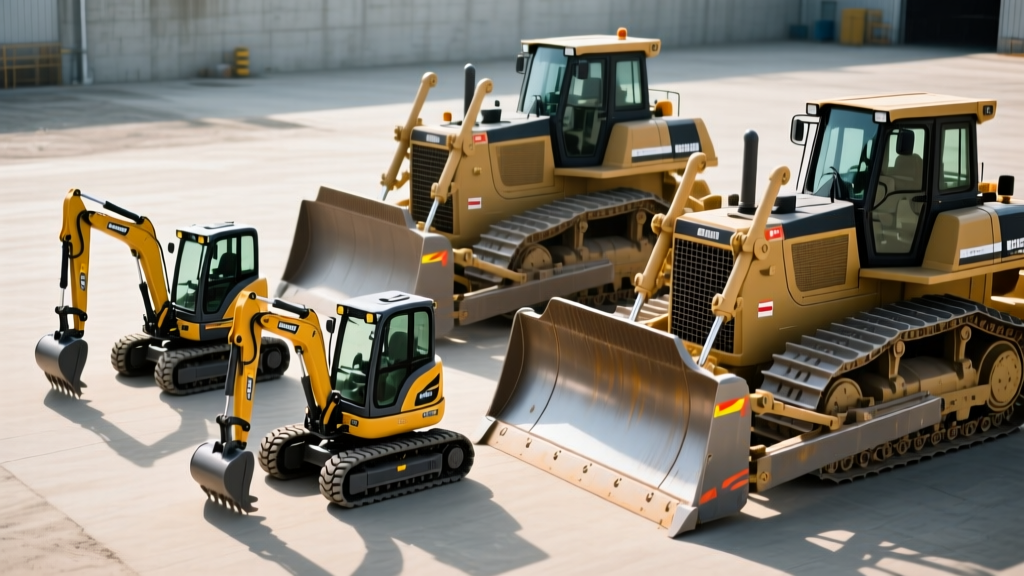
Compact machinery, typically defined as equipment under 10,000 pounds (4,500 kg), is engineered for high-density urban environments and interior demolition. Models like the Bobcat E35z (3.5-ton mini excavator) and the Kubota KX040-4 are staples in this category. The primary safety advantage of these units lies in their Zero-Tail-Swing (ZTS) or short-tail-swing designs, which keep the counterweight within the track width during rotation.
ROPS and Confined Space Compliance
Roll-Over Protective Structures (ROPS) on compact machines must comply with ISO 3471. However, because compact machines frequently operate in confined trenches or near retaining walls, the ROPS canopy often creates vertical clearance hazards. Procurement teams must specify retractable ROPS or low-profile FOPS (Falling Object Protective Structures) when bidding on projects with overhead obstructions, such as underbridge repairs or indoor industrial retrofits. Failing to verify vertical clearance against the machine's maximum ROPS height is a leading cause of structural damage and operator injury in confined sites.
| Machine Model | Operating Weight | Tail Swing Profile | Min. Safe Barricade Radius |
|---|---|---|---|
| Bobcat E35z | 7,659 lbs (3,474 kg) | Zero-Tail-Swing (ZTS) | Track Width + 2 ft buffer |
| Kubota KX040-4 | 9,195 lbs (4,171 kg) | Conventional Overhang | 8 ft 6 in (2.59 m) + 3 ft |
| Caterpillar 305 CR | 11,905 lbs (5,400 kg) | Compact Radius (CR) | 6 ft 5 in (1.96 m) + 3 ft |
Full-Size Heavy Equipment Machine Profiles: Managing Massive Kinetic Energy
Transitioning to full-size equipment, such as the Caterpillar 336 or Komatsu PC360LC (both hovering around the 80,000 lb / 36,000 kg mark), introduces exponential increases in kinetic energy and blind spot geometry. The safety compliance focus shifts from overhead clearance to blind spot mitigation, ground-bearing pressure, and advanced FOPS requirements.
Blind Spot Mitigation and Backover Prevention
According to data tracked by the National Institute for Occupational Safety and Health (NIOSH), backovers and blind-spot strikes account for a significant percentage of fatal construction incidents involving heavy machinery. A standard 36-ton excavator possesses a rear blind spot that can easily conceal a light-duty pickup truck or a group of ground workers.
To comply with modern site safety mandates, full-size machines must be equipped with ISO 5006-compliant operator visibility standards. This necessitates the installation of multi-camera arrays and, increasingly, LiDAR-based proximity detection systems. Retrofitting a legacy full-size heavy equipment machine with a 4-camera bird's-eye view system and ultrasonic proximity alarms typically costs between $4,500 and $8,200, an investment that is mandatory for Tier-1 general contractor site approvals.
"The assumption that a spotter is sufficient for a 40-ton machine's blind spot is a fatal fallacy. Human error in communication, combined with the ambient noise of a full-size diesel powertrain, renders spotter-only protocols inadequate for modern compliance audits. Active electronic intervention is now the baseline."
— Director of Safety Operations, National Earthwork Compliance Group
Decision Matrix: Matching Machine Class to Site Hazard Zones
Procurement teams must utilize a structured decision framework to align machine size with site-specific hazard zones. Use the following matrix to determine the appropriate equipment class based on your site's safety constraints:
Zone A: High-Density Urban / Active Traffic (Under 15 ft clearance)Mandate: Compact ZTS machinery only. Mandatory use of rubber tracks to preserve infrastructure. Spotters required for all travel movements. Full-size machines are strictly prohibited due to swing-radius barricade impossibility. Zone B: Subdivision / Open Trenching (15 ft to 50 ft clearance)
Mandate: Compact Radius (CR) or mid-size machines permitted. Conventional tail-swing full-size machines allowed only if a dedicated, hard-barricaded swing zone is established and audited daily. Zone C: Heavy Civil / Mass Excavation (Unrestricted footprint)
Mandate: Full-size heavy equipment machine deployment optimized. Mandatory integration of telematics, auto-idle shut-off, and LiDAR proximity braking. Ground-bearing pressure analysis required to prevent trench wall collapse.
Telematics and Active Safety Interventions
The integration of telematics has fundamentally altered how safety compliance is verified. Modern heavy equipment machines utilize GPS and CAN-bus data to enforce safety protocols digitally. For example, geofencing technology allows site managers to create virtual boundaries. If a compact excavator approaches an unshored trench edge or an active roadway, the machine's hydraulic system can be programmatically restricted to slow-motion or halted entirely.
Furthermore, auto-braking systems utilizing solid-state LiDAR are becoming standard on full-size wheel loaders and dozers. These systems detect thermal and spatial anomalies (such as a ground worker obscured by dust) and override the operator's throttle input to apply service brakes. When drafting equipment specifications for upcoming bids, explicitly requiring ISO 21815 (Earth-moving machinery - Object detection) compliance will future-proof your fleet against impending regulatory shifts.
Operator Certification and Tiered Training Requirements
Operating a compact skid steer does not legally qualify an individual to operate a full-size hydraulic excavator under most union and Tier-1 contractor safety programs. While OSHA requires all operators to be trained and evaluated, the National Commission for the Certification of Crane Operators (NCCCO) and equivalent bodies differentiate heavily by machine class and kinetic potential. Ensure your operator matrix aligns the specific machine weight class with the corresponding practical evaluation certification.
Frequently Asked Questions: Compliance Quick-Answers
Does OSHA require a daily documented inspection for compact equipment?
Yes. OSHA 29 CFR 1926.602 mandates that all material handling equipment, regardless of size, be inspected at the beginning of each shift. While a compact track loader requires less time to inspect than a 50-ton articulated dump truck, the documentation of ROPS integrity, hydraulic hose condition, and backup alarm functionality must be recorded and kept on site for auditing.
Can I remove the ROPS canopy on a compact machine to fit through a doorway?
Removing a certified ROPS structure voids the machine's safety compliance and exposes the company to massive liability in the event of a rollover. If vertical clearance is an issue, you must procure a machine specifically designed with a foldable or retractable ROPS frame that maintains structural integrity when lowered and pinned, rather than unbolting the canopy entirely.
Are backup alarms mandatory on all heavy equipment machines?
OSHA requires a backup alarm that is audible above the surrounding noise level on all bidirectional machines (like wheel loaders and dozers) that have an obstructed rear view. For excavators, which rotate rather than travel in reverse in the traditional sense, the requirement shifts toward swing-radius warnings and travel alarms when the machine is tracking in reverse.