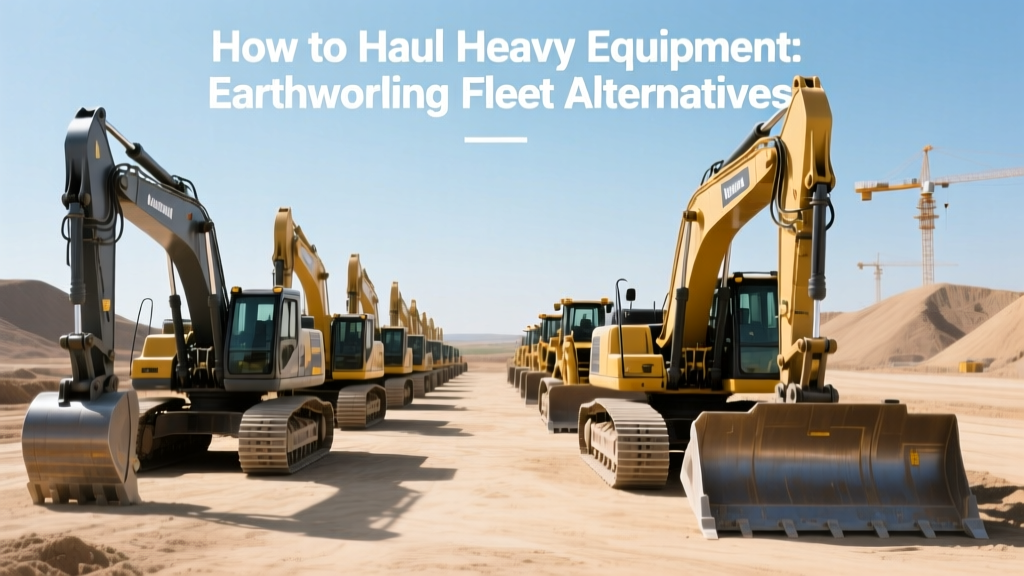
How to Haul Heavy Equipment: Earthmoving Fleet Alternatives
Compare top earthmoving equipment types and learn the most efficient ways to haul heavy equipment for your construction projects. Expert logistics analysis.
The Hidden Cost of Earthmoving: Transportability vs. Application
When selecting earthmoving equipment types for a fleet, contractors typically focus entirely on dig depth, breakout force, and cycle times. However, the logistical reality of how you haul heavy equipment between job sites often dictates the true profitability of a machine. A crawler excavator might move 30% more dirt per hour than a wheel excavator, but if its width and weight trigger oversize load permits and require specialized multi-axle trailers for every mobilization, the transport costs can erase its production advantage on short-term projects.
In 2026, with lowboy trailer rates averaging $5.50 to $8.00 per mile and overweight permit fees rising across state lines, fleet managers must evaluate earthmoving alternatives through a dual lens: site application and transport logistics. This analysis breaks down the primary earthmoving machine categories, comparing their operational utility against the physical and financial constraints of hauling them.
⚠️ Logistics Warning: The 8.5-Foot Interstate RuleAccording to the Federal Highway Administration (FHWA), the maximum legal width on the Interstate Highway System without an oversize permit is 102 inches (8.5 feet). Many mid-size and large crawler excavators and dozers exceed this width when equipped with standard tracks or blades, instantly requiring route surveys, escort vehicles, and state-specific permits that add $800 to $2,500 per move.
Earthmoving Fleet Transportability Matrix
The following matrix compares standard earthmoving equipment types, highlighting the specific logistical footprint required to haul heavy equipment of each class.
| Equipment Type | Model Example | Operating Weight | Trailer Required | Permit Risk |
|---|---|---|---|---|
| Crawler Excavator | Cat 336 | 81,900 lbs | Multi-Axle RGN | High (Width/Weight) |
| Wheel Excavator | Cat M322 | 48,500 lbs | Standard 3-Axle Lowboy | Low |
| Crawler Dozer | Komatsu D65PX-18 | 46,000 lbs | Lowboy (Blade Removed) | Medium (Width) |
| Wheel Loader | Volvo L120H | 41,500 lbs | Step Deck / Lowboy | Low |
| Articulated Hauler | Volvo A45G | 70,000 lbs | Heavy Haul RGN | Extreme (Width/Length) |
Crawler vs. Wheel Excavators: Digging Power vs. Hauling Agility
The most common dilemma in earthmoving fleet procurement is choosing between crawler and wheel excavators. Crawlers offer superior traction, lower ground pressure, and heavier lifting capacities. However, when you need to haul heavy equipment frequently across a metro area, wheel excavators present a compelling logistical alternative.
The Crawler Disadvantage: Track Width and Deck Height
A standard 35-ton class crawler like the Caterpillar 336 features a track gauge that often pushes the overall transport width past 108 inches with standard shoes. Furthermore, the sheer height of the boom and cab requires a Removable Gooseneck (RGN) trailer with a low deck height (typically 24 inches) to clear 13.5-foot bridge overpasses. Loading a crawler excavator requires detaching the bucket, managing track tension, and utilizing heavy-duty ramps, adding 45 to 60 minutes to the mobilization process.
The Wheel Alternative: Road-Mobile Earthmoving
Wheel excavators, such as the Cat M318 or M322, are designed with highway transport in mind. Their overall width typically remains under 100 inches, keeping them strictly within legal interstate limits without oversize permits. Because they ride on pneumatic tires, they can be driven directly onto a standard lowboy trailer without the need for heavy ramps or track alignment. While a wheel excavator sacrifices roughly 15% of the digging breakout force compared to its crawler counterpart, the elimination of $1,500 in permit fees and escort car requirements per move makes it the superior alternative for utility contractors working on dispersed, multi-site municipal projects.
"Fleet managers often miscalculate the true cost of mobilization. If a machine is moved more than 12 times a year across county lines, the logistical overhead of a crawler fleet will outpace the fuel and maintenance savings of a wheel-based fleet."
Material Hauling Alternatives: ADTs vs. Highway Dump Trucks
Earthmoving isn't just about digging; it's about moving mass. When the application requires hauling earth off-site or across long distances, contractors must choose between Articulated Dump Trucks (ADTs) and highway-legal rigid frame dump trucks.
- Articulated Dump Trucks (e.g., Bell B30E, Volvo A30G): These are strictly off-highway machines. They excel in soft, muddy terrain due to their 6x6 drivetrain and oscillating hitch. However, they cannot be driven on public roads. To use an ADT on a remote site, you must first haul heavy equipment trailers to deliver the ADT to the location, incurring massive inbound and outbound freight costs.
- Highway-Legal Tandem Axle Trucks (e.g., Mack Granite, Peterbilt 567): While they lack the off-road traction of an ADT, highway dump trucks eliminate the need for specialized equipment hauling entirely. They are loaded by an excavator on-site and driven directly to the landfill or fill location via public highways.
The Decision Framework: If the haul distance is under 2 miles entirely on private, unimproved dirt, the ADT is the correct application. If the material must travel more than 5 miles and touch a paved public road, relying on highway-legal dump trucks is the vastly superior alternative, saving thousands in lowboy trailer mobilization fees.
Trailer Selection for Earthmoving Logistics
Choosing the right trailer is just as critical as choosing the earthmover. Mismatching the trailer to the machine results in blown tires, DOT fines, or catastrophic loading accidents. The National Institute for Occupational Safety and Health (NIOSH) frequently cites improper loading and trailer selection as a primary cause of heavy equipment transport incidents.
Trailer Matching Guide
- Removable Gooseneck (RGN): Required for machines over 60,000 lbs or with tall cabs (large dozers, 30-ton+ excavators). The deck drops to the ground, eliminating the need for steep loading ramps, which reduces the risk of track slippage and machine tip-overs.
- Standard Lowboy (Drop Deck): Ideal for wheel loaders and mid-size wheel excavators (30,000 to 50,000 lbs). Features a 35-inch deck height. Requires machines to be backed up heavy-duty flip ramps.
- Flatbed / Step Deck: Reserved strictly for compact earthmoving equipment, such as skid steers, compact track loaders (CTLs), and mini-excavators under 15,000 lbs. Do not attempt to haul a full-size wheel loader on a step deck; the center of gravity will exceed legal bridge-formula limits.
Regulatory Compliance and Emissions in 2026
When hauling earthmoving fleets across state lines, transport logistics intersect with environmental regulations. The EPA's transition toward stricter nonroad diesel engine standards means that older, Tier 3 earthmoving equipment faces scrutiny and potential idling restrictions when transported through or operated in non-attainment zones. According to the EPA Emission Standards Reference Guide, ensuring your hauled fleet meets Tier 4 Final or emerging Tier 5 equivalents prevents project delays at regulated municipal sites.
Furthermore, securing the load requires adherence to strict tie-down protocols. A 80,000 lb excavator requires a minimum of four direct tie-downs with a combined working load limit (WLL) equal to 50% of the machine's weight. Using standard 3/8-inch Grade 70 transport chains is insufficient for large crawlers; fleet managers must specify 5/8-inch or 3/4-inch Grade 100 alloy chains with heavy-duty binders to survive the dynamic forces of highway transport.
Final Fleet Procurement Strategy
Do not purchase earthmoving equipment in a vacuum. Before signing a PO for a new crawler dozer or excavator, run a 12-month logistical simulation. Calculate the exact number of mobilizations, the distance between sites, and the specific DOT permit costs for the machine's transport width and weight. In many modern construction environments, the contractor who wins the bid isn't the one with the largest bucket, but the one who has optimized how they haul heavy equipment to the dig site.