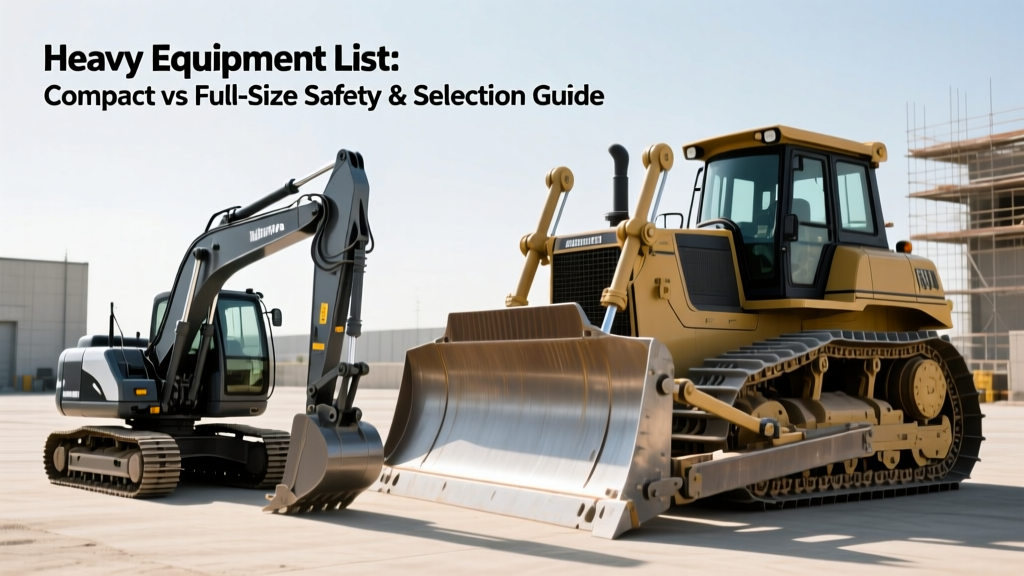
Heavy Equipment List: Compact vs Full-Size Safety & Selection Guide
Building a heavy equipment list? Compare compact vs full-size construction machinery through the lens of OSHA compliance, blind-spot safety, and ROI.
The Compliance Cost of Your Heavy Equipment List
When compiling a project's heavy equipment list, the decision between compact and full-size machinery dictates far more than just earthmoving productivity. It fundamentally alters your site's safety compliance profile, insurance premiums, and required operator certifications. A common failure mode in project planning is treating equipment sizing purely as a volume-to-cost equation, ignoring the cascading regulatory requirements triggered by larger machines.
Under OSHA 1926.602 (Material Handling Equipment), the deployment of full-size earthmovers introduces strict mandates for audible backup alarms, dedicated spotters, and specialized ground-bearing assessments. Compact equipment, while not exempt from safety standards, inherently mitigates several high-risk vectors—specifically blind-spot crushing hazards and overhead powerline encroachment. Selecting the right class of machine requires a rigorous analysis of site constraints against federal and international safety frameworks.
⚠️ OSHA Citation Trigger Warning: Failing to maintain a daily inspection log for heavy equipment is a frequent OSHA citation. Full-size equipment requires comprehensive daily checks of hydraulic lines, ROPS integrity, and track tension. Compact equipment inspection protocols, while still mandatory, generally involve fewer critical structural checkpoints, reducing daily downtime by an estimated 15-20 minutes per machine.Compact vs. Full-Size: Safety & Operational Matrix
The following matrix contrasts the operational realities and safety compliance burdens of standard compact models against their full-size counterparts. Pricing reflects average 2026 market rates for base models with standard safety packages.
| Machine Class & Model | Approx. Cost | Tail Swing Profile | Backup Alarm Mandate | Spotter Requirement |
|---|---|---|---|---|
| Compact Excavator (Bobcat E35) | $62,000 - $75,000 | Zero Tail Swing (ZTS) | Required if view is obstructed | Rarely needed in open zones |
| Full-Size Excavator (CAT 320) | $275,000 - $310,000 | Conventional (10ft+ radius) | Strictly Mandatory (15dB > ambient) | Mandatory in high-traffic zones |
| Compact Track Loader (CAT 259D3) | $85,000 - $95,000 | N/A (Skid-steer pivot) | Mandatory | Required for multi-directional |
| Full-Size Wheel Loader (Volvo L120H) | $320,000 - $360,000 | N/A (Articulated) | Mandatory + Rear Camera | Mandatory for stockpiling |
Blind Spot Management and ISO 5006 Visibility
Operator visibility is governed globally by ISO 20474-1 (Earth-moving machinery — Safety), which incorporates ISO 5006 for visibility test criteria. Full-size machinery inherently generates massive blind spots, particularly on the right-rear quadrant and directly behind the counterweight. When a CAT 320 or Komodo PC210 is added to your heavy equipment list, site safety plans must integrate proximity detection systems (PDS) or mandate dedicated ground spotters equipped with two-way radios.
Tail Swing Hazards in Confined Rights-of-Way
In urban environments or highway work zones, conventional tail swing poses a lethal strike hazard. A full-size excavator's counterweight can extend 4 to 6 feet beyond the track width during rotation. If a worker enters this pinch point, the crushing force is unsurvivable. Compact excavators featuring Zero Tail Swing (ZTS) or Conventional Tail Overhang (CTO) designs keep the counterweight within the track footprint. Selecting ZTS compact machinery for your list eliminates the need for physical barricades around the machine's swing radius, saving thousands in temporary fencing and traffic control labor.
Ground Bearing Pressure and Trench Edge Stability
Soil mechanics and trenching safety (OSHA 1926 Subpart P) heavily influence equipment selection. A common edge-case failure occurs when project managers deploy full-size excavators too close to an excavation edge, exceeding the soil's shear strength and triggering a catastrophic collapse.
💡 Ground Pressure Insight: A compact track loader like the John Deere 333 P-Tier exerts an average ground bearing pressure of 4.5 to 5.5 psi. In contrast, a full-size wheel loader can exert upwards of 45 psi on its front axle during bucket breakout. When working near the edge of a Type C soil trench, the competent person must calculate the equipment surcharge load. Compact machinery often allows operators to work 2 to 3 feet closer to the trench edge safely, reducing the required reach and allowing for the use of smaller, less expensive excavator classes.Furthermore, heavy equipment lists for utility work must account for underground asset protection. Full-size machines risk crushing shallow-buried PVC or aging cast-iron water mains due to sheer static weight, whereas compact rubber-tracked machines distribute weight sufficiently to traverse sensitive utility corridors without structural damage.
ROPS, FOPS, and Enclosure Mandates
Roll-Over Protective Structures (ROPS - ISO 3471) and Falling Object Protective Structures (FOPS - ISO 3449) are non-negotiable. However, the application differs by machine size. Full-size articulated dump trucks and wheel loaders operating on steep grades or demolition sites require heavily reinforced, enclosed cabs with Level II FOPS (capable of withstanding impact from heavy falling debris like concrete chunks or steel beams).
Compact equipment, such as skid steers and mini excavators, often utilize open canopies with Level I FOPS (designed for brick-sized debris). If your site involves active overhead demolition or scaling operations, adding open-canopy compact machinery to your heavy equipment list is a severe compliance violation. You must specify enclosed cabs with polycarbonate or laminated safety glass fronts, which typically add $3,500 to $6,000 to the base price of a compact machine but are mandatory for avoiding OSHA willful citations in high-risk zones.
Overhead Powerline Clearances
Working near energized power lines triggers strict adherence to OSHA 1926.1408 Table A. For lines up to 350 kV, the minimum clearance distance is 20 feet. Full-size excavators and tall telehandlers frequently possess boom heights exceeding 20 feet at rest. Simply raising the boom to a transport position can violate federal clearance limits, requiring dedicated observers and proximity alarms. Compact machinery, with transport heights frequently under 8 to 10 feet, drastically simplifies powerline compliance, allowing crews to work in utility easements without triggering the administrative burden of a formalized Encroachment Prevention Plan.
4-Step Compliance Selection Framework
Use this decision framework when finalizing your heavy equipment list to ensure safety and regulatory alignment:
- Map the Swing and Strike Zones: Overlay the equipment's tail-swing radius and maximum boom height onto the site plan. If the swing radius intersects pedestrian walkways or live traffic, default to Zero Tail Swing compact models or mandate physical barricades for full-size units.
- Calculate the Surcharge Load: For trenching operations, consult the geotechnical report. If soil bearing capacity is below 2,000 psf, restrict the heavy equipment list to compact track loaders and mini excavators to prevent edge shear failure.
- Audit the Overhead Hazards: Identify all overhead utilities and temporary structures. If boom clearance cannot guarantee a 20-foot buffer from high-voltage lines, eliminate full-size excavators from that specific work zone.
- Verify Alarm and Camera Redundancy: Ensure the procurement specifications for any full-size machine include 100-degree rear-view camera systems and dual-tone backup alarms calibrated to 15 decibels above the site's ambient noise floor, satisfying OSHA 1926.602(a)(9) requirements.
Strategic selection between compact and full-size machinery is not merely a matter of bucket capacity. By evaluating your heavy equipment list through the lens of blind-spot geometry, ground pressure limits, and OSHA clearance mandates, safety managers can engineer out hazards before the first machine arrives on site.