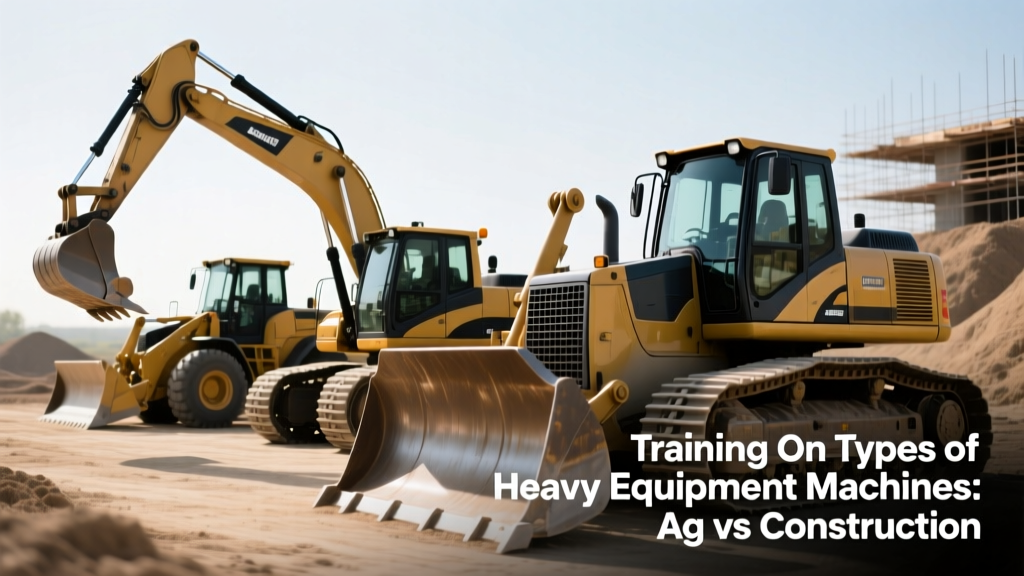
Training on Types of Heavy Equipment Machines: Ag vs Construction
Compare agricultural and construction types of heavy equipment machines. Learn operator training best practices, safety protocols, and crossover tips.
The Operational Divide: Soil Cultivation vs. Earthmoving
When evaluating the different types of heavy equipment machines, the operational divide between agriculture and construction is often underestimated by fleet managers and training coordinators. While a 400-horsepower John Deere 8R tractor and a Caterpillar 336 excavator may share similar gross vehicle weights and diesel powertrains, their kinetic behaviors, hazard profiles, and operator interfaces are fundamentally opposed. Agricultural machinery is engineered for high-speed, continuous linear travel across yielding surfaces, whereas construction equipment is optimized for high-torque, stationary or slow-travel cyclic digging and lifting on compacted, unpredictable terrain.
Training operators to transition between these sectors without addressing these core engineering differences leads to severe safety incidents and accelerated component wear. This guide details the specific training protocols required for both sectors, highlighting the exact mechanical and operational parameters that define modern heavy machinery operation.
Agricultural Types of Heavy Equipment Machines: Training Fundamentals
Modern agricultural tractors and harvesters, such as the Case IH Axial-Flow 9250 combine (retailing upwards of $550,000), are highly complex data-gathering platforms. Operator training must extend beyond basic steering and throttle management to encompass power take-off (PTO) safety, roll-over protective structures (ROPS), and precision agriculture calibration.
PTO and Driveline Entanglement Protocols
The PTO shaft is the most lethal component on any agricultural machine. Standard rear PTOs operate at either 540 RPM or 1000 RPM, generating enough rotational force to pull in an operator's clothing in a fraction of a second. According to the National Institute for Occupational Safety and Health (NIOSH), PTO entanglements remain a leading cause of severe injury in farming.
⚠️ CRITICAL SAFETY DIRECTIVE: Operators must be trained to verify that the master shield and implement driveline guards rotate freely before every engagement. A painted-over or zip-tied shield is an immediate fail on any pre-shift inspection. Never step over an engaged PTO shaft, even if it is shielded.Precision Ag and Auto-Steer Calibration
With the integration of RTK (Real-Time Kinematic) GPS systems offering sub-inch accuracy, operators must be trained to manage automation complacency. When operating a John Deere 8R 410 with AutoTrac engaged at 12 MPH, the operator's role shifts from active steering to system monitoring. Training must cover manual override procedures, specifically how to instantly disengage auto-steer via the steering wheel torque sensor or the secondary foot brake when encountering unmapped obstacles like irrigation culverts or washouts.
Construction Types of Heavy Equipment Machines: Site Safety & Operation
Construction equipment, particularly hydraulic excavators and wheel loaders, operates in highly congested, three-dimensional environments. The training focus here shifts from linear speed management to spatial awareness, load dynamics, and ground pressure distribution.
Swing Radius and Blind Spot Management
A standard Cat 320 excavator generates approximately 54,000 ft-lbs of swing torque. The counterweight sweeps a massive arc that can crush a worker against a trench box or structure in milliseconds. Operators must be trained to physically demarcate the swing radius using high-visibility barricade tape or physical barriers before beginning excavation. Furthermore, training must address the right-side blind spot inherent to the cab design, mandating the use of 360-degree camera systems and mandatory eye-contact protocols with ground personnel before initiating a swing.
Hydraulic Load Limits and Trenching Edge Safety
Lifting pipes or setting trench boxes with an excavator requires strict adherence to the machine's load chart. Operators must understand how lifting capacity degrades as the load moves further from the machine's centerline and as the boom angle increases. Additionally, when working near trench edges, operators must follow OSHA's trenching and excavation standards, maintaining a minimum clearance of two feet from the edge for Type B soil, and understanding the 1.5:1 slope requirement to prevent catastrophic trench wall collapse under the machine's track pressure.
Crossover Training: Transitioning Operators Between Sectors
Fleet managers frequently attempt to move agricultural operators to construction sites during off-seasons. This crossover requires targeted retraining due to severe muscle memory conflicts.
💡 EXPERT INSIGHT: The most dangerous crossover error involves travel pedal orientation. In many agricultural tractors, pressing the right pedal moves the machine forward. In standard ISO-pattern construction excavators, the right travel pedal moves the machine forward, but the operator is seated 90 degrees to the direction of travel, and the 'forward' orientation changes depending on where the excavator's sprockets are positioned relative to the cab. Operators must spend a minimum of 8 hours in a controlled, empty lot re-mapping their spatial orientation before entering an active construction site.Comparison Matrix: Ag vs. Construction Machine Parameters
| Parameter | Agricultural Tractor (e.g., JD 8R 410) | Construction Excavator (e.g., Cat 320) | Training Focus Area |
|---|---|---|---|
| Primary Hydraulics | Open-center / Closed-center (approx. 80 gpm) | Load-sensing, variable displacement (approx. 140 gpm) | Hydraulic shock prevention and implement tuning |
| Travel Speed | Up to 31 mph (50 km/h) on roads | Max 3.5 mph (5.7 km/h) on site | Braking distances vs. precise track positioning |
| Protective Structures | ROPS (Roll-Over Protective Structures) | FOPS (Falling Object) & ROPS integrated | Seatbelt interlocks and cab integrity checks |
| Ground Pressure | High (concentrated on 4 tires) | Low (distributed over track pads) | Soil compaction vs. trench edge stability |
| Certification Req. | State-specific Ag/OSHA guidelines | OSHA 29 CFR 1926 Subpart O/N | Documented competency and daily sign-offs |
Actionable Pre-Shift Inspection Frameworks
Generic walk-around checklists fail to catch sector-specific failure modes. Implement these targeted inspection steps to ensure machine readiness and operator compliance.
Agricultural Pre-Shift Protocol (High-Speed Travel Focus)
- Tire Pressure & Ballast: Verify rear tire pressures are set to manufacturer specs for the current ballast weight (often 12-15 PSI for radial R1-W tires) to prevent sidewall blowouts at highway speeds.
- SMV Emblem & Lighting: Ensure the Slow Moving Vehicle triangle is clean, unfaded, and mounted point-up, 2 to 6 feet above the ground. Test all flashing amber beacons.
- Drawbar & Hitch Pins: Inspect the drawbar for elongation. Verify the hitch pin has a positive mechanical lock (e.g., a linchpin or bolt), never just a washer.
- Coolant & DEF Levels: Check Tier 4 Final emissions fluid (DEF) levels. Running dry will force the ECU into a severe derate mode, limiting engine RPM to idle.
Construction Pre-Shift Protocol (Cyclic Load Focus)
- Track Tension & Undercarriage: Measure track sag. For a standard 320-class excavator, ideal sag is typically 1 to 1.5 inches over the front idler. Excessive tightness accelerates idler wear; excessive looseness risks track de-tracking during side-slope operations.
- Swing Bearing Grease: Verify the auto-lube system reservoir is full and check for fresh grease purging from the swing gear seal. A dry swing bearing will suffer catastrophic pitting within 50 hours.
- Bucket Linkage & Pins: Check the H-linkage and bucket pins for lateral play. More than 1/8 inch of lateral wobble indicates worn bushings that will cause sloppy trench grades and accelerated hydraulic hose fatigue.
- Backup Alarm & Camera:Test the 97-decibel backup alarm and wipe the 360-degree camera lenses. A muddy rear camera renders the blind-spot mitigation system useless.
"The assumption that heavy iron is universally operated the same way is a fatal management error. A farmer who spends 2,000 hours a year managing momentum and PTO loads possesses a completely different neurological map than an excavator operator managing micro-hydraulic swing tolerances. Respect the engineering intent of the machine, and train the operator for the specific physics of their sector." — Director of Fleet Safety, National Earthmoving Contractors Association
By recognizing the distinct engineering purposes and hazard profiles of these different types of heavy equipment machines, safety managers can deploy highly specific training modules. This targeted approach not only ensures compliance with OSHA's agricultural and construction safety directives but also significantly reduces costly downtime caused by operator-induced mechanical failures.