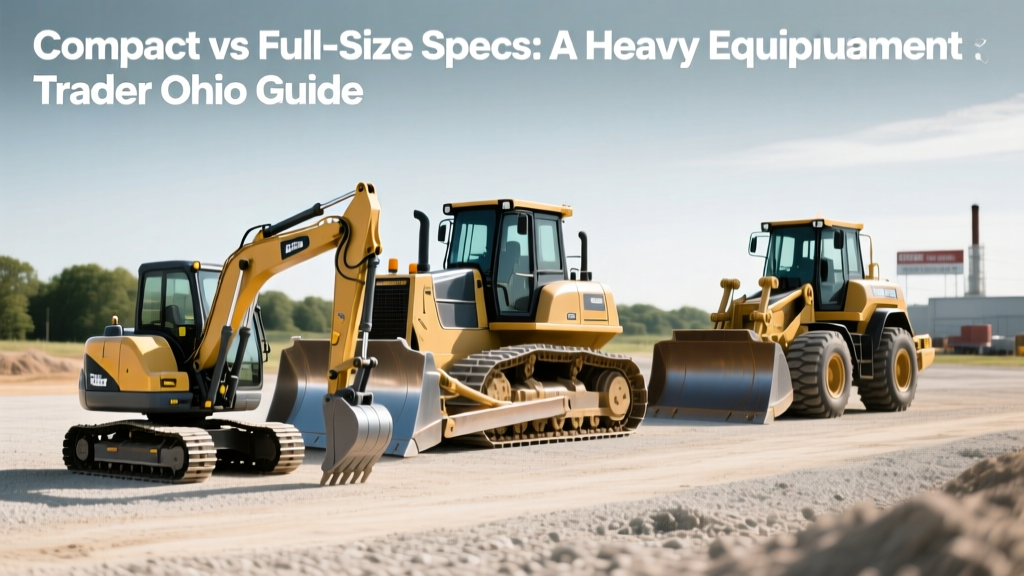
Compact vs Full-Size Specs: A Heavy Equipment Trader Ohio Guide
Compare compact vs full-size construction equipment specs. A heavy equipment trader Ohio guide covering hydraulics, ground pressure, and TCO.
The Engineering Divide: Compact vs. Full-Size Earthmoving Architecture
Selecting between compact (3 to 8 metric tons) and full-size (20 to 35 metric tons) construction equipment is not merely a matter of scaling up physical dimensions; it requires navigating fundamentally different mechanical architectures, hydraulic circuit designs, and thermal management systems. While a compact excavator like the Kubota KX057-4 excels in high-confinement urban utility work, a full-size Caterpillar 320 operates on an entirely different kinematic and hydraulic paradigm designed for high-yield mass excavation. Understanding the technical specifications that separate these classes is critical for fleet optimization and preventing catastrophic premature wear.
The Physics of Footprint: Ground Pressure and Soil Mechanics
The primary mechanical advantage of compact equipment lies in its ground pressure distribution, measured in pounds per square inch (PSI). This metric dictates whether a machine can operate on saturated clay or sensitive turf without causing deep rutting or shear failure in the subgrade.
Ground Pressure Comparison Matrix
- Compact Track Loader (e.g., Bobcat T770): 3.5 to 4.8 PSI. Achieved via wide, 18-inch rubber tracks and a lightweight chassis (approx. 10,500 lbs).
- Full-Size Wheel Loader (e.g., Cat 966): 18.0 to 24.0 PSI (tire contact patch). Requires stable, compacted aggregate bases to prevent tire sidewall deflection and sinking.
- Full-Size Crawler Excavator (e.g., Volvo EC220): 8.5 to 11.2 PSI. Distributes 48,000+ lbs over 24-inch steel grousers, but concentrates immense point-loads during the swing-and-dump cycle.
In regions with high-plasticity soils, such as the glacial till common in the Midwest, ground pressure is a limiting factor. When analyzing these soil mechanics, working with a specialized heavy equipment trader Ohio contractors trust ensures you match the machine's footprint to local bearing capacities rather than relying on generic brochure specs. According to OSHA excavation standards, understanding soil mechanics is also a critical safety requirement to prevent trench wall collapses caused by excessive surcharge loads from heavy equipment tracks parked too close to the excavation edge.
Hydraulic Circuit Architectures: Gear vs. Load-Sensing Piston Pumps
The most profound technical divergence between compact and full-size machinery is the hydraulic system architecture. This dictates not only how fast the machine cycles, but how efficiently it burns fuel under partial loads.
Compact Class: Open-Center Gear Pumps
Most machines in the 3-to-8-ton class utilize an open-center hydraulic system driven by fixed-displacement gear pumps. These pumps generate a constant flow (typically 15 to 28 Gallons Per Minute) regardless of whether the operator is moving a joystick. When the controls are in neutral, the hydraulic fluid bypasses the valves and returns directly to the tank at low pressure. While this design is cost-effective, robust, and highly tolerant of fluid contamination, it generates excessive parasitic heat when the machine is idling or performing light-duty tasks, requiring larger hydraulic coolers relative to the machine's size.
Full-Size Class: Closed-Center Load-Sensing Piston Pumps
Machines in the 20-ton and above class rely on closed-center, variable-displacement axial piston pumps. These systems utilize load-sensing technology. When the operator demands a function (e.g., boom raise), a signal line transmits the required pressure back to the pump's swashplate. The pump instantly alters its stroke volume to deliver the exact flow and pressure required—nothing more. A full-size excavator can generate upwards of 115 GPM at 5,400 PSI. This architecture reduces fuel consumption by up to 18% during mixed-cycle operations and allows for simultaneous, multi-function movements without the hydraulic 'stalling' common in open-center systems.
| Attachment Type | Required Flow (GPM) | Required Pressure (PSI) | Compatible Equipment Class |
|---|---|---|---|
| Standard Auger (12-inch) | 12 - 18 GPM | 2,500 - 3,000 | Compact (3-8 Ton) |
| Hydraulic Breaker (Medium) | 20 - 35 GPM | 2,200 - 2,800 | Compact / Mid-Size |
| Tiltrotator (e.g., Engcon EC219) | 40 - 65 GPM | 3,500 - 4,000 | Full-Size (15-25 Ton) |
| Mulching Head (Heavy Duty) | 80 - 120 GPM | 4,500 - 5,000 | Full-Size (20+ Ton) |
Powertrain Thermal Management and Tier 4 Final Emissions
The transition to EPA Tier 4 Final emissions standards forced divergent engineering solutions based on engine displacement. According to the EPA Nonroad Diesel Engine guidelines, manufacturers must drastically reduce particulate matter (PM) and nitrogen oxides (NOx), but the physical space constraints of compact equipment dictate a different approach than full-size machinery.
The Compact DPF Challenge
Compact equipment (under 75 HP) typically relies on a Diesel Particulate Filter (DPF) without Selective Catalytic Reduction (SCR). Because these small engines operate at lower exhaust gas temperatures (EGTs), passive regeneration of the DPF is often insufficient. This forces the machine's ECU to initiate active regeneration, injecting raw fuel into the exhaust stream to raise temperatures to 1,100°F and burn off soot. If operators frequently shut down the engine before the active regen cycle completes—a common occurrence in stop-and-go utility work—the DPF will plug, triggering severe engine derates and requiring expensive off-board thermal baking.
The Full-Size SCR Advantage
Full-size equipment (over 75 HP) utilizes SCR technology, which injects Diesel Exhaust Fluid (DEF) into the exhaust stream to convert NOx into harmless nitrogen and water. Because SCR does not rely on high EGTs to function, full-size machines do not suffer from the same active regeneration downtime as compact machines. However, this introduces a secondary logistical requirement: fleet managers must maintain DEF storage and dispensing infrastructure on-site, adding a fluid cost of approximately $0.15 to $0.25 per gallon of diesel burned.
Kinematics and Breakout Force Geometry
Breakout force—the maximum force exerted by the bucket teeth to penetrate unexcavated material—is a function of hydraulic cylinder bore size and linkage geometry.
Engineering Insight: A 5-ton compact excavator generates approximately 9,500 lbs of bucket breakout force using a 3.5-inch bore cylinder. In contrast, a 20-ton full-size excavator generates over 39,000 lbs of breakout force. This is not simply a 4x multiplier in weight; it requires a massive increase in hydraulic pressure and structural reinforcement of the boom-to-stick pin joints, which are subjected to immense torsional shear stress during hard-rock trenching.
Full-size wheel loaders utilize a Z-bar linkage system, which provides superior breakout force and bucket rollback angles compared to the parallel-lift (P-linkage) systems often found on compact track loaders. P-linkage prioritizes parallel fork lifting for palletized materials, sacrificing the raw curling force necessary for digging into compacted, virgin soil.
Procurement Economics: Total Cost of Ownership (TCO)
The initial purchase price is only a fraction of the capital deployment strategy. The logistical footprint of the equipment drastically alters the TCO over a 5-year lifecycle.
- Capital Expenditure (CapEx): A 2026 model 5-ton compact excavator ranges from $75,000 to $95,000. A 20-ton full-size excavator commands $280,000 to $360,000.
- Transport Logistics: Compact machines can be transported on a standard 20-foot flatbed trailer pulled by a Class 8 dump truck, often keeping the Gross Combined Weight Rating (GCWR) under 26,000 lbs to avoid Commercial Driver's License (CDL) requirements for local municipal crews. Full-size machines require multi-axle lowboy trailers, heavy-haul permits, and sometimes pilot escort vehicles, adding $400 to $800 per mobilization event.
- Fuel Burn Rates: Under a mixed duty cycle, a compact machine consumes 0.8 to 1.5 gallons of diesel per hour (GPH). A full-size machine burns 5.5 to 8.0 GPH. Over a 2,000-hour annual utilization, the fuel differential alone represents a $35,000+ operational variance.
Ultimately, the selection between compact and full-size iron must be driven by the specific hydraulic flow requirements of your attachments, the bearing capacity of your job sites, and your logistical transport capabilities. Matching machine kinematics to site constraints prevents both under-utilization of capital and premature mechanical failure.