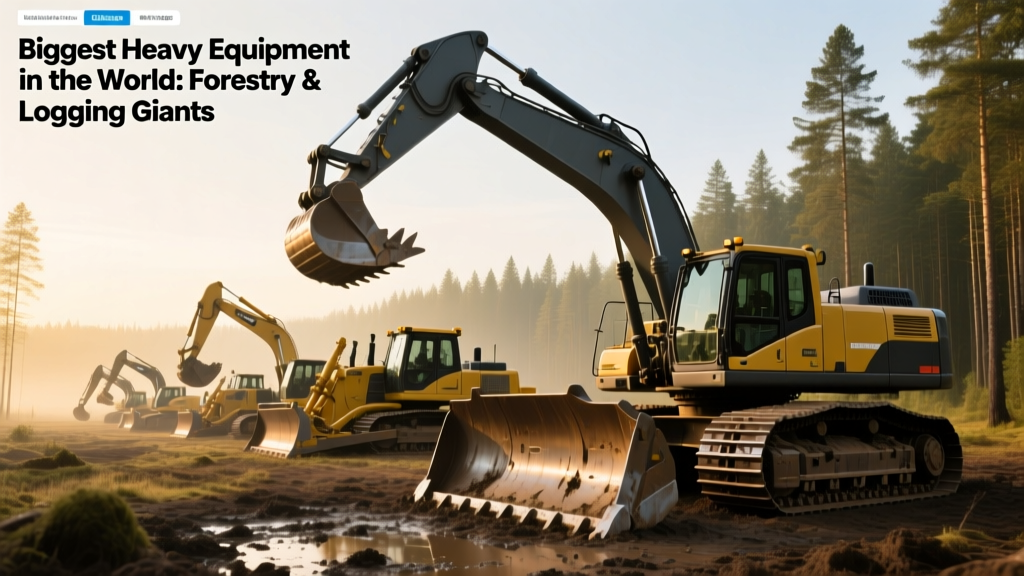
Biggest Heavy Equipment in the World: Forestry & Logging Giants
Explore the biggest heavy equipment in the world used in forestry. We analyze 2026 tech trends, massive harvesters, and steep-slope logging innovations.
Redefining the Biggest Heavy Equipment in the World: The Forestry Sector
When industry professionals discuss the biggest heavy equipment in the world, the conversation typically defaults to the 14,000-ton Bagger 288 bucket-wheel excavators in surface mining or the 400-ton payload Caterpillar 797F mining trucks. However, in the forestry and logging sector, "biggest" is not defined by sheer static mass. It is defined by the highest concentration of complex hydraulics, gyroscopic stabilization, and terrain-defying traction packed into a mobile, off-road chassis. Navigating 40-degree slopes, deep mud, and unpredictable debris requires a power-to-weight ratio and structural durability that dwarfs standard earthmoving machinery.
As of 2026, the largest logging machines have evolved from purely mechanical beasts into highly digitized, sensor-laden platforms. This guide dissects the absolute giants of the timber industry, examining their technical specifications, cutting-edge innovations, and the operational edge cases fleet managers must navigate.
The Titans of the Timber: 2026's Largest Logging Machines
Ponsse Scorpion King: The 8-Wheel Harvester Behemoth
The Ponsse Scorpion King represents the pinnacle of wheeled harvester design. Unlike standard 6-wheel or 8-wheel rigid frames, the Scorpion King utilizes a unique three-frame articulation system. This allows the massive 220 kW (295 hp) Mercedes-Benz engine and 14-tonne operating weight to maintain constant ground contact across highly uneven terrain. The machine features Meritor axles and an active frame locking mechanism that stabilizes the crane during heavy felling head operations. With a base price hovering around $920,000, it is engineered for high-yield clearcutting and large-diameter selective logging.
Tigercat 880D: The Massive Forwarder
Once the trees are felled, the timber must be extracted. The Tigercat 880D Forwarder is one of the largest and most capable extraction machines on the market. Generating 340 hp from its FPT engine, the 880D boasts a massive 20-tonne payload capacity. Its defining feature is the wide-track bogie system, which drastically reduces ground pressure (measured in PSI) to prevent soil compaction and rutting in wet, sensitive environments. Priced at approximately $850,000, the 880D utilizes Tigercat’s patented WideRange transmission, providing exceptional tractive effort at low speeds without the heat generation associated with traditional hydrostatic drives.
John Deere 953MH: Tracked Steep-Slope Feller Buncher
For extreme gradients where wheeled machines lose traction, the John Deere 953MH Tracked Harvester is the undisputed heavyweight. Weighing in at over 38,000 lbs and producing 286 hp, the 953MH features a fully leveling cab and upper structure. This gyroscopic leveling keeps the operator upright and the engine oil pans properly lubricated even when operating on 45-degree inclines. The machine is specifically designed to integrate with tethering winch systems, allowing it to operate safely on slopes that would cause a standard machine to roll over.
Giant Forestry Machine Specifications & Pricing Matrix
| Model | Machine Type | Gross Power | Operating Weight | Max Payload / Reach | 2026 Est. Base Price |
|---|---|---|---|---|---|
| Ponsse Scorpion King | Wheeled Harvester | 295 hp (220 kW) | 30,864 lbs (14,000 kg) | 27.9 ft (8.5 m) reach | $920,000 |
| Tigercat 880D | Wheeled Forwarder | 340 hp (254 kW) | 52,000 lbs (23,586 kg) | 20-tonne payload | $850,000 |
| John Deere 953MH | Tracked Harvester | 286 hp (213 kW) | 38,100 lbs (17,282 kg) | 32.5 ft (9.9 m) reach | $780,000 |
| Komatsu 931.1 | Wheeled Harvester | 280 hp (209 kW) | 33,500 lbs (15,195 kg) | 26.2 ft (8.0 m) reach | $815,000 |
Technology Trends Pushing Forestry Giants to the Limit
Intelligent Boom Control (IBC) and LiDAR Integration
The biggest heavy equipment in the world is now defined by its brain as much as its brawn. Modern harvesters utilize Intelligent Boom Control (IBC) systems that employ joint-angle sensors and hydraulic pressure transducers to automate the boom's path. Instead of manually controlling extension, lift, and swing simultaneously, the operator simply moves the joystick toward the target tree, and the machine calculates the most efficient hydraulic flow, preventing boom shock and reducing structural fatigue on the crane pillars.
Furthermore, 2026 models are increasingly integrating roof-mounted LiDAR arrays. These sensors map the stand density in real-time, allowing the onboard computer to calculate optimal felling directions and estimate timber volume before the chainsaw bar even touches the bark.
💡 Tech Insight: LiDAR occlusion remains a primary edge case. In heavy fog, dense snow, or extreme dust from dry summer clearcutting, the point cloud data degrades. Fleet managers must specify multi-sensor fusion packages (combining LiDAR with millimeter-wave radar) to ensure the automated measurement systems do not fail during adverse weather.Tethering and Winch-Assist Systems
Operating the largest tracked and wheeled machines on slopes exceeding 30% requires physical tethering. Heavy-duty winch systems, such as those manufactured by HAWE or Ecoforst, are anchored to the top of the slope and attached to the harvester. These systems use closed-loop hydraulic circuits to maintain constant tension on the steel cable, effectively reducing the machine's ground pressure and preventing soil shear. A complete tethering setup can add upwards of $150,000 to the capital expenditure of a logging fleet but is mandatory for compliance with modern occupational safety standards in steep-slope logging.
Operational Edge Cases and Failure Modes
Pushing heavy forestry machinery to its absolute limits introduces specific mechanical and hydraulic failure modes that standard maintenance schedules often miss.
- Hydraulic Shear Thinning: Feller heads cycle continuously, generating immense heat and shear stress in the hydraulic fluid. Using standard AW46 hydraulic fluid in a high-cycle Scorpion King will lead to rapid viscosity loss (shear thinning), resulting in cavitation in the feed roller motors. Synthetic, high-viscosity-index (VI) fluids are mandatory for 2026 high-yield operations.
- Undercarriage Sprocket Wear: On tracked units like the 953MH, operating in rocky, abrasive soil causes accelerated wear on the drive sprockets and track chain bushings. If track tension is not adjusted daily to account for mud packing in the idlers, the resulting over-tensioning will snap track links under peak tractive load.
- Feed Roller Slip: In winter logging, frozen bark and ice buildup on the harvester head feed rollers causes severe slip. This not only damages the timber but triggers false alarms in the machine's diameter-measuring sensors, corrupting the payload data sent to the mill.
Decision Framework: Selecting the Right Heavy Forestry Equipment
Choosing among the biggest heavy equipment in the world for your fleet requires matching the machine's physical architecture to your specific topographical and silvicultural constraints.
- If operating on flat to rolling terrain (0-20% slope) with high-volume clearcutting: Deploy the Ponsse Scorpion King or Komatsu 931.1. The 8-wheel and 6-wheel configurations offer superior travel speeds and lower ground compaction compared to tracked alternatives.
- If extracting timber over long distances in wet, sensitive soils: The Tigercat 880D Forwarder with wide-track bogies is the optimal choice. The 20-tonne payload reduces the number of passes required, minimizing the overall footprint on the forest floor.
- If harvesting on extreme gradients (30-45% slopes) or unstable scree: You must utilize a tracked, leveling-cab machine like the John Deere 953MH paired with a synchronized tethering winch. Wheeled machines will suffer from severe soil shear and rollover risks in these conditions.
The Bottom Line
The biggest heavy equipment in the world used in forestry represents a masterclass in mobile hydraulic engineering and spatial computing. By understanding the exact specifications, failure modes, and technological integrations of these giants, fleet managers can maximize uptime, ensure operator safety, and drive profitability in an increasingly demanding timber market.