Heavy Equipment Mover Bemis Heights: Snow Fleet Troubleshooting
Troubleshoot snow removal heavy equipment post-transit. Expert repair guides for wheel loaders, skid steers, and graders in freezing Bemis Heights winters.
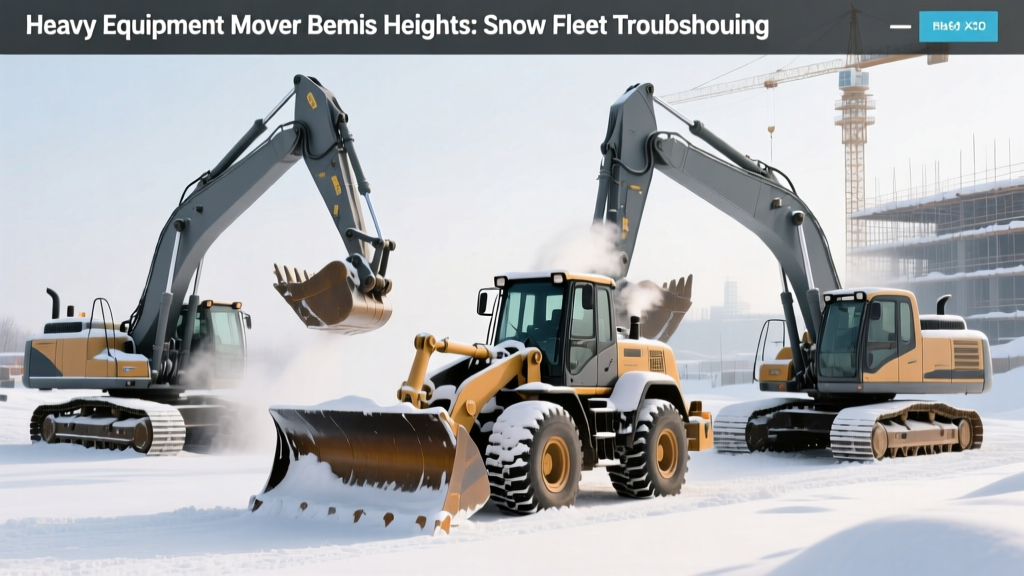
Operating a snow removal fleet in upstate New York requires machinery that can endure extreme thermal cycling, high-impact shock loads from frozen windrows, and prolonged idle times in sub-zero temperatures. When sourcing a heavy equipment mover, Bemis Heights municipal and private fleets face unique transit challenges, particularly when relocating machinery between staging yards during active winter storms. Post-transit diagnostics and cold-weather hydraulic troubleshooting are critical to preventing catastrophic component failure before the first snowplow hits the asphalt.
This guide provides advanced troubleshooting frameworks for the primary snow removal heavy equipment types—wheel loaders, skid steers, and motor graders—focusing on cold-soak recovery, hydraulic cavitation, and undercarriage ice-packing.
Post-Transit Diagnostics: The Cold-Soak Handoff
When a transport rig delivers your fleet after a long-distance haul, the machinery experiences 'cold-soak'—a state where the engine block, hydraulic reservoir, and gearboxes equalize with the ambient freezing air. Attempting to immediately engage PTO (Power Take-Off) units or snow pusher hydraulics can cause immediate seal blowouts.
WARNING: Cold-Start Hydraulic ShockNever dead-head a hydraulic cylinder on a snow pusher attachment immediately after a cold-soak. The NIOSH guidelines on cold stress and equipment safety note that operators rushing cold machinery account for 30% of early-season hydraulic hose ruptures. Always cycle the loader arms and bucket tilt through their full range of motion at 1,200 RPM for a minimum of 15 minutes to allow fluid friction to warm the reservoir.
Battery and Cranking Amp Deficits
Modern Tier 4 Final engines, such as the Cummins B6.7 found in many mid-sized wheel loaders, require immense cranking power to overcome thickened 5W-40 synthetic engine oil. If the engine cranks sluggishly post-transit:
- Test Voltage Drop: Measure across the battery cables under load. A drop exceeding 0.5V indicates corroded lugs, common after exposure to road salt spray during transport.
- Check CCA Ratings: Ensure replacement batteries meet the OEM minimum. For a Cat 966M wheel loader, you need dual batteries providing a combined minimum of 1,900 Cold Cranking Amps (CCA) at 0°F (-18°C).
Hydraulic System Failures in Sub-Zero Snow Pushing
Snow removal attachments, particularly heavy-duty box plows and snow pushers, place immense lateral and vertical stress on loader hydraulics. The most common failure mode in deep freezes is hydraulic pump cavitation, which sounds like a distinct 'whining' or 'gravel in the pump' noise.
Fluid Viscosity and Relief Valve Calibration
If your skid steer (e.g., Bobcat S86) or wheel loader exhibits slow, jerky cylinder movement when lifting a loaded snow pusher, the fluid viscosity is likely too high for the ambient temperature.
| Ambient Temp Range | Recommended Hydraulic Fluid | Common Failure Symptom |
|---|---|---|
| Above 32°F (0°C) | ISO VG 46 | Overheating during continuous plowing |
| 32°F to -10°F (0°C to -23°C) | ISO VG 32 | Pump cavitation, sluggish lift times |
| Below -10°F (-23°C) | Arctic Grade Synthetic (ISO 22) | Seal extrusion, suction hose collapse |
Troubleshooting Relief Valves: If the machine stalls when the snow pusher hits a frozen ice ridge, the main hydraulic relief valve may be set too low, causing continuous bypassing and rapid fluid degradation. For a standard Caterpillar 966M, the main implement relief valve should be calibrated to 4,060 psi (28,000 kPa). Connect a 6,000 psi flow meter to the implement pump test port, deadhead the cylinder, and adjust the main relief screw until pressure peaks precisely at the OEM spec.
Motor Grader Circle Drive & Moldboard Chatter
Motor graders like the John Deere 872 are essential for scraping hard-packed snow and ice down to the bare pavement. However, the circle drive mechanism—the gear that allows the moldboard to rotate—is highly susceptible to chatter and slip when subjected to the extreme friction of icy asphalt.
According to the Federal Highway Administration (FHWA) winter maintenance guidelines, maintaining bare pavement requires aggressive scraping angles, which exponentially increases torque load on the grader's circle drive. Improper lubrication leads to rapid gear tooth wear and irreversible circle deformation.
Troubleshooting Circle Slip and Chatter
If the moldboard violently chatters or the circle slips under heavy lateral loads:
- Inspect Wear Shoes: The replaceable bronze or polymer wear shoes between the circle and the drawbar must be shimmed to a maximum clearance of 0.040 inches (1 mm). Excessive clearance causes the blade to 'grab' and release, creating chatter.
- Grease Purge Protocol: Old, hardened grease mixed with road salt acts as a lapping compound on the circle gear teeth. You must manually purge the circle drive cavity with fresh NLGI #2 lithium-complex grease until clean grease is visibly expelled from all four quadrant seals.
- Check Pinion Torque: Verify the pinion gear mounting bolts. On heavy graders, these must be torqued to 450 lb-ft (610 Nm) using a calibrated hydraulic torque wrench. Loose pinions will strip the circle gear teeth under snow load.
Track Loader De-Tracking and Ice Packing
Track loaders (e.g., Cat 953K) offer superior traction in deep snow berms, but they introduce a unique troubleshooting headache: ice packing in the undercarriage. As wet snow melts against the warm undercarriage and subsequently freezes against the cold outer steel, solid ice blocks form inside the track links and sprockets.
Symptoms of Ice-Packed Undercarriages
- Track Sag Loss: The track appears overtightened, causing the front idler to lock or the track to de-track (roll off) during high-speed travel between snow dumps.
- Sprocket Damage: The sprocket teeth fail to seat into the track link bushings, resulting in 'track jumping' and severe wear to the sprocket flanks.
The Grease Valve Relief Fix
Never attempt to pry packed ice out from between the track links with a crowbar while the machine is running; this is a fatal crush hazard. Instead, utilize the track adjuster's grease relief valve.
Step-by-Step Adjustment:
1. Park the loader on a flat, cleared surface and lower the bucket.
2. Locate the track adjuster grease valve on the mainframe.
3. Loosen the relief valve exactly one-and-a-half turns.
4. Slowly drive the machine forward. The tension of the packed ice will naturally push the front idler backward, forcing the excess grease out of the relief valve.
5. Once the ice clears from the sprocket and idler, re-grease the adjuster to achieve the standard 1.5 to 2.0 inches (38 to 50 mm) of track sag measured between the front idler and the first carrier roller.
Summary: Proactive Fleet Readiness
Snow removal heavy equipment operates in some of the most unforgiving conditions on earth. By understanding the specific failure modes of cold-soaked hydraulics, circle drive torque limits, and undercarriage ice packing, fleet managers and operators can drastically reduce mid-storm downtime. Whether you are performing post-transit checks after utilizing a specialized transport service or diagnosing a stalled loader at 3:00 AM during a nor'easter, relying on exact OEM pressure specifications and proper fluid viscosities is the only way to ensure your fleet survives the winter.