Airport GSE Heavy Equipment Recliners: Technical Specs and Mechanics
Explore the technical specifications, pneumatic suspension mechanics, and ergonomic design of heavy equipment recliners used in airport ground support.
The Biomechanical Challenge of Airport Ramp Operations
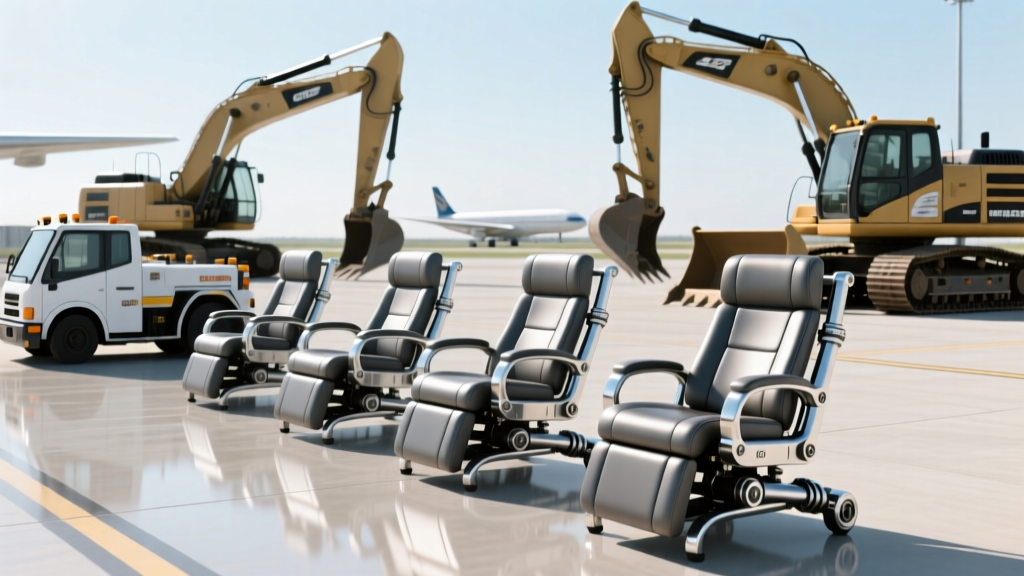
Airport ground support equipment (GSE) operators face a unique and punishing physical environment. Unlike highway construction or open-pit mining, the airport tarmac presents a complex vibration profile characterized by low-frequency concrete slab transitions, high-frequency jet blast debris impacts, and the severe torque variations of aircraft pushback maneuvers. To mitigate the resulting spinal compression and muscular fatigue, modern GSE cabins are equipped with specialized heavy equipment recliners. In industrial terminology, these are not static chairs, but highly engineered, multi-axis suspension seat assemblies with adjustable backrests, seat pan tilts, and dynamic damping systems.
The primary function of these heavy equipment recliners is to maintain the operator's line of sight during critical reverse-maneuvering (such as pushing a 400-ton wide-body aircraft) while isolating the lumbar spine from whole-body vibration (WBV). According to guidelines published by the CDC National Institute for Occupational Safety and Health (NIOSH), prolonged exposure to unmitigated WBV leads to severe musculoskeletal disorders. Advanced GSE seating addresses this through precise mechanical and pneumatic engineering.
DATA HIGHLIGHT: ISO 2631-1 Vibration LimitsUnder the ISO 2631-1 standard, the Seat Effective Amplitude Transmissibility (SEAT) value for heavy equipment recliners in GSE applications must remain below 0.70 to be classified as "vibration-attenuating." Premium active-suspension models deployed in 2026 push this SEAT value down to 0.45, effectively absorbing 55% of the tarmac's kinetic energy before it reaches the operator's pelvis.
Core Technical Specifications of GSE Recliners
The architecture of a heavy equipment recliner designed for airport ramp use differs significantly from standard earthmover seats. The specifications prioritize rearward visibility, rapid weight-adjustment, and extreme durability against jet fuel and de-icing fluid exposure.
| Specification Category | Standard Mechanical GSE Seat | Pneumatic Suspension Recliner | Active Electromagnetic Recliner |
|---|---|---|---|
| Weight Adjustment Range | Manual ratchet (50-120 kg) | Pneumatic auto-level (45-150 kg) | Sensor-driven dynamic (40-170 kg) |
| Backrest Recline Angle | 15° to 30° (Mechanical lock) | 15° to 45° (Gas-strut assisted) | 15° to 60° (Memory preset positions) |
| Seat Pan Tilt | Fixed | -8° to +4° manual adjustment | Auto-adjusting based on recline angle |
| Suspension Travel | 60 mm (Steel coil spring) | 110 mm (Air bellows) | 150 mm (Linear electromagnetic motor) |
| SEAT Value (Average) | 0.95 (Poor attenuation) | 0.65 (Good attenuation) | 0.42 (Excellent attenuation) |
| Estimated Unit Cost (2026) | $450 - $650 | $1,200 - $1,800 | $3,500 - $5,200 |
How Pneumatic and Active Suspension Mechanisms Work
The core of a heavy equipment recliner is its suspension base, which operates independently of the backrest recline mechanism. Understanding the interplay between these systems is critical for fleet managers and maintenance technicians.
The Scissor-Linkage and Air Spring Dynamics
Most premium GSE recliners utilize a pantograph (scissor) linkage system constructed from extruded aluminum or stamped high-carbon steel. When the operator sits, a mechanical leveling valve—connected to the cabin's onboard 12V or 24V air compressor—regulates airflow into the rubber air bellows (air springs).
- Inflation Phase: As weight is applied, the scissor arms compress. The leveling valve detects the drop in ride height and opens the air intake, inflating the bellows until the seat returns to the optimal mid-stroke position (typically 55mm of travel remaining in both directions).
- Damping Phase: Air springs alone would cause a harmonic bouncing effect. To counter this, a hydraulic shock absorber is mounted diagonally across the scissor linkage. Modern GSE seats feature adjustable damping valves that allow the operator to stiffen the ride for high-speed baggage tractor transit or soften it for low-speed, high-torque pushback operations.
Recline Synchronization and Gas-Strut Mechanics
When an operator engages the recline lever to look backward during an aircraft pushback, the center of gravity shifts rearward. In advanced heavy equipment recliners, the backrest recline is synchronized with the seat pan tilt via a mechanical cam or electronic sensor.
As the backrest tilts past 20 degrees, a high-pressure nitrogen gas strut pushes the front of the seat pan upward by 4 to 6 degrees. This prevents the operator from sliding forward (submarining) and maintains the optimal 95-degree lumbar-pelvic angle, reducing shear force on the L4 and L5 vertebrae. According to OSHA's ergonomics guidelines, maintaining neutral pelvic posture during extended static loading is the primary defense against chronic lower back degradation.
Application in Specific Ground Support Equipment
The specifications of heavy equipment recliners must be matched to the specific GSE platform. A one-size-fits-all approach results in rapid component failure and operator injury.
Aircraft Pushback Tractors (e.g., Goldhofer AST-1, Charlatte)
Pushback tractors generate immense low-frequency torque vibrations as they move aircraft weighing up to 600 metric tons. The operator frequently swivels or reclines the seat up to 45 degrees to monitor the nose gear and tow bar. Recliners in these units require heavy-duty scissor linkages rated for 3G dynamic loading and reinforced gas struts to prevent backrest collapse under sudden braking events. Active electromagnetic suspension is increasingly standard here, as it can anticipate torque spikes via the tractor's CAN bus system and pre-stiffen the suspension damping in milliseconds.
Belt Loaders and Cargo Conveyors
Belt loaders operate with high-frequency, low-amplitude vibrations caused by small-diameter solid rubber tires on uneven concrete aprons. The heavy equipment recliners used in belt loaders prioritize high-frequency isolation. Instead of large-travel air springs, these seats often utilize specialized elastomeric shear mounts combined with a mid-back recline mechanism that allows the operator to lean back while reaching for cargo controls, reducing shoulder and cervical strain.
⚠️ WARNING: De-Icing Fluid DegradationAirport ramp operations expose GSE to potassium acetate and glycol-based de-icing fluids. These chemicals rapidly degrade standard polyurethane seat foams and unprotected steel scissor rails. When specifying heavy equipment recliners for cold-climate airports, always mandate closed-cell vinyl upholstery with ultrasonic welded seams and zinc-nickel plated scissor linkages to prevent chemical corrosion and subsequent suspension seizure.
Calibration and Preventative Maintenance Protocols
Even the most advanced heavy equipment recliner will fail to protect the operator if maintenance is deferred. Fleet managers must implement strict preventative protocols tailored to the ramp environment.
- Air System Integrity (Monthly): Inspect the pneumatic leveling valve and air bellows for micro-cracks. A leaking air spring forces the onboard compressor to cycle continuously, leading to premature motor burnout. Apply a soapy water solution to the brass barbed fittings; replace any O-rings showing signs of flattening.
- Scissor Rail Lubrication (Bi-Weekly): The slide rails of the scissor mechanism must be lubricated with an NLGI #2 lithium-complex grease. Avoid liquid lubricants like WD-40, which attract tarmac grit and form an abrasive paste that accelerates rail wear and introduces high-frequency friction into the suspension travel.
- Gas Strut Pressure Testing (Annually): The backrest recline gas strut loses nitrogen pressure over time. If the backrest fails to hold a 30-degree recline angle when subjected to 15 kg of rearward pressure, the strut must be replaced. Do not attempt to recharge sealed industrial gas struts.
- SEAT Value Validation: As outlined by the International Air Transport Association (IATA) Ground Operations standards, modern GSE fleets should utilize telemetry to monitor operator health. Some 2026 active suspension seats feature built-in accelerometers that log daily vibration exposure; fleet managers should review this data to identify seats that require mechanical recalibration.
"The transition from passive mechanical springs to active electromagnetic damping in heavy equipment recliners represents the most significant leap in GSE operator safety over the last decade. By reading the tarmac profile 500 times per second, these seats eliminate the 'end-stop' impacts that historically caused the most severe spinal compression injuries on the ramp."
Specifying the correct heavy equipment recliners for airport ground support requires a rigorous understanding of both the biomechanical needs of the operator and the mechanical realities of the tarmac. By prioritizing low SEAT values, chemical-resistant materials, and synchronized recline mechanics, fleet operators can drastically reduce injury-related downtime and improve the precision of critical aircraft handling operations.