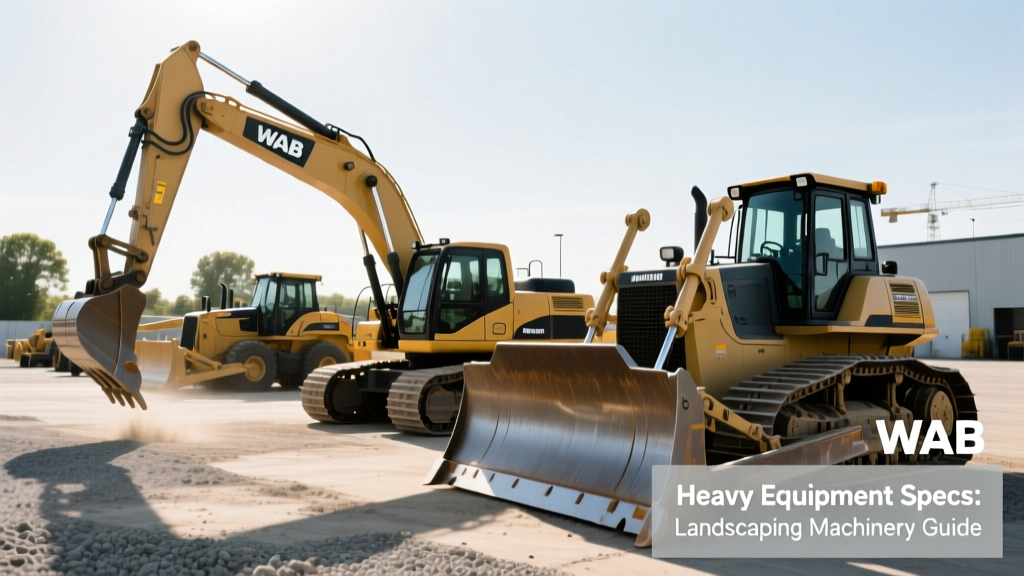
WAB Heavy Equipment Specs: Landscaping Machinery Guide
Explore technical specifications and hydraulic capabilities of WAB heavy equipment for landscaping. Compare mini excavators and articulated loaders.
Core Powertrain and Load-Sensing Hydraulics in Landscaping Machinery
When specifying WAB heavy equipment (Wheeled Articulated Backhoe and loader variants) for commercial landscaping, the primary differentiator between standard and high-production machines lies in the hydraulic architecture. Modern 2026 model year compact landscaping machines utilize load-sensing, variable-displacement axial piston pumps rather than fixed-displacement gear pumps. This technical shift allows the hydraulic system to deliver flow only when an attachment or steering function demands it, reducing parasitic engine load by up to 18% during idle or light-transport cycles.
In a typical 70 to 80 horsepower landscaping loader, the primary hydraulic circuit operates at a relief pressure of 3,500 PSI to 3,800 PSI. The load-sensing pump maintains a standby pressure margin (usually 200 to 250 PSI above the highest load circuit) to ensure instantaneous response when engaging hydraulic thumbs or brush cutters. For landscaping contractors, this translates to faster cycle times when switching between a grading bucket and a hydraulic auger without stalling the diesel engine.
Baseline 2026 Hydraulic Specifications (70-HP Class):- Pump Type: Variable-displacement axial piston
- Maximum System Pressure: 3,650 PSI (251 bar)
- Standard Auxiliary Flow: 22.5 GPM (85 L/min)
- High-Flow Option: 38.0 GPM (143 L/min) at 3,000 PSI
- Steering Circuit: Dedicated 11 GPM gear pump (priority valve equipped)
Machine Category 1: Compact Articulated Wheel Loaders
The core of the WAB heavy equipment category in landscaping is the compact articulated wheel loader. Unlike skid steers, which rely on differential steering that tears up turf and hardscapes, articulated loaders utilize a central pivot joint. This steering geometry yields a significantly lower ground disturbance footprint, making them mandatory for high-end residential landscaping and golf course maintenance where surface preservation is critical.
Breakout Force vs. Tipping Load: The Landscaping Metric
Procurement managers often mistake gross operating weight for lifting capacity. In landscaping, the critical metrics are full-turn tipping load and bucket breakout force. When lifting dense, wet topsoil or retaining wall blocks (which can weigh 60 to 80 lbs per cubic foot), the machine must maintain stability at maximum articulation. A 2026-spec compact articulated loader with an 8,500 lb operating weight typically delivers a full-turn tipping load of 4,200 lbs and a breakout force exceeding 9,500 lbs.
| Model Class (2026) | Engine Output | Full-Turn Tipping Load | Breakout Force | Est. Base Price (USD) |
|---|---|---|---|---|
| Giant V5003T (Tele) | 66 HP (Kubota V3307) | 5,070 lbs | 8,900 lbs | $82,500 |
| Bobcat L85 | 74 HP (Kubota V3307) | 4,620 lbs | 9,250 lbs | $78,000 |
| Kramer KL19.5 | 47 HP (Kubota V2403) | 3,630 lbs | 6,800 lbs | $64,000 |
Machine Category 2: Mini Excavators for Precision Grading
While WAB loaders handle bulk material transport, mini excavators in the 3 to 5 metric ton class execute precision grading, trenching for irrigation, and boulder placement. The technical specification that dictates a mini excavator's landscaping viability is swing torque combined with tail swing radius.
Swing torque is measured in pound-feet (lb-ft) and determines the machine's ability to start and stop a loaded bucket on a slope without drifting. For a 4-ton class excavator like the Kubota KX057-4, swing torque is rated at approximately 6,100 lb-ft. This is achieved via a dedicated axial piston swing motor paired with a planetary gear reduction drive. When placing 2,000 lb limestone boulders on an incline, insufficient swing torque results in load drift, compromising grading accuracy and safety.
“Zero-tail-swing (ZTS) excavators reduce rear counterweight overhang to within 2 inches of the track width. However, this design shifts the center of gravity forward, reducing the maximum lift capacity over the side by roughly 12% compared to conventional tail-swing models of the same weight class.”
— Equipment Engineering Guidelines, Association of Equipment Manufacturers (AEM)
Auxiliary Hydraulics: Sizing for Landscaping Attachments
The versatility of WAB heavy equipment relies entirely on auxiliary hydraulic circuits. Specifying the correct flow rate (GPM) and pressure (PSI) for attachments prevents cavitation, overheating, and premature motor failure. Landscaping attachments fall into three distinct hydraulic demand profiles:
- High-Flow / High-Pressure (30-40 GPM @ 3,500 PSI): Hydraulic brush cutters, forestry mulchers, and cold planers. These require a high-flow auxiliary package and a dedicated case drain line to prevent seal blowout in the attachment motor.
- Standard-Flow / High-Pressure (18-24 GPM @ 3,000 PSI): Hydraulic thumbs, tiltrotators, and breaker hammers. Standard auxiliary circuits are sufficient, but a pressure-relief valve must be calibrated to the attachment's specific limit.
- Standard-Flow / Low-Pressure (15-20 GPM @ 2,000 PSI): Earth augers and post-hole diggers. Exceeding 2,200 PSI on standard planetary auger drives will strip the ring gears.
Undercarriage Dynamics and Ground Pressure Calculations
In landscaping, minimizing soil compaction is vital for root zone health and turf recovery. The technical metric for this is Ground Pressure, measured in PSI. Rubber-tracked mini excavators and compact track loaders (CTLs) distribute the machine's weight across the track footprint.
To calculate ground pressure, divide the machine's operating weight by the total track contact area (track width × track length on the ground). For example, a 9,000 lb compact track loader with 18-inch wide tracks and 60 inches of ground contact length yields a footprint of 2,160 square inches (18 × 60 × 2 tracks). Dividing 9,000 lbs by 2,160 sq in results in a ground pressure of just 4.16 PSI. By comparison, a standard human foot exerts roughly 8 to 10 PSI. This technical specification allows heavy machinery to operate on saturated spring soils without causing deep rutting or subgrade failure.
Track Tensioning and Pitch Specifications
Maintaining correct track tension is critical for undercarriage longevity. Over-tensioning increases rolling resistance and accelerates idler wear, while under-tensioning leads to de-tracking during sidehill grading operations. For 2026 rubber-track models, the standard sag specification is measured by placing a straight edge across the top of the track rollers and measuring the gap to the track pad. The acceptable sag range is strictly between 0.75 inches and 1.25 inches (19mm to 32mm) at the midpoint. Track pitch (the distance between the center of two consecutive track links) must be monitored; a 10% increase in pitch indicates internal steel cord stretching, requiring immediate track replacement to prevent sprocket mismatch and drive motor damage.
Emissions Compliance and Fluid Specifications
All diesel-powered WAB heavy equipment operating in the United States must comply with EPA Tier 4 Final nonroad diesel standards. This requires the use of Diesel Exhaust Fluid (DEF) and advanced particulate filters. Landscaping fleets operating in high-dust environments must adhere to strict maintenance intervals for the engine air pre-cleaners and hydraulic breathers.
For the hydraulic reservoir, manufacturers specify ISO VG 46 or AW32 anti-wear hydraulic fluid, depending on the ambient operating temperature. In regions where winter landscaping and snow removal are performed, AW32 is mandatory to maintain proper viscosity and prevent pump cavitation at sub-zero startups. Hydraulic return filters must be replaced every 500 hours, and fluid sampling should be conducted annually to monitor for silicon (dust ingestion) and iron (pump wear) particulates.
For comprehensive safety protocols regarding operator visibility, rollover protection (ROPS), and falling object protection (FOPS) in landscaping environments, contractors must consult the NIOSH Landscaping and Horticulture Safety Guidelines and adhere to AEM operational safety standards. Proper specification and maintenance of these machines ensure maximum uptime, precise grading capabilities, and long-term asset viability.