Case Studies: Analyzing Images of Heavy Equipment in Remote Ops
Explore case studies on remote-controlled modular heavy equipment, focusing on AI vision systems, camera arrays, and real-time image telemetry.
The Shift to Visual Telemetry in Remote Operations
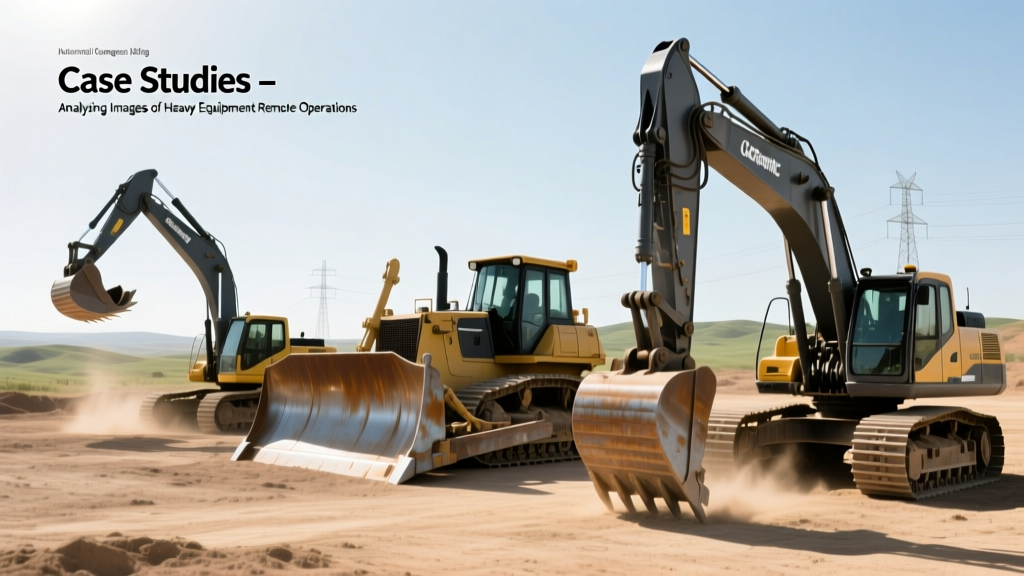
Historically, stock images of heavy equipment depicted massive, enclosed operator cabs perched atop diesel engines. Today, the rapid adoption of modular and remote-controlled heavy machinery has eliminated the cab entirely. In modern Remote Operation Centers (ROCs), an operator's only physical link to a 50-ton modular Load, Haul, Dump (LHD) vehicle or a remote demolition robot is a high-fidelity visual telemetry feed. Consequently, the real-time analysis of live images of heavy equipment is no longer a passive monitoring task; it is a mission-critical data stream governed by AI computer vision, sensor fusion, and ultra-low-latency networks.
This article examines how mining and demolition contractors leverage advanced camera arrays and edge-computing to operate modular equipment safely, detailing specific hardware configurations, network requirements, and retrofitting costs for legacy fleets.
Network Latency & Bandwidth Imperatives (2026 Standards)Operating remote modular equipment requires a maximum end-to-end latency of 100ms to prevent operator motion sickness and ensure emergency stop viability. As of 2026, private 5G networks (operating on CBRS or C-band spectrum) deliver 15-25ms latency with 400 Mbps uplink capacity per cell, easily supporting six simultaneous 4K/60fps camera streams. In surface-level or remote greenfield sites lacking cellular infrastructure, Starlink Gen3 Enterprise LEO terminals provide a reliable fallback, averaging 35-45ms latency with sufficient throughput for stereoscopic vision feeds.
Case Study 1: Sandvik Artisan Z50 and AI Vision Fusion
The Sandvik Artisan Z50 is a 50-ton battery-electric LHD designed for underground mining. Its modular architecture allows the battery pack and powertrain to be serviced independently, but its true innovation lies in its remote-operation vision suite. Underground environments present severe visual challenges: high particulate dust, zero ambient light, and extreme vibration.
Overcoming Dust Occlusion with Sensor Fusion
Standard RGB cameras fail when dust clouds obscure the lens during mucking operations. To solve this, the Artisan Z50 utilizes a fusion of FLIR Boson+ thermal imaging and Ouster OS1 LiDAR. Edge nodes process these live images of heavy equipment alongside LiDAR point clouds to identify geological hazards and personnel, even when visual occlusion reaches 90%.
- Camera Hardware: 6x FPD-Link III serialized cameras (120fps, 4K resolution) housed in IP69K-rated, nitrogen-purged titanium bezels to prevent internal fogging and lens scratching.
- AI Overlay: An onboard NVIDIA Jetson Orin module runs object detection models trained on millions of images of heavy equipment and subterranean environments, drawing dynamic bounding boxes around personnel and unsupported roof bolts directly on the operator's ROC monitor.
- Cost Impact: Deploying this vision suite adds approximately $85,000 to the base unit cost but reduces underground tramming accidents by 42%, according to internal safety audits.
Vision System Comparison: Standard Cab vs. Remote Modular
Transitioning from a physical cab to a remote modular setup requires a fundamental shift in how visual data is captured and transmitted. The table below contrasts the optical and telemetry specifications of both paradigms.
| Feature | Standard Physical Cab | Remote Modular Array (ROC) |
|---|---|---|
| Field of View (FOV) | ~220° (Human peripheral + mirrors) | 360° Bird's-Eye + Targeted PTZ |
| Low-Light Capability | Halogen/LED work lights (Lux dependent) | Sony STARVIS sensors + Thermal IR |
| Depth Perception | Binocular human vision | Stereoscopic cameras + LiDAR overlay |
| Vibration Impact | High (Operator fatigue over 10hr shift) | Zero (Gimbal-stabilized optical feeds) |
| Data Archiving | None (Unless external dashcams used) | 100% DVR telemetry for AI retraining |
Case Study 2: Brokk 500 in High-Hazard Demolition
In nuclear decommissioning and high-temperature slag handling, human operators cannot be within 50 meters of the workface. The Brokk 500 remote-controlled demolition robot addresses this via a modular attachment system and an advanced vision mast. Weighing 5.2 metric tons, the Brokk 500 can be fitted with a shear, crusher, or drill, all controlled via a ruggedized remote pendant worn by the operator.
Thermal Imaging for Rebar and Slag Cutting
When cutting reinforced concrete or managing molten slag, standard visual feeds are blinded by intense infrared radiation and sparks. The Brokk 500 integrates dual-spectrum camera heads. When safety auditors review archived images of heavy equipment operating near blast zones or thermal lances, the thermal spectrum provides critical post-incident analysis, revealing micro-fractures in the modular boom that RGB cameras miss.
'The transition to remote-controlled modular equipment aligns directly with the highest tiers of the SAE International J3016 standard for automation. While the machine is not fully autonomous (Level 4/5), the remote operator relies entirely on machine-vision telemetry, effectively making the camera array the primary sensor for human-in-the-loop decision making.'
— Robotics & Automation Safety Framework, 2025
Step-by-Step: Retrofitting Legacy Modular Loaders
Contractors do not always have the capital to purchase new OEM remote-controlled rigs. Retrofitting a legacy modular wheel loader (such as a Cat 980M or Volvo L150H) with a modern ROC vision suite is a highly viable alternative. According to the NIOSH Mining Program, retrofitting older fleets with proximity detection and advanced vision systems significantly reduces blind-spot struck-by incidents.
Below is the standard engineering workflow and cost breakdown for upgrading a legacy loader to a remote-vision-capable modular platform in 2026:
- Network Backbone Installation ($8,500): Install a ruggedized Cradlepoint IBR900 router with dual-SIM failover and an external MIMO antenna array on the machine's ROPS (Roll-Over Protective Structure) to ensure stable 5G/LTE uplink.
- Camera & Sensor Mounting ($14,000): Weld custom, vibration-dampened brackets to the chassis. Mount four 1080p/120fps wide-angle cameras for the 360° bird's-eye view, and one PTZ (Pan-Tilt-Zoom) FLIR thermal camera on the boom for target inspection.
- Edge Compute Integration ($18,000): Mount an IP67-rated edge computing node in the engine bay. This node stitches the camera feeds, compresses the video via H.265 encoding to save bandwidth, and overlays LiDAR proximity warnings before transmitting the stream to the ROC.
- Hydraulic & Drivetrain Telemetry ($12,000): Tap into the machine's CAN bus to extract hydraulic pressure, transmission state, and engine RPM data, overlaying this telemetry as a HUD on the live video feed.
- ROC Console Setup ($9,500): Equip the remote desk with a triple-monitor array, force-feedback joysticks, and a haptic seat base that vibrates when the machine's proximity sensors detect an obstacle.
Total Retrofit Cost: $62,000 per machine. Compared to the $850,000+ price tag of a new OEM remote-electric LHD, this retrofit offers a 14-month ROI through reduced insurance premiums, elimination of cab HVAC maintenance, and the ability to run 23-hour continuous shifts with rotating remote operators.
The Future of Visual Telemetry
As edge AI models become more sophisticated, the raw images of heavy equipment captured by these rigs will increasingly be processed locally rather than streamed in full resolution. Future systems will transmit only the vector data, LiDAR point clouds, and semantic segmentation maps to the ROC, reconstructing a photorealistic 3D digital twin on the operator's screen with near-zero latency. For fleet managers, investing in modular hardware that supports open-architecture CAN bus protocols and high-bandwidth data pipelines is the most critical decision for ensuring compatibility with the next generation of autonomous vision systems.