Heavy Equipment Lights: Ag vs Construction Safety Compliance
Compare heavy equipment lights compliance for agricultural tractors vs construction excavators. Covers ASABE, OSHA, SAE standards, and IP ratings.
The Regulatory Divide: Why Lighting Standards Diverge
Heavy equipment lights serve fundamentally different operational purposes depending on the machine's classification. While both agricultural tractors and construction excavators operate in harsh, off-road environments, their regulatory frameworks are entirely distinct. Agricultural machinery frequently transitions between private fields and public roadways, requiring strict adherence to transit visibility standards. Conversely, construction earthmovers remain confined to closed job sites, where lighting is governed by occupational safety and task-specific illumination metrics.
Agricultural Lighting Mandates: ASABE and DOT Overlap
Agricultural heavy equipment lights must satisfy a dual mandate: field productivity and roadway safety. The American Society of Agricultural and Biological Engineers (ASABE) sets the baseline for off-road ag lighting under standard S313.3, while the Department of Transportation (DOT) regulates any equipment that crosses public right-of-ways.
Roadway Transit vs. Field Operation
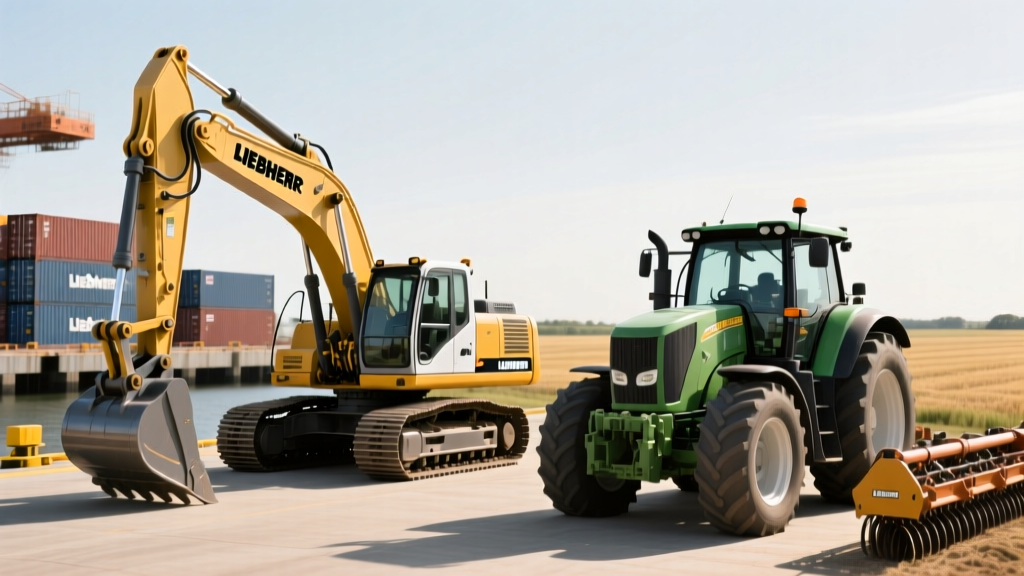
When a modern tractor, such as the John Deere 8R 410, travels on a highway, its lighting configuration must mimic commercial trucks. This includes DOT-approved headlamps, amber side markers, and red rear tail lights. However, when the machine enters a field, the operator engages the "field work" lighting circuit. This activates high-intensity discharge (HID) or LED flood lamps that are explicitly illegal for road use due to their blinding glare to oncoming traffic.
- SMV Emblems: Required on the rear of any ag equipment traveling under 25 mph. Must be mounted 2 to 8 feet above the ground and kept free of dirt.
- Amber Flashing Beacons: Minimum of two required on the cab roof for roadway transit to warn motorists of wide loads.
- Illumination Width: Headlights must illuminate the extreme left and right protrusions of the equipment (e.g., duals or wide fenders) at a distance of 50 feet.
According to OSHA Agricultural Operations guidelines, employers must also ensure that lighting on farm equipment is maintained to prevent accidents during low-light harvesting or nighttime grain cart operations, though public road transit remains the primary legal liability.
Construction Lighting Mandates: OSHA and SAE
Construction heavy equipment lights are regulated by the Occupational Safety and Health Administration (OSHA) and the SAE International standards body. Because excavators, bulldozers, and wheel loaders rarely use public roads under their own power, DOT compliance is secondary to job site safety and task visibility.
Task Illumination and Glare Control
Under OSHA Standard 1926.56, construction sites have strict foot-candle (fc) requirements. General construction areas require a minimum of 5 fc, while active excavation zones and tunnel work demand 10 fc to 30 fc depending on the hazard level. Equipment manufacturers design work lights to meet these metrics without creating dangerous glare for ground personnel.
For example, the Caterpillar 320 GC excavator features an LED work light package designed with asymmetric beam patterns. These lights cast intense illumination directly into the trench while utilizing physical shrouds to cut off upward light spill, protecting the operator of adjacent machinery and ground workers from temporary flash blindness.
Direct Comparison: Ag vs. Construction Lighting Specs
| Parameter | Agricultural (Tractors/Combines) | Construction (Excavators/Dozers) |
|---|---|---|
| Governing Body | ASABE, DOT, State Highway Patrol | OSHA, SAE, MSHA (if mining/quarry) |
| Primary Beam Pattern | Wide flood (field coverage) + Pencil beam (road) | Asymmetric flood (trench/workface focus) |
| Color Temperature | 5000K - 5500K (mimics daylight for crop color ID) | 6000K (high contrast for soil/rock edges) |
| Rear Warning | SMV Emblem, Red DOT tail lights, Amber flashers | Backup alarms, Rotating amber beacons |
| OEM Package Cost | $1,800 - $3,500 (Premium LED Packages) | $600 - $1,200 (Heavy Duty Work Light Arrays) |
Environmental Sealing: IP67 vs. IP69K
A critical divergence in heavy equipment lights is the Ingress Protection (IP) rating required for the machine's operating environment.
Construction Standard: IP67
Most construction equipment lights, such as those fitted to Komatsu PC210 excavators, are rated IP67. This guarantees total dust ingress protection and survival when submerged in up to 1 meter of water for 30 minutes. This is sufficient for muddy trenches, rain, and standard job-site hose downs.
Agricultural Standard: IP69K
Agricultural equipment faces a unique threat: high-pressure, high-temperature chemical washdowns. After harvesting, tractors and combines are frequently cleaned with pressure washers using degreasers and hot water to prevent the spread of weed seeds and crop diseases. Lights rated only to IP67 will quickly suffer from moisture intrusion and lens fogging under these conditions. Therefore, premium ag lighting (like the Hella LED work lamps used on Case IH Axial-Flow combines) utilizes IP69K sealing, which withstands close-range, high-pressure steam and water jets at temperatures up to 80°C (176°F).
The Aftermarket Compliance Trap
Fleet managers and owner-operators frequently attempt to upgrade aging halogen work lights with aftermarket LED light bars. This introduces severe compliance risks if the components are not matched to the machine's classification.
"Slapping a 50-inch, DOT-non-compliant off-road LED light bar onto a tractor's cab roof is one of the most common infractions we see. If that tractor turns onto a county road, the light bar will blind oncoming traffic, and the operator is subject to immediate citation and massive liability in the event of a collision."
— Midwest Ag Fleet Safety Auditor
Actionable Guidance: When retrofitting agricultural equipment, ensure any forward-facing LED pods carry a DOT/SAE J583 stamp for fog lamps or J581 for headlamps if they are to be used during road transit. For construction equipment, prioritize SAE J1383 off-road work light certifications and ensure the alternator output (e.g., upgrading from a 100A to a 150A alternator on a John Deere 750K dozer) can handle the amperage draw of the new LED arrays without draining the battery during idle-heavy operations.
Frequently Asked Questions (Compliance)
Can I use construction excavator work lights on my farm tractor?
Technically, you can wire them for field-only use, but it is highly discouraged. Construction lights typically lack the specific amber/red roadway transit markers required by ASABE S313.3 and DOT regulations. Furthermore, their 6000K color temperature is less ideal for agricultural tasks like identifying crop disease or moisture levels, which benefit from a 5000K CRI-optimized spectrum.
Do SMV emblems require their own lighting?
The standard fluorescent orange SMV triangle does not require internal illumination, but it must be retroreflective. However, if the tractor is wider than 8.5 feet or towing implements that obscure the SMV sign, a secondary, illuminated or retroreflective SMV emblem must be mounted on the extreme left rear of the towed implement.
What is the penalty for inadequate job site lighting on a construction project?
Under OSHA 1926.56, failing to provide adequate illumination (minimum 5 fc for general areas, 10 fc for active excavation) can result in a Serious citation. As of 2024/2025 enforcement adjustments, serious penalties can reach $16,131 per violation, and willful violations can exceed $161,000, not including civil liability if an accident occurs in a poorly lit trench.