Heavy Equipment Total Cost of Ownership Calculator for Haul Fleets
Learn how to build a heavy equipment total cost of ownership calculator tailored for lowboy trailers, multi-axle rigs, and oversize transport fleets.
Why Generic Fleet Calculators Fail in Heavy Transport
Standard over-the-road (OTR) freight calculators are fundamentally misaligned with the realities of heavy haul logistics. When fleet managers attempt to use generic software to estimate the expenses of moving 150,000-pound excavators or modular wind turbine components, the resulting projections routinely miss the mark by 25% to 40%. A true heavy equipment total cost of ownership calculator must account for the extreme mechanical stress, specialized compliance requirements, and unique depreciation curves inherent to the oversize load industry.
According to operational benchmarks tracked by the American Trucking Associations (ATA), the cost per mile for specialized heavy haul operations frequently exceeds $3.50, compared to the $1.80 to $2.20 average seen in standard dry van and flatbed operations. Building a customized financial model for your fleet requires isolating the variables that generic algorithms ignore.
The 60/40 Capital-to-Operating Shift
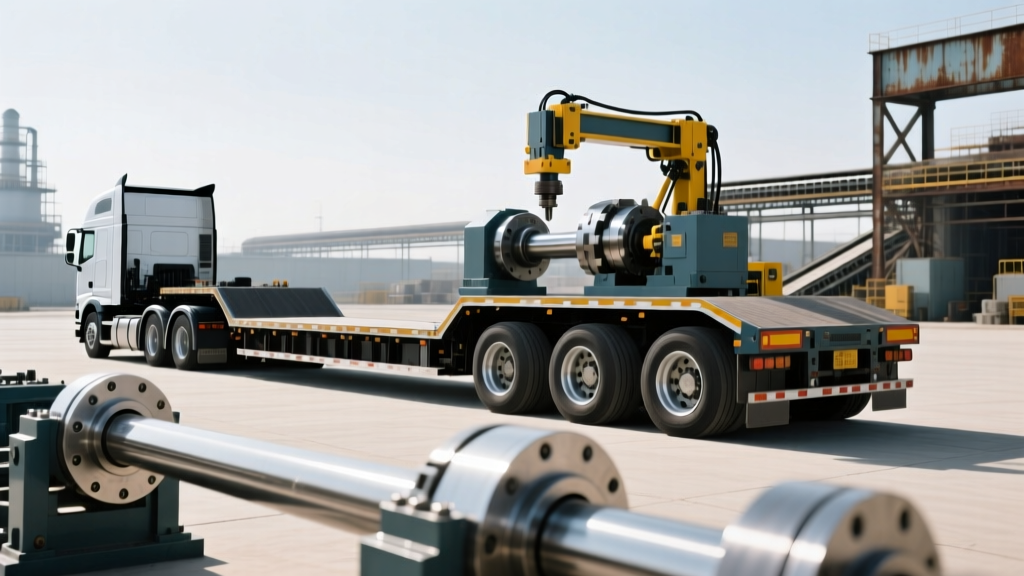
In standard trucking, operating costs (fuel, driver pay, maintenance) dwarf capital costs. In heavy haul transport, capital acquisition and specialized trailer depreciation account for nearly 40% of the total lifecycle cost. A multi-axle, hydraulically steered Goldhofer or Faymonville trailer can cost upwards of $450,000, radically altering your TCO formula compared to a $45,000 standard flatbed.
Core Inputs for Your Heavy Equipment Total Cost of Ownership Calculator
To build an accurate financial model, your calculator must ingest specific data points across four primary categories. Below is the architectural framework required for a heavy-haul-specific TCO tool.
1. Capital Acquisition and Depreciation Schedules
Heavy haul tractors (e.g., Kenworth W990 or Peterbilt 589 configured with 6x4 or 8x4 drivetrains and 605 HP engines) carry a premium. Furthermore, the IRS MACRS (Modified Accelerated Cost Recovery System) depreciation schedules differ: tractors generally fall under a 3-year or 5-year property class, while specialized heavy-duty trailers often fall under a 7-year class. Your calculator must map the purchase price against the expected residual value at year 5, which for niche modular trailers often remains higher than standard flatbeds due to lower production volumes and high replacement costs.
2. Variable Operating Costs Under Extreme Load
Fuel economy models must be dynamic. A heavy haul tractor pulling 180,000 lbs GCW (Gross Combination Weight) will see fuel efficiency drop to 3.2 to 4.1 MPG, compared to 6.5 MPG running empty. Your calculator must include:
- Diesel Fuel: Calculated at regional averages (e.g., $4.15/gallon) but weighted by load-specific MPG curves.
- DEF (Diesel Exhaust Fluid): Heavy engines under continuous high-load stress consume DEF at a ratio of roughly 3% to 5% of diesel consumption.
- Tire Scrubbing and Wear: Multi-axle trailers utilizing 17.5-inch R17.5 low-profile tires experience severe scrubbing during turns. Budget $450 per tire, but reduce the expected lifespan from 150,000 miles to 85,000 miles due to lateral friction.
Comparative TCO Breakdown: Standard Flatbed vs. 13-Axle Modular Lowboy
The following table illustrates the stark contrast in annualized TCO variables between a standard OTR flatbed operation and a specialized 13-axle heavy haul configuration. These figures represent annualized costs based on 60,000 miles for the flatbed and 35,000 miles for the heavy haul rig (reflecting slower transit times and route restrictions).
| Cost Category (Annualized) | Standard OTR Flatbed (80k GCW) | 13-Axle Modular Lowboy (180k GCW) |
|---|---|---|
| Capital Depreciation & Interest | $28,500 | $84,200 |
| Fuel & DEF | $62,000 | $58,500 (Lower miles, worse MPG) |
| Specialized Maintenance (Hydraulics/Axles) | $4,200 | $18,600 |
| Permits, Escorts, & Route Surveys | $1,500 | $34,000 |
| Insurance (Cargo & Liability) | $9,000 | $22,500 |
| Estimated Annual TCO (Excluding Driver Pay) | $105,200 | $217,800 |
The Compliance and Permitting Multiplier
The most frequently omitted variable in generic calculators is the compliance multiplier. Moving oversize and overweight loads requires a complex web of state and municipal approvals. Your heavy equipment total cost of ownership calculator must feature a dedicated module for permitting logistics.
State oversize permits typically range from $15 to $500 per jurisdiction, but the true cost lies in the ancillary requirements. Route surveys conducted by specialized engineering firms to verify bridge clearances and weight limits cost between $800 and $1,500 per corridor. Furthermore, pilot and escort vehicles are mandatory for loads exceeding 12 feet in width or 105 feet in length. Escort car services charge an average of $1.75 to $2.50 per mile, plus hotel and per diem expenses for multi-day hauls. If your calculator does not dynamically add $2.20/mile for escort services on oversize routes, your profit margins will evaporate before the load reaches the destination.
Maintenance Realities for Multi-Axle and Hydraulic Trailers
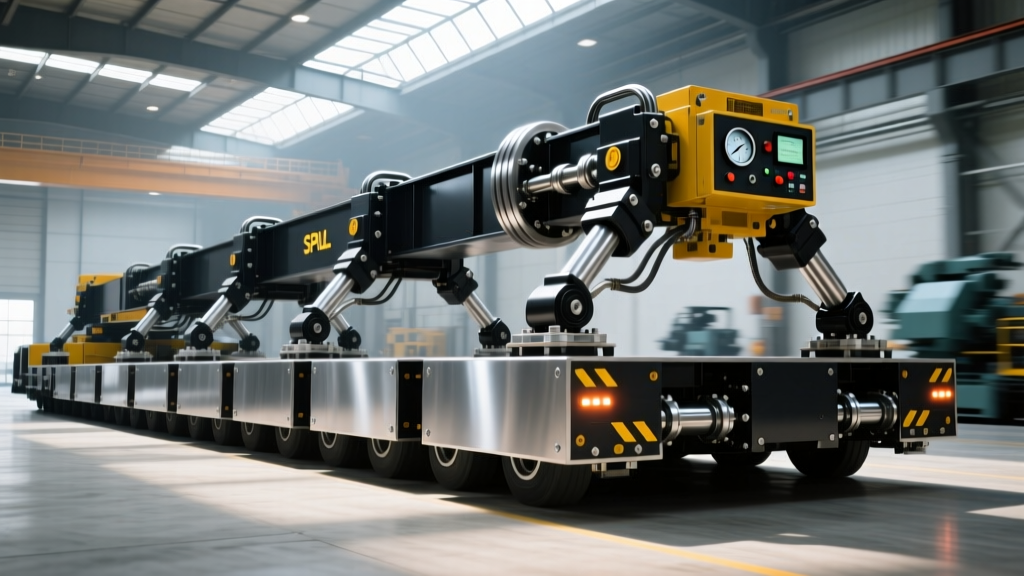
Heavy haul trailers are not passive steel structures; they are complex machines with independent steering, hydraulic suspension, and self-leveling capabilities. Maintenance budgets for a Scheuerle or Goldhofer modular trailer must account for:
- Hydraulic Fluid and Filtration: Bi-annual flushing of the hydraulic steering and suspension systems, utilizing specialized high-viscosity fluids (e.g., ISO VG 32 or 46) that cost upwards of $25 per gallon.
- Pendulum Axle Greasing: Unlike standard cam-and-bracket suspensions, pendulum axles require rigorous, high-volume greasing every 10,000 miles to prevent catastrophic bearing failure under 40,000-lb per-axle point loads.
- Hose and Fitting Degradation: Hydraulic hoses exposed to road debris and UV radiation have a functional lifespan of 3 to 5 years. Budget $3,500 annually for preventative hose replacement to avoid mid-transit suspension collapse.
"In heavy haul transport, a $40 hydraulic hose failure doesn't just cost $40 to fix. If it causes a suspension lock-up on a 160,000-pound load in a restricted corridor, the resulting crane rental, tow fees, and permit violations can easily trigger a $15,000 downtime event."
— Fleet Maintenance Director, Specialized Heavy Haul Division
Calculating Downtime and Revenue Leakage
Data published by the Federal Motor Carrier Safety Administration (FMCSA) highlights the severe impact of equipment failure on freight networks, but heavy haul downtime carries exponential penalties. When building your calculator, implement a 'Downtime Multiplier' formula.
Standard OTR downtime is calculated based on lost daily revenue (e.g., $800/day). In heavy haul, downtime must also include demurrage fees at the origin or destination site (often $250 to $500 per hour for delayed crane crews), expired permit renewal fees, and the cost of re-routing escort vehicles. Your calculator should include a risk-adjusted variable that adds 8% to 12% to the baseline TCO to serve as a financial buffer for complex, multi-day load delays.
Implementing Your Custom TCO Model
To operationalize this data, export your fleet's historical telematics, fuel receipts, and permit logs into a centralized spreadsheet or fleet management API. Map the specific GCW of your typical loads to the MPG curves provided by your OEM (e.g., Cummins or PACCAR). By replacing generic industry averages with the precise, high-stress variables outlined above, your heavy equipment total cost of ownership calculator will transition from a theoretical estimating tool into a definitive instrument for bidding on complex, multi-state heavy haul contracts.