Heavy Transport Equipment: Lowboy vs. Modular Trailers
Compare heavy transport equipment options. We analyze RGN lowboys, multi-axle modular trailers, and extendable flatbeds for heavy hauling logistics.
The Core Dilemma: Static vs. Dynamic Heavy Transport Equipment
Selecting the correct heavy transport equipment requires matching the cargo center of gravity, gross vehicle weight (GVW), and footprint to the trailer structural limits and route axle-weight restrictions. Fleet managers and logistics coordinators frequently default to standard Removable Gooseneck (RGN) lowboys out of familiarity. However, when payloads exceed 55 tons or feature extreme dimensional overhangs, relying on static-deck trailers leads to route failures, bridge permit rejections, and massive escort costs.
This analysis breaks down the engineering specifications, 2026 market pricing, and operational realities of the three primary heavy transport equipment categories: RGN lowboys, multi-axle modular trailers, and extendable double-drop flatbeds.
Quick-Reference Selection Matrix
| Equipment Type | Max Payload Capacity | Deck Height / Clearance | Primary Use Case |
|---|---|---|---|
| Standard RGN Lowboy (3-4 Axles) | 55 to 65 Tons | 24 - 29 inches (Static) | Excavators, standard CNC machinery, wheel loaders |
| Multi-Axle Modular (Hydraulic) | 100 to 500+ Tons | 12 - 40+ inches (Variable) | Power transformers, refinery vessels, bridge beams |
| Extendable Double-Drop Flatbed | 40 to 50 Tons | 24 - 36 inches (Static) | Horizontal boring machines, wind blades, long structural steel |
Removable Gooseneck (RGN) Lowboys: The 55-Ton Baseline
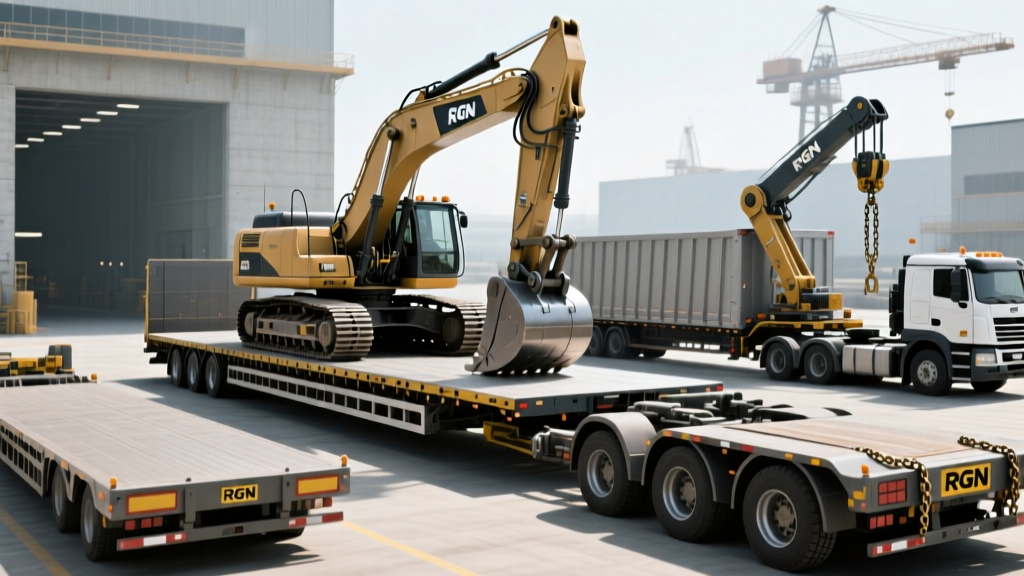
The RGN lowboy remains the foundational heavy transport equipment for mid-range oversized loads. The detachable gooseneck allows cargo to be driven or winched directly onto the main deck without the need for loading docks or heavy-duty ramps. The industry benchmark in this category is the Talbert 55SA-L or the Trail King TK70HP.
Engineering Specifications and Limits
- Well Length: Typically 24 to 29 feet. This restricts the transport of elongated machinery unless the unit features a flip-axle or spread-axle configuration.
- Deck Height: A standard 24-inch loaded deck height provides critical overhead clearance for tall equipment like forestry mulchers or large mining excavators, keeping the total rig height under the standard 13-foot 6-inch legal limit.
- Suspension: Air-ride or hydraulic point-loading. Air-ride is preferred for sensitive electronic manufacturing equipment to dampen high-frequency road vibrations.
Cons: Fixed deck height limits overhead clearance routing; strict weight distribution requirements; incapable of handling concentrated point-loads exceeding 65 tons without axle add-ons.
Multi-Axle Modular Trailers: Beyond 100 Tons
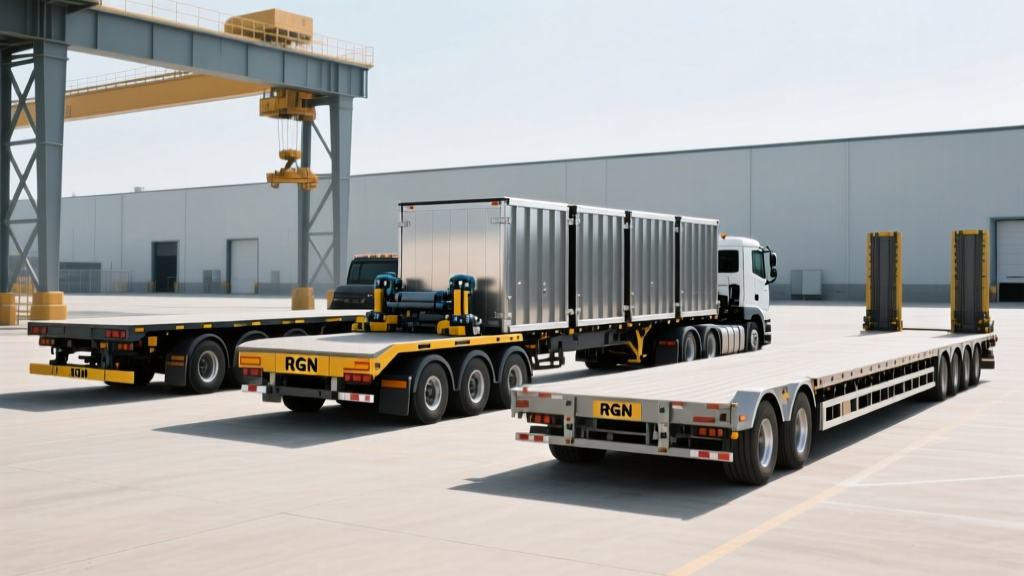
When payloads exceed the physical limits of a static steel beam deck, logistics teams must transition to multi-axle modular systems. Manufacturers like Goldhofer (PST/ES series) and Scheuerle (InterCombi) dominate this space. These systems do not use traditional leaf or air suspension; instead, they rely on hydraulic pendulum axles.
The Advantage of Hydraulic Pendulum Axles
Each axle line on a modular trailer features independent hydraulic cylinders that provide up to 12 inches of vertical stroke. This allows the operator to manually level the load when traversing uneven terrain or to raise the deck to clear railway crossings and steep approach angles. Furthermore, the pendulum steering mechanism allows for steering angles up to 60 degrees, drastically reducing the swept path radius in tight urban industrial zones.
"Routing a 200-ton power transformer requires more than just counting axles. The hydraulic stroke on a Goldhofer modular setup allows us to transfer weight dynamically across the bogie when crossing older municipal bridges, a physical impossibility with a rigid RGN lowboy."
— Heavy Haul Route Engineer, Specialized Carriers & Rigging Association (SC&RA) Guidelines
Extendable Double-Drop Flatbeds: Solving the Length Problem
Weight is only one axis of the heavy transport equipment equation; length is the other. For cargo like horizontal directional drilling (HDD) rigs, wind turbine blades, or extrusion presses, the footprint is too long for a standard 29-foot RGN well. Extendable double-drop flatbeds (often called 'stretch trailers') feature a telescoping main beam that can expand the well length from 29 feet up to 50 feet or more.
The trade-off for this length is structural deflection. As the beam extends, the concentrated load capacity drops significantly. A trailer rated for 55 tons when closed may only safely support 35 tons when fully extended, requiring precise load blocking and dunnage placement to prevent main beam buckling.
The Federal Bridge Formula and Permitting Realities
Purchasing heavy transport equipment without understanding the Federal Highway Administration Bridge Formula is a critical financial risk. The formula dictates that the maximum allowable weight on any group of axles is determined by the distance between them.
Warning: The Bridge Formula TrapAdding axles to a rigid RGN trailer does not linearly increase your legal payload. If the distance between the outermost axles is not sufficient, the bridge formula will cap your legal weight far below the trailer physical steel capacity. Modular trailers solve this by allowing operators to space axle groups using spacer bars or by utilizing the entire length of the tractor-trailer combination to maximize the 'L' (length) variable in the W=500[LN/(N-1) + 12N + 36] equation.
State-level freight size and weight regulations further complicate routing. While the federal baseline caps gross weights at 80,000 lbs without permits, oversize/overweight (OSOW) permits are issued at the state level. Moving a 120-ton load across four states requires four separate engineering reviews, often necessitating private utility companies to lift power lines along the route.
2026 Pricing and Total Cost of Ownership (TCO)
Capital expenditure for heavy transport equipment varies wildly based on modularity and hydraulic complexity. Below is a breakdown of current market pricing and operational TCO factors.
Capital Expenditure (CapEx)
- Standard 55-Ton RGN Lowboy: $115,000 to $145,000. Highly dependent on flip-axle additions and steel vs. aluminum wheel options.
- Extendable Double-Drop: $130,000 to $180,000. The telescoping beam mechanism and reinforced crossmembers drive up the base manufacturing cost.
- Modular Axle Lines (Goldhofer/Scheuerle):strong> Priced per axle line, typically $30,000 to $45,000 per line in 2026. A functional 8-line setup, complete with a heavy-duty gooseneck and power pack, easily exceeds $350,000.
Operational Expenditure (OpEx)
The hidden cost of heavy haul equipment lies in escort requirements. Loads exceeding 12 feet in width or 100,000 lbs require pilot cars. Loads exceeding 16 feet in width or 150,000 lbs often require state police escorts and private utility bucket trucks. A modular trailer setup moving a 300-ton refinery vessel can incur escort and route-survey costs exceeding $15,000 per day, dwarfing the fuel and maintenance costs of the tractor.
Final Selection Framework
Do not select heavy transport equipment based solely on the cargo weight. Use this three-step decision framework:
- Calculate the Point-Load PSI: If the cargo footprint is small but the weight is massive (e.g., a steel stamping press), a standard RGN deck will punch through the wood and steel. You must use a modular trailer with a specialized load-spreading turntable.
- Map the Overhead and Ground Clearances: If the route includes railway crossings with steep cambers, the static 24-inch deck of a lowboy will ground out. Specify a modular trailer with a minimum 10-inch hydraulic stroke.
- Run the Bridge Formula Simulation: Before ordering a new trailer configuration, input the exact axle spacings into a bridge formula calculator to ensure your desired payload is legally achievable in your primary operating states.