Heavy Equipment Hauling Methods: Flatbed vs Lowboy vs RGN Compared
Compare heavy equipment hauling methods including flatbed, step deck, lowboy, and RGN trailers. Discover costs, weight limits, and best use cases.
Strategic Trailer Selection for Heavy Equipment Hauling
Selecting the correct trailer configuration for heavy equipment hauling dictates your profit margin, transit safety, and legal compliance. Misjudging deck height by just four inches can result in a catastrophic bridge strike, while miscalculating axle weight distribution triggers overweight fines exceeding $10,000 per violation. In 2026, with fluctuating diesel prices and stricter state-level enforcement of the Federal Bridge Gross Weight Formula, matching the exact machinery profile to the optimal trailer type is a critical logistical competency.
This analysis breaks down the primary trailer configurations—flatbed, step deck, lowboy, and Removable Gooseneck (RGN)—detailing exact weight capacities, deck heights, current market rates, and specific equipment pairings.
Quick Decision Matrix:- Skid Steers & Mini Excavators: Standard Flatbed (48ft/53ft)
- Wheel Loaders & Backhoes: Step Deck (Drop Deck)
- Crawler Excavators & Dozers: 2-Axle Lowboy or RGN
- Mining Trucks & Crushers: Multi-Axle RGN with Jeep/Booster
Flatbed Trailers: The Baseline for Lighter Machinery
Standard flatbed trailers are the workhorses of the transport industry, featuring a continuous, level deck. While they offer the most versatility for general freight, their application in heavy equipment hauling is strictly limited by deck height and weight distribution.
Specifications and Limitations
- Deck Height: 54 to 60 inches from the ground.
- Maximum Payload: Approximately 48,000 lbs (depending on tractor weight and axle spread).
- 2026 Average Rate: $2.50 to $3.25 per mile.
The 60-inch deck height is the primary limiting factor. Loading a machine that is 8 feet tall onto a flatbed pushes the total height to 13 feet. While this remains under the standard 13-foot 6-inch legal height limit in most states, it leaves zero margin for error on routes with low-clearance overpasses or uneven road shoulders. Flatbeds are ideal for compact track loaders (e.g., Bobcat T770), skid steers, and mini excavators (e.g., Kubota KX040-4) where overall height is well under 8 feet.
Step Deck (Drop Deck) Trailers: Solving the Clearance Problem
When equipment exceeds the height limits of a standard flatbed, the step deck trailer provides a necessary drop. Featuring an upper deck (usually 10 feet long) and a lower deck (38 to 43 feet long), the step deck drops the cargo center of gravity and overall transit height.
Specifications and Limitations
- Lower Deck Height: 36 to 42 inches from the ground.
- Maximum Payload: Approximately 45,000 lbs (slightly reduced due to trailer weight and axle constraints).
- 2026 Average Rate: $3.00 to $3.75 per mile.
Step decks are the optimal choice for mid-sized wheel loaders (e.g., Caterpillar 926, John Deere 544L) and tractor-loader backhoes. The lower deck height provides an additional 18 to 24 inches of vertical clearance compared to a flatbed. However, the physical step creates a loading constraint; tracked machines with low ground clearance or long wheelbases risk bottoming out on the transition ramp unless specialized folding ramps or detachable goosenecks are utilized.
RGN and Lowboy Trailers: The Heavyweights
For true heavy equipment hauling, Removable Gooseneck (RGN) and fixed-neck lowboy trailers are mandatory. These trailers drop the deck height dramatically and allow for massive weight distribution across specialized axle configurations.
Removable Gooseneck (RGN) Advantages
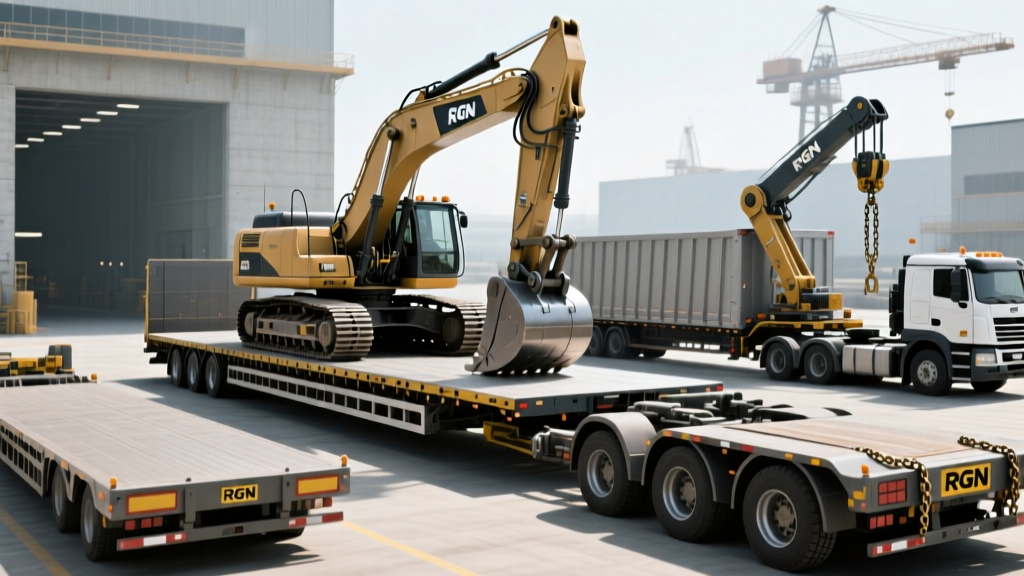
The RGN trailer detaches at the front, dropping the gooseneck to the ground to create a built-in ramp. This eliminates the need for heavy, dangerous folding ramps and allows tracked machines to drive directly onto the main deck. This drive-on capability is critical for heavy crawler excavators (e.g., Cat 330, Komatsu PC210LC) and large bulldozers where climbing steep ramp angles could cause track slip or transmission damage.
Lowboy and Axle Configurations
A standard 2-axle lowboy or RGN typically handles payloads up to 40,000–42,000 lbs. However, the true power of the RGN lies in its modularity. By adding a jeep axle (between the tractor and trailer) and a booster axle (at the rear), haulers can legally scale up to 120,000+ lbs. This modular configuration is required for hauling heavy mining equipment, such as the Cat 777 off-highway truck, or large stationary rock crushers.
| Trailer Type | Deck Height | Max Payload (Base) | Avg. Rate/Mile | Best Equipment Match |
|---|---|---|---|---|
| Standard Flatbed | 54" - 60" | 48,000 lbs | $2.50 - $3.25 | Skid steers, trenchers |
| Step Deck | 36" - 42" | 45,000 lbs | $3.00 - $3.75 | Wheel loaders, backhoes |
| 2-Axle RGN / Lowboy | 18" - 24" | 42,000 lbs | $4.00 - $5.50 | Crawler excavators, dozers |
| Multi-Axle RGN | 18" - 24" | 120,000+ lbs | $6.00 - $8.50+ | Mining trucks, crushers |
Axle Configurations and Bridge Law Compliance
Payload capacity in heavy equipment hauling is rarely limited by the trailer's structural steel; it is limited by the Federal Bridge Gross Weight Formula. This regulation dictates that the maximum allowable weight on a group of axles is determined by the distance between the outermost axles.
For example, hauling a 95,000 lb Caterpillar D8 dozer on a standard 2-axle RGN will severely overload the tractor drive axles and the trailer's rear tandem, regardless of the trailer's 100,000 lb structural rating. To legalize this load, the hauler must deploy a 3-axle jeep and a 2-axle booster, extending the wheelbase and distributing the 95,000 lbs across 10+ axles to satisfy the bridge formula. Failing to calculate this prior to dispatch results in forced offloading at the scale and massive delay penalties.
The Hidden Costs: Permits, Escorts, and Route Surveys
When equipment dimensions exceed standard legal limits—typically 8 feet 6 inches wide, 13 feet 6 inches high, or 80,000 lbs Gross Vehicle Weight (GVW)—the load transitions into the oversize/overweight (OSOW) category. The base hauling rate is only a fraction of the total project cost.
Permitting and Escort Pricing
- State Permits: Range from $15 for a simple single-state overweight permit to $250+ for multi-state superload routing.
- Escort Vehicles: Loads exceeding 12 feet in width or 14 feet in height typically require at least one escort car. Escort rates average $1.50 to $2.50 per mile, plus fuel surcharges and hotel layovers if the transit takes multiple days.
- High-Pole Route Surveys: For loads exceeding 15 feet 6 inches in height, utility companies require a high-pole truck to run the route in advance, identifying and temporarily raising low-hanging power lines. This service costs between $500 and $1,500 per day.
Cargo Securement: Avoiding 49 CFR Part 393 Violations
Securing heavy machinery requires strict adherence to the FMCSA cargo securement rules under 49 CFR Part 393. The days of simply throwing a few ratchet straps over a backhoe bucket are over; DOT inspectors actively target heavy haulers for securement violations.
Critical Securement Rule: Equipment weighing over 10,000 lbs requires a minimum of four direct tie-downs. Furthermore, the aggregate working load limit (WLL) of all tie-downs must equal at least 50% of the equipment's total weight.Chain vs. Strap Selection
For heavy equipment hauling, Grade 70 and Grade 100 transport chains with grab hooks and binders are the industry standard. While heavy-duty polyester winch straps (rated up to 20,000 lbs WLL) are acceptable for lighter, smooth-surfaced machinery, they are highly susceptible to abrasion and cutting from the sharp grousers of tracked excavators or the jagged edges of crusher frames. Always use edge protectors if straps are utilized, and never secure a machine solely by its hydraulic cylinders or buckets, as hydraulic pressure loss during transit can cause the attachment to drop, releasing tension on the tie-downs and creating a catastrophic shift risk.
Frequently Asked Questions
Can I haul a 50,000 lb excavator on a step deck trailer?
Technically, a step deck's weight limit might hover around 45,000 to 48,000 lbs depending on the specific trailer's axle rating and the tractor's weight. However, a 50,000 lb excavator will almost certainly push the Gross Vehicle Weight (GVW) over the legal 80,000 lb limit without specialized permits. Furthermore, the track height and ground clearance of a 50,000 lb machine (like a Cat 336) make loading onto a step deck ramp physically dangerous. An RGN is the required choice.
Who pays for the oversize permits and escort cars?
In standard heavy equipment hauling contracts, the logistics provider or carrier fronts the cost for permits and escorts, but these are passed directly to the shipper as line-item accessorial charges on the final invoice. Always request a fully itemized quote that separates the base linehaul rate from OSOW accessorial fees to avoid billing disputes.
What happens if my load shifts during transit?
Load shifting is the primary cause of heavy haul rollovers. If an inspector finds a shifted load, the truck will be placed Out-of-Service (OOS) immediately. The carrier must dispatch a service truck with a winch or crane to re-secure or reposition the machinery on the side of the highway, resulting in thousands of dollars in recovery fees, missed delivery windows, and severe CSA (Compliance, Safety, Accountability) score penalties for the carrier.