Army Heavy Equipment Transporter Deployments: M1070A1 Case Studies
Explore army heavy equipment transporter logistics through M1070A1 HET case studies, payload specs, and tactical deployment strategies for armor.
The Backbone of Armored Mobility: M1070A1 HET System Overview
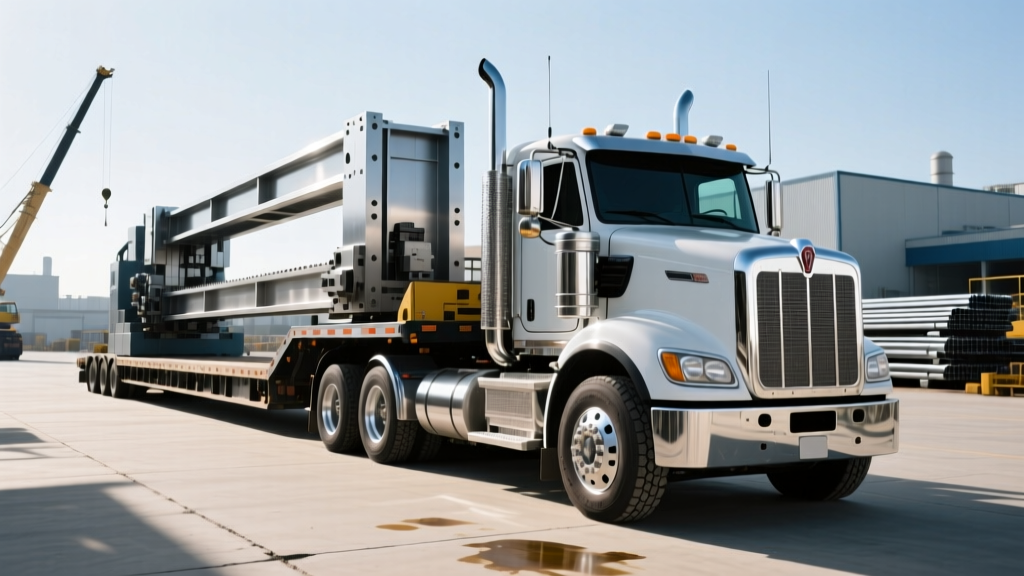
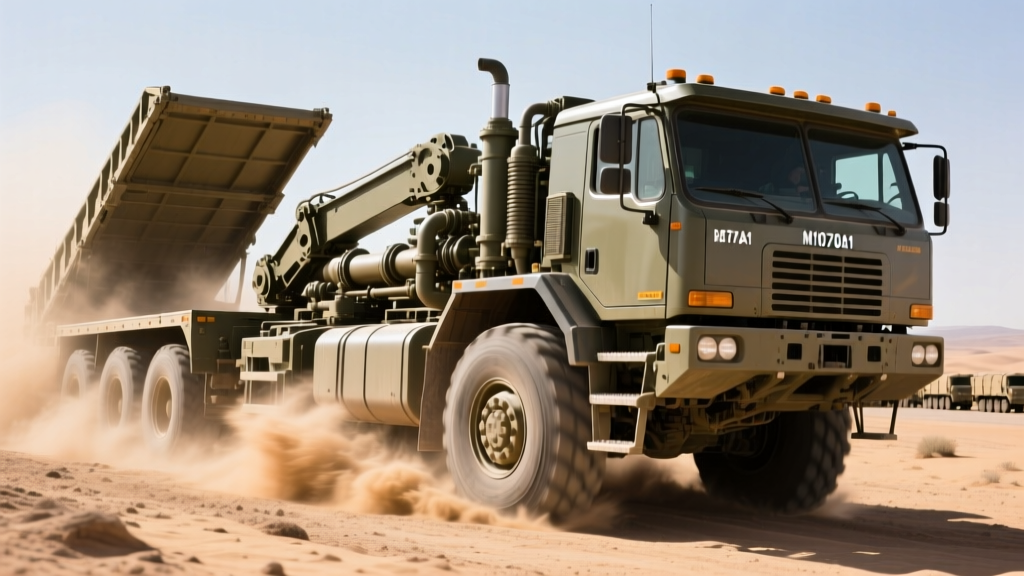
The tactical mobility of armored brigade combat teams (ABCTs) relies entirely on the ability to move 70-ton main battle tanks without degrading their combat readiness. Self-deploying an M1A2 SEPv3 Abrams tank over long distances destroys track pads, overheats the AGT-1500 gas turbine engine, and causes unnecessary wear on final drives. To solve this, the U.S. Army utilizes the Heavy Equipment Transporter (HET) system, specifically the Oshkosh M1070A1 tractor paired with the M1000 semi-trailer. This combination is the definitive army heavy equipment transporter for inter-theater and intra-theater logistics.
M1070A1 & M1000 Technical Specifications
- Tractor Engine: Caterpillar C18, 18.1L inline-6, producing 700 hp at 2,100 rpm.
- Transmission: Allison HD 4076 PR automatic with integrated torque converter.
- Trailer Axles: 5 axles with hydraulic pendulum suspension (40 tires total).
- Max Payload: 80 tons (160,000 lbs) for the M1000 trailer.
- Winch Capacity: Two 55,000-lb hydraulic winches for self-recovery and disabled vehicle loading.
Case Study 1: European Deterrence Initiative (EDI) Intermodal Logistics
During recent EDI rotations, moving ABCT assets from the port of Bremerhaven, Germany, to forward operating bases in Poland requires a complex intermodal shift. While the initial 800-mile transit is handled by military rail, the final 150-mile push to dispersed training areas requires the army heavy equipment transporter fleet.
The 'Last Mile' Highway Constraint
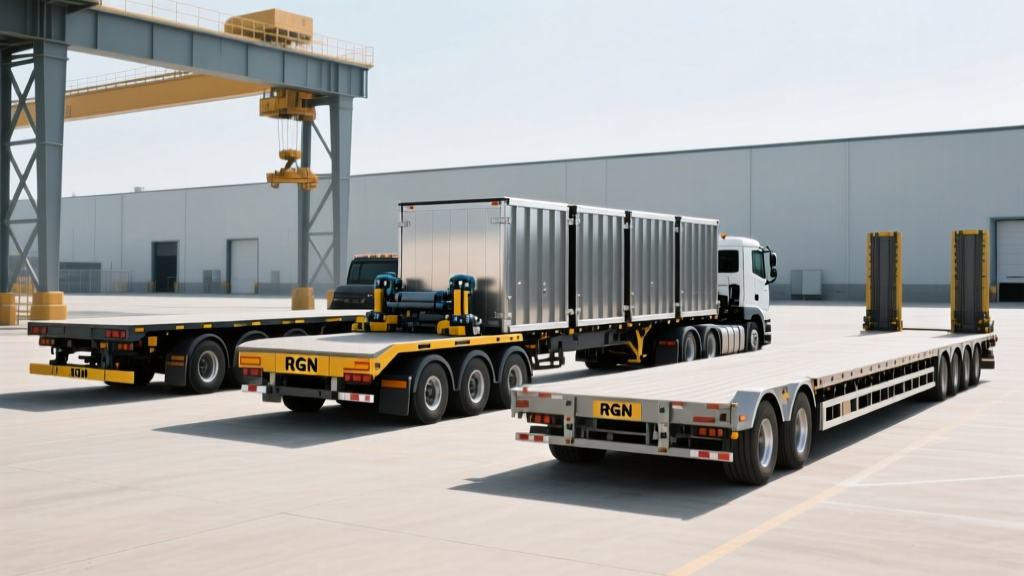
European highway infrastructure presents unique challenges for the M1000 trailer. Unlike U.S. Interstate highways, many secondary Polish and German roads feature weight-restricted bridges and tight roundabouts. The M1000 trailer utilizes a hydraulic pendulum axle system that allows the deck height to be adjusted from 41 inches down to 21 inches. Lowering the deck reduces the center of gravity and clears low overpasses, but it drastically increases the scrub radius during tight turns, requiring convoy commanders to pre-plan routes that avoid roundabouts with center islands.
| Metric | Civilian 8-Axle Lowboy | Military M1070A1 + M1000 |
|---|---|---|
| Deck Width | 102 inches (Max DOT) | 120 inches (10 feet) |
| Bridge Formula Exemption | None (Strict adherence) | Tactical convoy exemption |
| Tie-Down Standard | FMCSA Grade 70 Chain | Military spec 1/2' chain + D-rings |
| Turning Radius | ~45 feet | ~52 feet (requires steering axle) |
Case Study 2: C-17 Globemaster III Airlift Integration Constraints
A common misconception in defense logistics is that the M1070A1 HET can be driven directly into a C-17 Globemaster III with an Abrams tank loaded on the back. Analyzing the physical dimensions reveals why this is operationally impossible and how the army heavy equipment transporter is actually utilized in strategic airlift scenarios.
Dimensional Conflict Warning: The C-17 cargo floor is 180 inches wide. The M1A2 Abrams is 144 inches wide over the tracks and skirts. The M1000 trailer deck is 120 inches wide. Because the tank overhangs the trailer by 12 inches on each side, the total width remains 144 inches. However, the M1000 trailer's wheel hubs and hydraulic lines extend outward, and the C-17's internal sidewall width narrows to 162 inches above the floor. Loading a tank on an M1000 trailer into a C-17 will result in severe structural damage to the aircraft sidewalls.Instead, for strategic airlift, Abrams tanks are driven directly onto the C-17 cargo floor using specialized shoring and tied down using aircraft-specific 10,000-lb tension straps anchored to the floor grid. The M1070A1 HETs are flown on separate sorties or pre-positioned via sealift to the destination airfield to receive the tanks as they drive off the aircraft ramp.
Maintenance & Failure Modes in Theater
Operating a 160,000-lb payload in extreme environments exposes specific failure modes in the HET fleet. Maintenance crews supporting ABCT deployments must monitor three critical systems:
- Hydraulic Pendulum Axle Seals: During winter EDI rotations in sub-zero temperatures, standard MIL-PRF-5606 hydraulic fluid thickens, causing cavitation in the pendulum axle pumps when adjusting deck height. Units must flush and replace with synthetic MIL-PRF-83282 fluid, which maintains viscosity down to -40°F.
- Caterpillar C18 Particulate Filters: In desert environments (e.g., NTC rotations at Fort Irwin), the C18 engine's air intake ingests fine silica dust. If the primary cyclonic pre-cleaners are not dumped every 12 hours, the engine will derate to 400 hp, making it impossible to pull an 80-ton load up a 6% grade.
- Winch Cable Degradation: The 55,000-lb hydraulic winches use 1-inch wire rope. Under heavy tension during disabled vehicle recovery, the core of the wire rope can fail internally without visible outer strand breakage. Magnetic rope testing (MRT) is required every 180 days of active deployment.
Tactical Decision Matrix: When to Deploy the HET
Logistics officers use a specific framework to determine when to commit the army heavy equipment transporter versus alternative movement methods:
- Distance < 50 miles: Self-deployment (driving the tank) if road surfaces are reinforced and traffic control is established. Saves HET fuel and driver fatigue.
- Distance 50 - 300 miles: Mandatory HET transport. Self-deployment beyond 50 miles causes unacceptable track pad wear (replacing a full set of M1A2 track pads costs over $45,000 and requires 40 maintenance man-hours).
- Distance > 300 miles: Intermodal rail transport. HETs are only used for the railhead-to-base 'last mile' transit.
Regulatory Exemptions and Civilian Interface
When military convoys operate on public highways, they are generally subject to state and federal weight limits. However, the Federal Bridge Gross Weight Formula (Bridge Law) is frequently bypassed for tactical movements under specific U.S. Army Transportation Corps directives and state-issued emergency or military convoy permits. The M1070A1 tractor and M1000 trailer combination often exceeds 200,000 lbs Gross Combination Weight Rating (GCWR), which is illegal for civilian heavy haulers without specialized multi-axle modular trailers. Military convoys mitigate bridge damage by maintaining strict 50-foot following distances between loaded HETs, ensuring dynamic load resonance does not compound on bridge spans.
For civilian heavy haul contractors looking to understand military logistics standards, studying the M1070A1's powertrain and suspension geometry provides a masterclass in extreme-load engineering. The integration of automated torque-converter transmissions with hydraulic load-leveling remains the gold standard for moving concentrated, high-center-of-gravity cargo over unpredictable terrain. Further analysis of strategic mobility and defense logistics frameworks can be found via the RAND Corporation's military transportation research, which frequently evaluates the cost-benefit ratios of the HET fleet against commercial heavy haul alternatives.