Heavy Equipment Trailer Loading: Operator Training & Safety Guide
Master heavy equipment trailer loading with our operator training guide. Learn weight distribution, tie-down specs, and DOT compliance best practices.
The Physics and Protocol of Heavy Equipment Trailer Loading
Operating a multi-axle heavy equipment trailer requires more than a commercial driver's license; it demands a rigorous understanding of physics, material science, and federal regulations. When transporting a 95,000-pound Caterpillar 336 excavator or a John Deere 850LC dozer, a miscalculated center of gravity or an under-specified tie-down can result in catastrophic cargo shifts, bridge law violations, or fatal highway incidents. This operator training guide details the exact specifications, mathematical requirements, and step-by-step procedures for safely loading and securing heavy machinery.
CRITICAL SAFETY ALERT: According to the Commercial Vehicle Safety Alliance (CVSA), cargo securement violations consistently rank in the top three reasons for out-of-service (OOS) orders during North American Standard Inspections. A single missing or defective tie-down can ground your rig immediately.Pre-Trip Inspection: The 14-Point Trailer Checklist
Before the equipment even approaches the ramp, operators must verify the structural and mechanical integrity of the trailer. Do not rely on a generic walk-around; heavy haul demands specific tolerances.
- Kingpin and Fifth Wheel: Inspect for hairline cracks. Ensure the locking jaw is fully closed around the kingpin and the secondary safety latch is engaged.
- Landing Gear: When loaded, landing gear must maintain a minimum 2-inch clearance from the ground to prevent dragging on uneven transitions.
- Air Brake Chambers: Check pushrod stroke. For standard Type 30 chambers, the maximum allowable stroke is 2.0 inches. Anything exceeding 1.75 inches requires immediate adjustment before departure.
- Suspension and U-Bolts: Check for shifted axles. Measure the distance from the kingpin to the center of the front and rear trailer axles on both sides; a variance greater than 1/8 inch indicates a broken leaf spring or shifted torque rod.
- Hydraulic Lines (RGN/Lowboy): Inspect quick-disconnect fittings for weeping fluid. A slow leak will cause the trailer neck to drop during transit.
Weight Distribution and Axle Scaling
Improper weight distribution on a heavy equipment trailer is the leading cause of blown steer tires and drive axle overloads. The Federal Bridge Gross Weight Formula dictates that the maximum allowable weight on a tandem axle is 34,000 pounds, and the steer axle is typically capped at 12,000 to 14,600 pounds depending on tire ratings.
| Axle Group | Target Weight Range | Maximum Legal Limit (Standard) | Adjustment Method |
|---|---|---|---|
| Steer Axle | 11,500 - 12,350 lbs | 12,000 lbs (varies by tire rating) | Slide tractor fifth wheel |
| Drive Axles (Tandem) | 33,000 - 33,800 lbs | 34,000 lbs | Slide tractor tandems |
| Trailer Axles | 33,000 - 33,800 lbs | 34,000 lbs (per tandem group) | Reposition equipment on deck |
Operator Best Practice: Always load the heaviest part of the machine (usually the engine block or counterweight) directly over the trailer's rear axles or slightly forward of the center point on a spread-axle configuration. Use the trailer's deck markings—often painted every 12 inches—to align the machine's tracks or wheels symmetrically.
Securement Protocols: Chains, Binders, and Angles
The Federal Motor Carrier Safety Administration (FMCSA) mandates that the aggregate Working Load Limit (WLL) of all tie-downs must equal at least 50% of the cargo's total weight. This is where many operators fail the math.
Calculating Aggregate WLL
If you are hauling a 60,000-pound excavator, your tie-downs must provide a minimum aggregate WLL of 30,000 pounds. Let us break down the hardware specifications:
| Chain Size & Grade | WLL per Chain | Chains Required for 60k lb Machine | Total Aggregate WLL |
|---|---|---|---|
| 5/16" Grade 70 | 4,700 lbs | 7 chains | 32,900 lbs |
| 3/8" Grade 70 | 6,600 lbs | 5 chains | 33,000 lbs |
| 1/2" Grade 100 | 15,000 lbs | 2 chains (minimum 4 for stability) | 60,000 lbs (with 4) |
While four 3/8" Grade 70 chains technically meet the 50% WLL requirement (26,400 lbs is close, but actually falls short of 30,000 lbs—you would need five), best practice dictates using a minimum of four tie-downs regardless of WLL math to prevent lateral shifting and pitch bouncing. Upgrading to Grade 100 alloy chain reduces the physical weight the operator must handle while drastically increasing the WLL.
The 45-Degree Rule and Indirect Tie-Downs
The angle of your tie-down dictates its effectiveness. A chain pulled at a 90-degree angle (straight down) provides 100% of its WLL as downward force. As the angle increases toward horizontal, downward force decreases, and lateral force increases.
FMCSA Regulation 393.112 states that tie-downs must be arranged to prevent lateral movement. For optimal downward clamping force, maintain a tie-down angle between 30 and 45 degrees relative to the deck. Angles exceeding 60 degrees severely compromise vertical securement.PRO TIP: When securing crawler tracks, route the chain through the track links and hook it back onto itself (an indirect tie-down or 'choker' configuration). Ensure you use a Grade 70 or higher grab hook with a positive locking latch to prevent the chain from slipping out of the link during transit vibrations.
Step-by-Step Loading Procedure for RGN Trailers
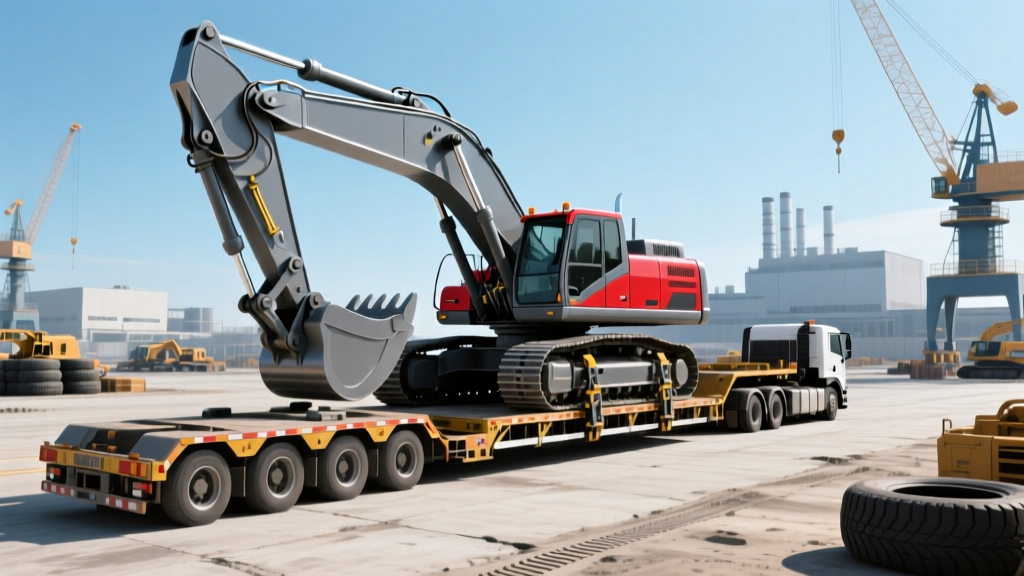
Removable Gooseneck (RGN) trailers are the industry standard for tall, heavy equipment. Loading an RGN requires a precise sequence to avoid hydraulic failure or deck damage.
- Site Preparation: Ensure the ground is level and compacted. An RGN detached on soft asphalt will sink, altering the ramp angle and potentially causing the machine to bottom out.
- Detach the Neck: Pull the kingpin release, lower the hydraulic cylinders to drop the deck to the ground, and disconnect the hydraulic hoses and electrical pigtail. Drive the tractor forward exactly 4 feet.
- Deploy Ramps: Unpin and swing the folding ramps into position. Verify that the ramp pins are fully seated in their locking grooves.
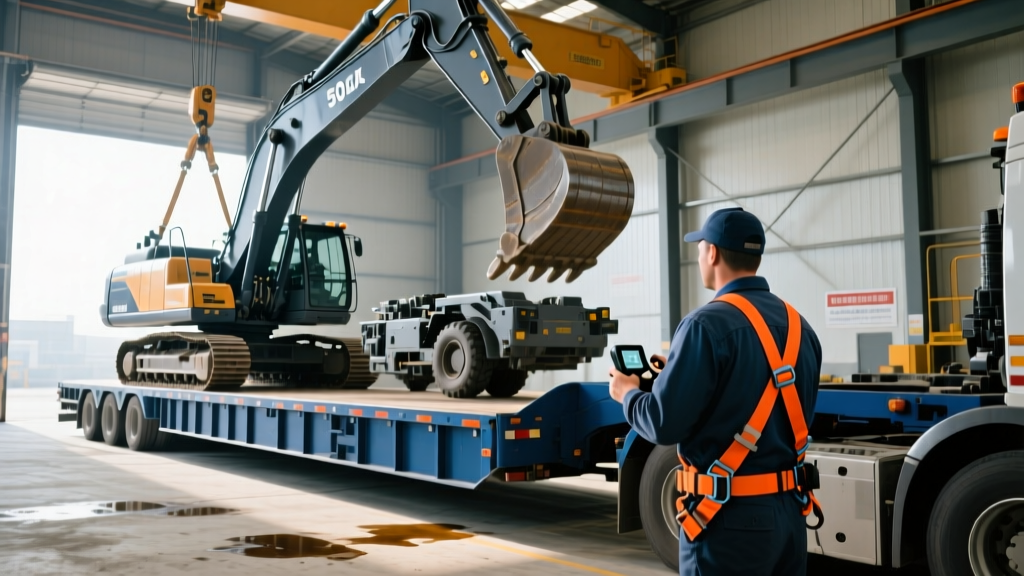
- Machine Approach: Drive the equipment straight up the ramps. Keep the bucket or blade low (no more than 12 inches off the deck) to maintain a low center of gravity. Never steer sharply while transitioning from the ramp to the deck.
- Positioning: Center the machine on the main deck. Leave at least 6 inches of clearance on either side of the tracks to the deck edge.
- Reattach the Neck: Reverse the tractor, align the gooseneck, raise the hydraulics to lift the deck until the kingpin slides into the fifth wheel, and lock it. Reconnect all hoses and test the trailer brakes before applying tie-downs.
Common Operator Mistakes and How to Avoid Them
Even veteran operators develop bad habits that compromise safety. Address these specific failure modes during your next training session:
1. Ignoring Track Tension and Debris
Loading an excavator with loose tracks is a major hazard. During highway transit, vibration and wind can cause a loose track to unroll and whip off the machine, destroying the trailer deck or striking trailing vehicles. Always tension tracks to the manufacturer's specified grease-cylinder measurement (typically 1 to 1.5 inches of sag) before loading. Furthermore, spend 15 minutes knocking packed mud and rocks out of the undercarriage; dried mud adds hundreds of pounds of phantom weight and can freeze solid in winter, locking up the idlers.
2. Over-Tightening Ratchet Binders
While lever binders are common, ratchet binders are safer for heavy haul. However, operators often use cheater bars on ratchets, applying tension that exceeds the chain's yield strength. A 3/8" Grade 70 chain has a breaking strength of 26,400 pounds. Over-tensioning can cause micro-fractures in the links. Tighten the binder until the chain is taut and the suspension compresses slightly, then stop.
3. Failing to Secure Articulated Joints
Wheel loaders and articulated haulers have a pivot joint. If this joint is not locked, the machine can articulate during transit, snapping the tie-down chains. Always engage the factory articulation lock pin. If the pin is missing or damaged, use a heavy-duty steel chain routed through the articulation brackets and secured to the trailer deck to physically prevent movement.
Continuous Training and Compliance
Operator training for heavy equipment trailer loading is not a one-time event. Equipment weights increase with new attachments, and DOT enforcement technologies—like weigh-in-motion sensors and automated brake stroke cameras—are becoming more prevalent. Conduct monthly securement audits, weigh your rigs at CAT scales with varying load configurations to build spatial awareness, and maintain a detailed log of chain and binder inspections. Mastery of these protocols ensures your cargo arrives safely, legally, and intact.