Heavy Equipment Shipping Los Angeles: 2026 Safety Compliance Guide
Navigate 2026 safety standards, Caltrans permits, and CARB rules for heavy equipment shipping in Los Angeles. Avoid fines and routing delays.
Navigating the Los Angeles Heavy Haul Compliance Landscape
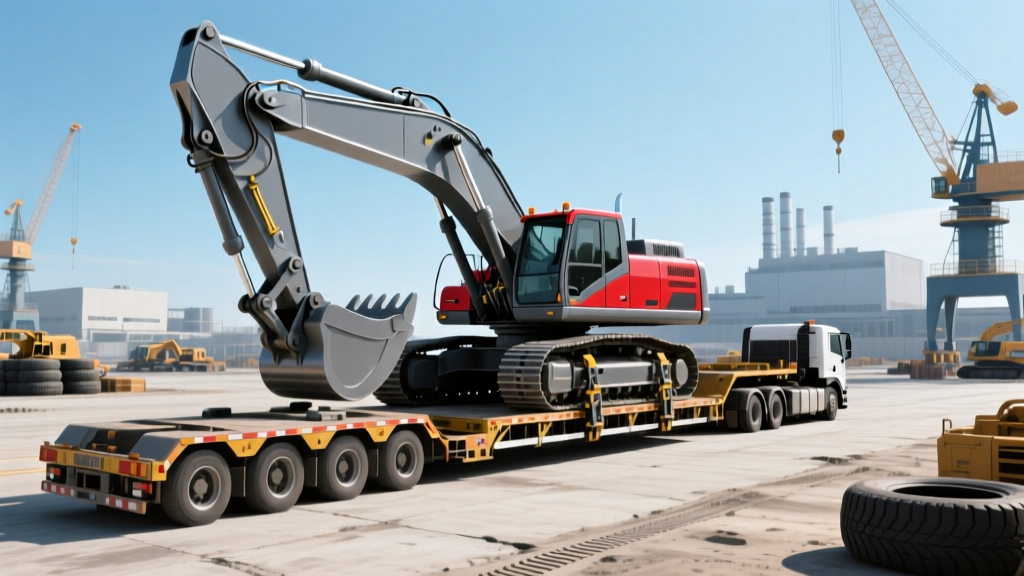
Moving 80,000 lb excavators or 120-ton crane components through the Los Angeles basin requires far more than a standard lowboy trailer and a commercial driver's license. The intersection of strict California Air Resources Board (CARB) emissions mandates, complex Caltrans permitting, and localized municipal routing bans makes heavy equipment shipping Los Angeles operators face some of the tightest compliance margins in North America. A single miscalculation in axle weight distribution or an expired port registry tag can result in impounded loads, thousands of dollars in fines, and severe project delays.
⚠️ Port Entry Alert: Entering the Port of Los Angeles or Long Beach with a non-compliant heavy haul tractor will result in immediate gate rejection and a $250+ fine. Ensure your drayage or heavy haul truck is registered in the Port Drayage Truck Registry and meets 2010+ EPA engine standards or zero-emission requirements before approaching the terminal gates.Caltrans Permitting and Axle Weight Thresholds
California operates on a distinct weight enforcement framework that differs from the Federal Bridge Formula. While federal interstate limits cap a single axle at 20,000 lbs, California state law (Vehicle Code Section 35550) enforces strict tolerances that require precise weight distribution across the lowboy trailer's axles and the truck's steering axle. For heavy equipment shipping in Los Angeles, operators must utilize the Caltrans Transportation Permits System (TRUCK) to secure Single-Trip or Continuous permits for oversize and overweight loads.
A standard continuous permit in California costs roughly $90 annually but is heavily restricted regarding dimensions and weights. For a 110,000 lb loaded combination (e.g., a CAT 374 excavator on a 13-axle lowboy), a Single-Trip permit is mandatory. These are calculated based on the exact route, axle spacing, and total gross vehicle weight (GVW), often costing between $150 and $400+ per trip depending on the mileage through LA County.
| Axle Configuration | CA Legal Limit | Federal Limit | Permit Trigger |
|---|---|---|---|
| Steer Axle (Standard Tires) | 12,500 lbs | 12,000 lbs | Over 12,500 lbs |
| Single Axle | 20,000 lbs | 20,000 lbs | Over 20,000 lbs |
| Tandem Axle | 34,000 lbs | 34,000 lbs | Over 34,000 lbs |
| Tridem Axle | 42,000 lbs | 42,000 lbs* | Over 42,000 lbs |
*Federal limits vary based on exact axle spacing; always calculate using the specific bridge formula chart.
Routing Nightmares: I-710, I-405, and Overpass Clearances
Los Angeles County features a labyrinth of aging infrastructure, low overpasses, and strict truck route ordinances. Relying on standard commercial GPS units is a primary failure mode for heavy haul operators. You must use specialized routing software (like PC*Miler or Rand McNally) calibrated for your exact trailer deck height and loaded clearance.
Critical Clearance Chokepoints
- I-5 at Colorado Street (Glendale): The clearance here is notoriously low at 13' 6". High-profile loads, such as wheel loaders with cabs intact or excavators with booms raised, must route around this via surface streets like San Fernando Road, adding significant time to the transit.
- I-405 Sepulveda Pass: The 6% grade combined with strict speed limits for heavy combinations requires tractors with high-torque powertrains (e.g., Cummins X15 rated at 605 hp and 2,050 lb-ft torque). Downshifting and runaway truck ramp awareness are critical safety protocols here.
- Vincent Thomas Bridge: Connecting San Pedro to Terminal Island, this bridge has specific toll and routing restrictions for oversize loads. Heavy haul carriers must ensure their FasTrak transponders are properly mounted and configured for commercial tolling, or risk $100+ per-axle violation notices.
Pilot Car and Escort Mandates in LA County
California Highway Patrol (CHP) and local municipalities enforce strict escort requirements. For loads exceeding 10' 0" in width, a rear escort is required on two-lane highways, and a front escort is required on multi-lane highways. If the load exceeds 12' 0" wide, both front and rear escorts are mandatory regardless of the road type. Loads exceeding 15' 0" in height require a height pole car equipped with a calibrated fiberglass pole set 6 inches higher than the load's maximum clearance.
CARB Emissions Compliance for Heavy Haul Tractors
As of 2026, the California Air Resources Board (CARB) has aggressively expanded its Clean Trucks and Buses regulations. Heavy haul tractors operating in the Los Angeles basin, particularly those entering the Ports of LA and Long Beach or the Inland Empire logistics hubs, must comply with stringent emissions standards.
💡 Pro Tip for Fleet Managers: If your heavy haul tractor is equipped with a 2010-2015 EPA engine, ensure the Diesel Particulate Filter (DPF) is cleaned every 150,000 miles and the Selective Catalytic Reduction (SCR) system's DEF dosing injector is free of crystallization. CARB's Mobile Source Air Toxic (MSAT) enforcement officers use portable emission measurement systems (PEMS) at weigh stations and port gates. A failed opacity test results in an immediate out-of-service order.Furthermore, the phase-in of zero-emission drayage and heavy haul requirements means that short-haul heavy equipment moves within a 50-mile radius of the ports are increasingly being pushed toward battery-electric or hydrogen fuel cell Class 8 tractors. Operators must verify their equipment's eligibility in the CARB Online System for Certificate of Compliance (ARBER) before dispatching.
Cargo Securement: WLL and Chain Binder Specifics
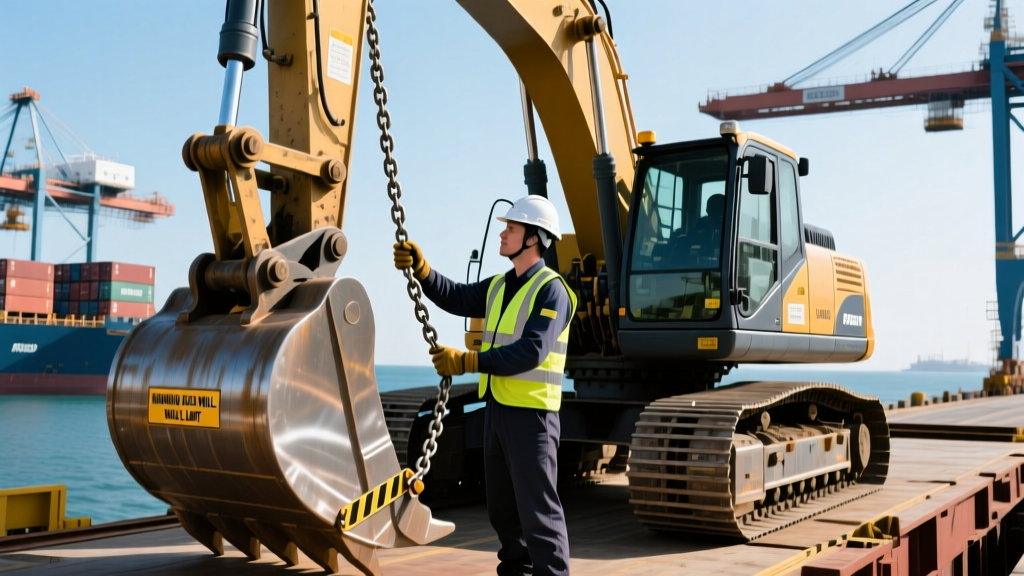
Securement failures on Los Angeles freeways are not just safety hazards; they are heavily penalized by the CHP Commercial Vehicle Section. Under FMCSA §393.130, heavy equipment weighing over 10,000 lbs requires a minimum of four tiedowns. However, the aggregate Working Load Limit (WLL) of those tiedowns must equal at least 50% of the equipment's total weight.
Consider shipping a 95,000 lb Komatsu PC800LC excavator. The aggregate WLL required is 47,500 lbs. If you use four 1/2-inch Grade 70 transport chains (each with a WLL of 11,300 lbs), your total WLL is 45,200 lbs—which is a violation. You must either upgrade to 5/8-inch Grade 70 chains (WLL 17,900 lbs each) or use six 1/2-inch chains to safely exceed the 50% threshold while accounting for dynamic forces on steep grades like the Grapevine (I-5).
| Chain Size & Grade | Working Load Limit (WLL) | Recommended Binder Type |
|---|---|---|
| 3/8" Grade 70 | 6,600 lbs | Ratchet Binder (Safer tensioning) |
| 1/2" Grade 70 | 11,300 lbs | Ratchet or Lever (with safety latch) |
| 5/8" Grade 100 | 22,600 lbs | Heavy-Duty Ratchet Binder |
Warning on Lever Binders: The use of standard lever binders (snap binders) is increasingly scrutinized due to the kinetic energy stored in the handle, which can cause severe operator injury if it kicks back. Always use recoilless lever binders or ratchet binders for heavy equipment shipping in Los Angeles to comply with both OSHA safety standards and CHP enforcement preferences.
Frequently Asked Questions (LA Heavy Haul Compliance)
Do I need a Caltrans permit for an empty lowboy trailer?
Generally, no. If your empty trailer and tractor combination remain within the legal California dimensions (8' 6" wide, 14' 0" high, and 48' trailer length) and legal weight limits, no oversize/overweight permit is required. However, if you are running a multi-axle expandable lowboy that exceeds 48' in its closed position, or if the empty deck height pushes you over 14' 0", an empty permit is mandatory.
What are the curfew hours for heavy haul in LA city limits?
The City of Los Angeles enforces strict noise and truck routing curfews. Oversize loads requiring pilot cars or lane closures generally cannot move between 6:00 AM and 9:00 AM, and 3:30 PM and 7:00 PM on weekdays to avoid peak commuter traffic. Additionally, many municipal surface streets prohibit commercial truck traffic over 10,000 lbs between 9:00 PM and 5:00 AM. Always verify local municipal codes (e.g., Santa Monica, Long Beach, Pasadena) as they vary significantly from LA County unincorporated areas.
How do I handle oversize loads crossing the Vincent Thomas Bridge?
The Vincent Thomas Bridge is a critical chokepoint for heavy equipment moving into the Port of Los Angeles. Loads exceeding 12' 0" wide or requiring lane control must coordinate with the CHP and the Port of LA Traffic Management Center. Escort vehicles must maintain specific spacing, and the load must travel in the designated right-hand truck lane. Failure to pre-coordinate with port authorities can result in the load being turned around at the San Pedro interchange, costing hours in delays and burning expensive single-trip permit validity windows.