USMC Heavy Equipment Operator: Union vs Non-Union Careers
Transitioning from a USMC heavy equipment operator to civilian roles? Compare IUOE union vs non-union careers, equipment specs, and pay scales.
Bridging the Tactical-Civilian Gap: Equipment Specifications
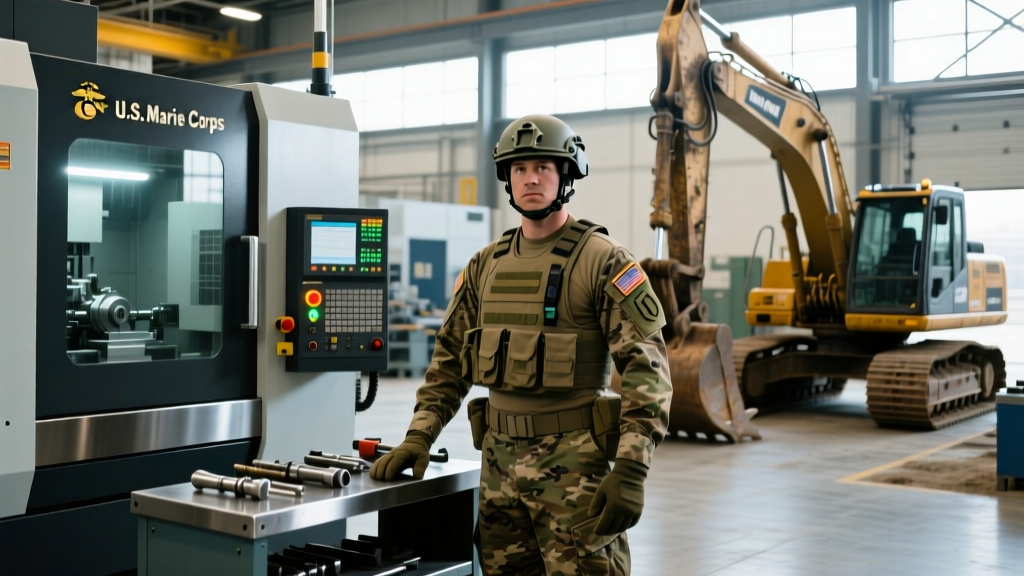
Transitioning from a heavy equipment operator USMC role (MOS 1345) to the civilian sector requires understanding the mechanical and technological delta between military and commercial fleets. Military modifications prioritize survivability, tactical deployment, and blackout capabilities, while civilian fleets prioritize production volume, emissions compliance, and automated grade control. Before choosing between a union or non-union civilian career path, separating Marines must evaluate how their technical skills map to commercial machinery.
In the USMC, operators frequently utilize modified commercial platforms, such as the Caterpillar D7R/XLG dozer or the John Deere 850LC excavator, equipped with military-spec wiring harnesses and convoy lighting. Civilian sites, however, operate massive production machines governed by EPA Tier 4 Final or Stage V emissions standards, requiring a completely different approach to powertrain management and daily maintenance.
| Specification Category | USMC Military Fleet (MOS 1345) | Civilian Union Fleet (IUOE) | Civilian Non-Union Fleet |
|---|---|---|---|
| Primary Dozer Platform | CAT D7R / D8T (Tactical Mods) | CAT D9 / Komatsu D375A | CAT D6 / John Deere 850LC |
| Excavator Class | 20-30 Ton (JD 850LC, CAT 320) | 40-80 Ton (CAT 390F, Komatsu PC800) | 15-35 Ton Mixed Fleet |
| Emissions Tech | Tier 2/3 (Deleted for tactical use) | Tier 4 Final (DEF/DPF mandatory) | Tier 3 to Tier 4 Final |
| Grade Control | Manual laser / Stringline | 3D GPS (Trimble Earthworks) | 2D Laser / Manual |
| Hydraulic Systems | Standard open-center | Load-sensing, variable displacement | Mixed open/closed center |
The IUOE Union Pathway: Precision and Automation
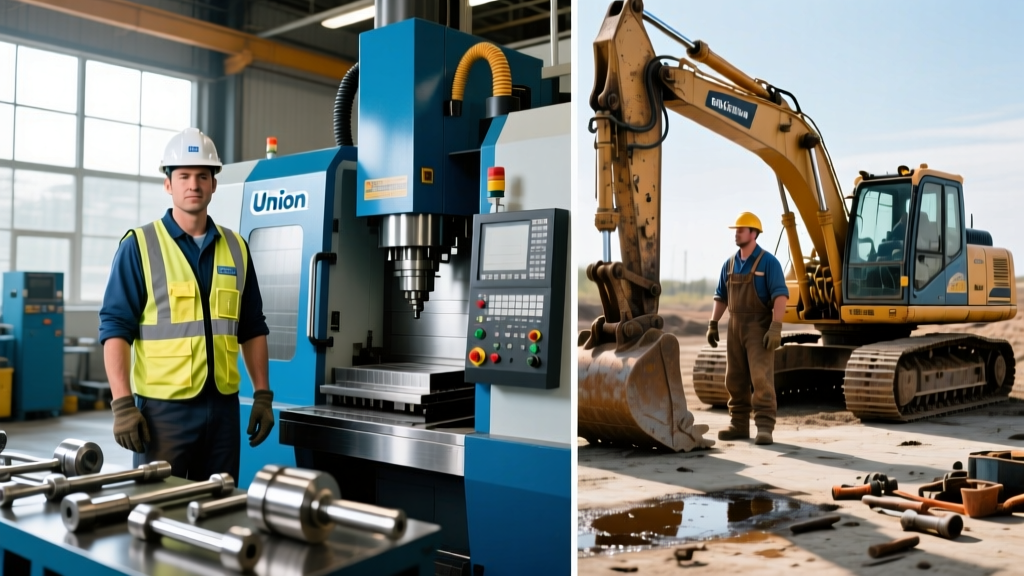
The International Union of Operating Engineers (IUOE) represents the heavy equipment sector's most technically specialized workforce. For a former USMC heavy equipment operator, the union pathway offers direct access to megaprojects—highway expansions, dam constructions, and commercial high-rises—where machine precision is dictated by digital models rather than visual estimation.
Technical Focus: 3D Machine Control and Tier 4 Emissions
Union operators are expected to master 3D machine control systems like Trimble Earthworks and Topcon X-53i. Unlike military grading, which often relies on manual blade pitch and laser receivers, union site dozers and motor graders (such as the CAT 14M or 12M) utilize GNSS receivers mounted on the cab roof. The machine's hydraulic valves automatically adjust the blade elevation and pitch based on a 3D CAD model uploaded to the cab's display.
Furthermore, union fleets strictly adhere to Tier 4 Final emissions protocols. Operators must understand the regeneration cycles of Diesel Particulate Filters (DPF) and the dosing rates of Diesel Exhaust Fluid (DEF). Failing to manage the machine's thermal load during idle times can trigger forced regeneration modes, locking out the hydraulic system and halting production—a scenario rarely encountered in older military fleets.
Apprenticeship and Certification Specs
Entering the IUOE requires completing a state-registered apprenticeship, typically spanning 4,000 hours of on-the-job training and 600 hours of classroom instruction. According to the Department of Veterans Affairs, separating service members can utilize GI Bill benefits to receive a monthly housing allowance while completing these civilian apprenticeships, effectively bridging the income gap during the transition.
The Non-Union (Merit Shop) Pathway: Versatility and Maintenance
Non-union contractors, often affiliated with organizations like the Associated Builders and Contractors (ABC), operate on a merit-shop model. The technical demands here shift from hyper-specialized precision to extreme mechanical versatility and operator-level maintenance.
Technical Focus: Operator-Mechanic Hybrids and Mixed Fleets
In a non-union environment, an operator is rarely confined to a single machine. A typical shift may require transitioning from a Bobcat T770 compact track loader to a Volvo A40G articulated hauler, and finally to a pneumatic-tired roller. This demands a broad understanding of varying hydraulic flow rates, PTO (Power Take-Off) engagements, and attachment coupler mechanics.
More critically, non-union operators frequently act as 'operator-mechanics.' Without a dedicated millwright or heavy diesel technician on site, the operator is responsible for track tensioning, grease-point mapping, hydraulic hose replacement, and diagnosing electrical faults via the machine's onboard diagnostic (OBD) screens. Understanding how to read CAN bus error codes on a John Deere or Case machine is a highly marketable skill in the merit shop sector.
Credential Translation: MOS 1345 to Civilian
Military experience does not automatically grant civilian certification. USMC operators must translate their tactical hours into civilian credentials. The National Center for Construction Education and Research (NCCER) offers a standardized Heavy Equipment Operations curriculum. Veterans can often test out of NCCER Level 1 and Level 2 practical exams by demonstrating proficiency in trenching, sloping, and load calculations, fast-tracking their non-union employability.
Compensation, Benefits, and Hour Requirements (2026 Data)
The financial and technical ceiling varies drastically between union and non-union roles. The Bureau of Labor Statistics notes that while the median pay for heavy equipment operators hovers around $55,000 annually, unionized mega-projects in metropolitan areas can push total compensation packages well past $120,000 when factoring in overtime and pension contributions.
| Metric | IUOE Union Operator | Non-Union Operator |
|---|---|---|
| Base Hourly Wage (2026 Avg) | $42.00 - $58.00 | $24.00 - $36.00 |
| Health & Pension Benefits | Fully funded by contractor | Employee-subsidized / 401k match |
| Equipment Access | Late-model, GPS-equipped fleet | Older, depreciated, mixed fleet |
| Maintenance Responsibility | Pre-shift checks only | Field repairs and hose swapping |
| Career Ceiling | Foreman, General Foreman, Rep | Site Superintendent, Fleet Mgr |
Step-by-Step Transition Protocol for MOS 1345 Veterans
To successfully navigate the shift from military to civilian heavy equipment operation, follow this technical transition framework:
- Audit Your Logbook: Compile your USMC equipment hours. Separate them by machine type (Dozer, Excavator, Grader, Loader). Civilian HR departments require verifiable hours, not just a DD-214.
- Choose Your Track: If you prefer 3D GPS technology, massive production machines, and specialized precision, target IUOE apprenticeships. If you prefer mechanical troubleshooting, mixed-fleet versatility, and faster promotion to site management, target non-union merit shops.
- Obtain NCCCO Certification (Optional but Recommended): If your military role involved crane operations or rigging, secure your National Commission for the Certification of Crane Operators (NCCCO) credentials. This instantly elevates your hourly bargaining power in both union and non-union sectors.
- Master Tier 4 Diagnostics: Spend time reviewing EPA Tier 4 Final DEF and DPF maintenance manuals. Demonstrating knowledge of forced-regeneration protocols during a civilian interview proves you are ready for modern commercial fleets.
The leap from a USMC heavy equipment operator to a civilian career is not just a change in uniform; it is a shift from tactical survival to commercial efficiency. By understanding the technical specifications of civilian fleets and the operational demands of union versus non-union environments, separating Marines can strategically target the career path that best aligns with their mechanical aptitude and financial goals.