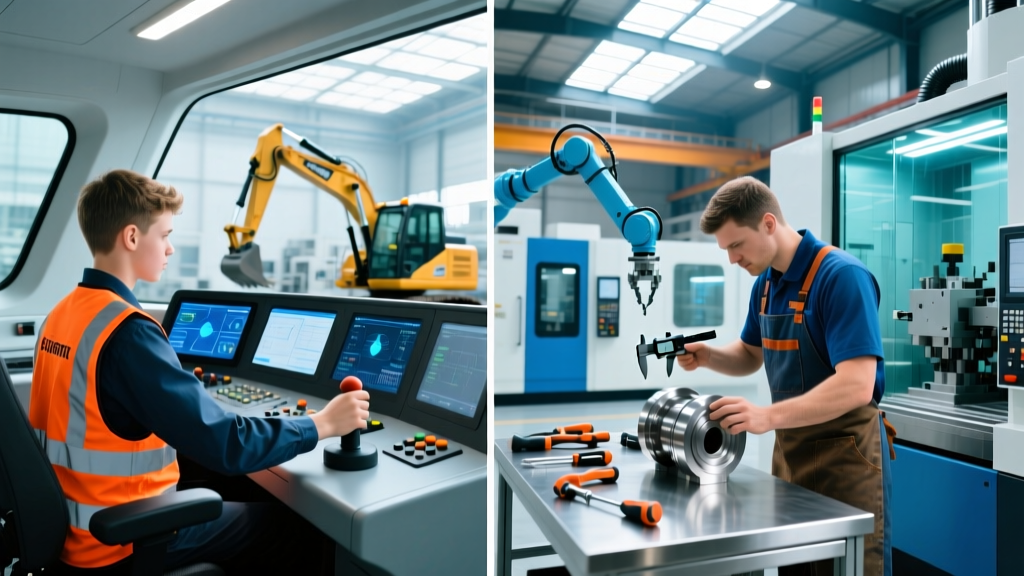
Tech Troubleshooting & The Modern Heavy Equipment Operator Licence
Learn how machine control tech impacts your heavy equipment operator licence, plus troubleshooting steps for GPS and sensor faults on modern dozers and excavators.
The Digital Shift in Heavy Equipment Operator Licence Requirements
The definition of a qualified operator has fundamentally changed. A decade ago, securing a heavy equipment operator licence required demonstrating mastery over hydraulic levers, spatial awareness, and basic mechanical maintenance. In 2026, licensing boards and major union apprenticeship programs (such as the IUOE) have integrated digital systems diagnostics into their practical testing modules. The rationale is economic: a licensed operator who can troubleshoot a machine control sensor fault on the fly saves the fleet an average of $1,800 in service truck dispatches and four hours of downtime.
Modern earthmoving equipment relies on a complex network of GNSS (Global Navigation Satellite System) receivers, IMUs (Inertial Measurement Units), and telematics gateways. When these systems fail, the machine's semi-autonomous features lock out, reverting a $650,000 intelligent dozer into a manual blade machine. Understanding how to diagnose and clear these faults is no longer optional for career advancement; it is a core competency tied directly to maintaining your heavy equipment operator licence and qualifying for tech-premium pay scales.
2026 Licensing Update: State and provincial certification bodies now require candidates to demonstrate the ability to differentiate between a mechanical hydraulic failure and a software sensor fault during the practical grading exam. Failing to correctly identify a severed CAN bus line versus a blown hydraulic hose will result in a failed tech-module assessment.Traditional vs. Tech-Endorsed Licence Competencies
| Competency Area | Legacy Licence Scope (Pre-2020) | 2026 Tech-Endorsed Licence Scope |
|---|---|---|
| Grade Control | Reading laser levels and physical grade stakes. | Managing 3D GNSS models, NTRIP network connections, and IMU calibration. |
| Fault Diagnosis | Checking fluid levels, belt tension, and visual leaks. | Interpreting CID/FMI electronic diagnostic codes via in-cab HMI displays. |
| Emissions Systems | Basic DEF tank refills. | Troubleshooting NOx sensor derates and managing active regeneration lockouts. |
| Telematics | None. | Utilizing fleet data to optimize cycle times and clear geofence-induced engine lockouts. |
Field Troubleshooting Guide: 3D Machine Control Sensor Faults
When your in-cab display (such as a Topcon X-53i or Cat AccuGrade) throws a fault code and drops you out of auto-mode, the immediate instinct is to call the site technician. However, 80% of machine control dropouts are environmental or connection-based issues that a properly trained operator can resolve in under five minutes. Mastering these fixes is a practical requirement for the modern heavy equipment operator licence.
Symptom 1: 'Loss of GPS Signal' or RTK Dropouts
The Scenario: You are cutting a subgrade with a Cat D6 XE, and the system suddenly flashes 'RTK Signal Lost,' dropping blade accuracy from 0.02 feet to manual mode.
- Cause A: Cellular NTRIP Timeout. If your site uses a cellular modem to pull corrections from a VRS (Virtual Reference Station) network, dead zones or APN (Access Point Name) configuration errors will sever the link.
- Cause B: UHF Radio Interference. If relying on a local base station broadcasting over UHF radio, overlapping frequencies from nearby survey crews or high-tension power lines cause packet loss.
- Cause C: Multipath Error. Operating near dense tree lines, chain-link fences, or large metallic structures causes the GNSS signal to bounce, confusing the receiver.
The Fix: Navigate to the modem settings on your HMI. If using cellular, verify the SIM card is seated correctly and ping the NTRIP mount point. If using UHF radio, switch the rover and base station to a backup channel (e.g., moving from Channel 1 to Channel 4) and ensure the baud rate matches exactly (typically 9600 or 19200 bps). For multipath errors, reposition the machine 20 feet away from the reflective surface to allow the receiver to re-initialize the integer ambiguity resolution.
Symptom 2: IMU Drift and Blade Oscillation
The Scenario: The machine is in auto-mode, but the blade is 'hunting' or oscillating aggressively up and down, tearing up the finished grade.
The Cause: The IMU (Inertial Measurement Unit), typically mounted on the mast or the cab roof, uses MEMS gyroscopes to measure pitch and roll. These sensors suffer from bias instability when ambient temperatures drop below 40°F (4°C), or if the mounting bracket has vibrated loose.
Warning: Never attempt to bypass the IMU software interlock to force the machine into auto-mode. Operating with an uncalibrated IMU will result in severe over-cutting, potentially damaging underground utilities and resulting in immediate revocation of your site-specific heavy equipment operator licence endorsements.The Fix:
- Bring the machine to a complete stop on a known, level surface.
- Allow the machine to idle for 5 to 7 minutes. This warms the IMU internal components, stabilizing the MEMS sensors.
- Access the 'Sensor Calibration' menu on the display and initiate a Static IMU Calibration. The screen will prompt you to remain perfectly still for 60 seconds.
- Physically inspect the IMU mast. Use a torque wrench to verify the mounting bolts are tightened to the manufacturer's specification (typically 25 Nm for standard mast brackets). A loose bracket introduces harmonic vibration that the software interprets as grade deviation.
Telematics Error Codes: Clearing Emissions Derates
Tier 4 Final and Stage V emissions systems are heavily monitored by telematics platforms like Cat VisionLink and Komatsu KOMTRAX. A common issue that halts production is an unexpected engine derate caused by the SCR (Selective Catalytic Reduction) system.
Operators often see a CID 3516 FMI 18 code (Data Valid but Below Normal) indicating low Diesel Exhaust Fluid (DEF) quality or a faulty NOx sensor. Before calling a mechanic, perform these field checks:
- Check DEF Crystallization: Inspect the DEF injector tip at the exhaust manifold. White, crusty buildup indicates the injector is clogged, preventing proper atomization. Carefully clean the tip with a brass wire brush and warm water (never use a steel pick, which will damage the spray pattern).
- Verify Fluid Quality: If the DEF was stored in direct sunlight or extreme heat on the job site, it may have degraded, triggering the quality sensor. Drain a small sample into a clear cup; it should be perfectly clear and colorless. If it is cloudy or contains particulates, flush the tank.
- Force a Parked Regen: If the soot load is high but the machine hasn't triggered an active regen due to low exhaust temps (common in light-duty trenching work), initiate a manual parked regeneration via the dash switch. Ensure the machine is in a clear area, free of dry brush, as exhaust temperatures will exceed 1,100°F (590°C).
Career Impact: The Wage Premium for Tech-Savvy Operators
The integration of technology into the heavy equipment operator licence framework has created a distinct bifurcation in the labor market. Operators who treat the in-cab display as a nuisance and rely entirely on field technicians for sensor resets are stagnating at baseline union or market rates. Conversely, operators who possess diagnostic literacy are commanding significant wage premiums.
According to the latest data from the U.S. Bureau of Labor Statistics, the median wage for operating engineers continues to climb, but the top 10% of earners—those heavily concentrated in tech-enabled earthmoving and precision grading—earn upwards of $95,000 annually, with total compensation packages exceeding $120,000 when factoring in tech-stipends and overtime. Furthermore, the Association of Equipment Management Professionals (AEMP) notes that fleets utilizing standardized telematics data actively seek operators who can interpret this data to optimize fuel burn and reduce undercarriage wear.
Actionable Steps for Career Advancement
- Request OEM Training: Ask your fleet manager to enroll you in the dealer's 'Machine Control Operator' certification courses. These 2-day intensives cover the exact diagnostic trees required for modern licensing exams.
- Master the HMI: Spend 15 minutes before your shift navigating the diagnostic menus of your specific machine model. Memorize the top 5 most common CID/FMI codes for your fleet.
- Update Your Credentials: If your heavy equipment operator licence was issued prior to 2022, contact your local certifying body to inquire about the 'Digital Systems Endorsement' add-on. Adding this to your physical card immediately signals to heavy civil contractors that you are capable of managing million-dollar autonomous grading assets.