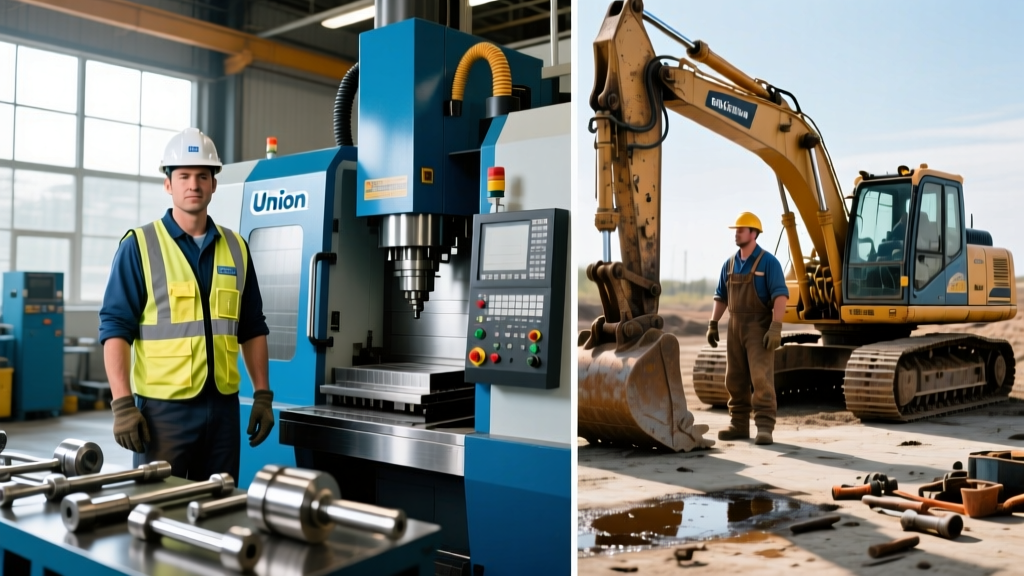
Union vs Non-Union Paths to Become a Heavy Equipment Operator
Compare union vs non-union paths to become a heavy equipment operator. Explore pay scales, training costs, benefits, and career growth in 2026.
The Core Dilemma: Choosing Your Entry Point
The decision to become a heavy equipment operator is no longer just about choosing between a dozer and an excavator. In 2026, the most critical career fork in the road is the employment and training model: union apprenticeship versus non-union private vocational schooling. With the ongoing deployment of Infrastructure Investment and Jobs Act (IIJA) funding, demand for skilled operators on highway, bridge, and utility projects has surged, making this choice more financially consequential than ever.
Both paths lead to the cab of a Cat 336 or a John Deere 944L, but the timeline, out-of-pocket costs, and long-term retirement structures differ drastically. According to the U.S. Bureau of Labor Statistics, the median pay for construction equipment operators continues to climb, but the ceiling and floor of that pay band are heavily dictated by whether you operate in an open-shop or union environment.
Fast Fact: The 2026 Infrastructure Boom
Federally funded infrastructure projects peaking in 2026 are subject to the Davis-Bacon Act, which mandates prevailing wage rates. In many states, prevailing wages mirror union scales, making union-trained operators highly competitive for these mega-projects.
The Union Route: IUOE Apprenticeships
The union path is governed primarily by the International Union of Operating Engineers (IUOE). To become a heavy equipment operator through the union, you must apply for a local apprenticeship program. This is not a quick certification; it is a comprehensive, multi-year commitment.
- Timeline: 3 to 4 years.
- Hour Requirements: Typically 6,000 hours of on-the-job training (OJT) combined with 400+ hours of classroom and simulator instruction.
- Cost: Virtually zero out-of-pocket. Apprentices are paid from day one.
- Wage Progression: Apprentices start at roughly 55% to 65% of the journeyman rate, with guaranteed raises every 1,000 hours or 6 months.
The primary advantage of the IUOE route is the 'earn-while-you-learn' model. You are employed by a union contractor, meaning you receive a paycheck, health insurance, and pension contributions while you learn to grade with a GPS-equipped dozer. However, the barrier to entry is high. Apprenticeship cohorts are highly competitive, often requiring aptitude tests, drug screenings, and interviews. Furthermore, you are subject to the pacing of the local union hall; if work slows down, you may be laid off before completing your hours.
The Non-Union Route: Private Vocational Schools
The non-union, or 'open shop,' route relies heavily on private heavy equipment colleges and vocational programs. Schools like the Heavy Equipment Colleges of America (HEC) or the National Association of Trade and Technical Schools (NATT) offer intensive, condensed training.
- Timeline: 3 to 12 weeks of intensive, full-time training.
- Curriculum: Focuses on core machine controls, daily maintenance, and basic safety, often aligned with NCCER Heavy Equipment Operations credentials.
- Cost: $15,000 to $25,000 in tuition, plus living expenses during the unpaid training period.
- Entry Level Role: Graduates typically enter the field as grade checkers, greasers, or entry-level compact equipment operators before moving up to heavy iron.
The open-shop model prioritizes speed to market. If you need to pivot careers and start earning a full paycheck in three months, private school is the only viable option. The trade-off is the upfront financial burden and the reality that private schools cannot replicate 6,000 hours of real-world dirt-moving. Non-union graduates must prove their worth on the job site, often starting on smaller machines like skid steers or mini-excavators before being trusted with production-class excavators.
Head-to-Head: Union vs. Non-Union Career Matrix
| Feature | Union (IUOE) | Non-Union (Open Shop) |
|---|---|---|
| Training Duration | 3 to 4 Years | 3 to 12 Weeks |
| Upfront Cost | $0 (Paid Apprenticeship) | $15,000 - $25,000 |
| Starting Wage (Year 1) | $22 - $28 / hr (Apprentice) | $18 - $22 / hr (Entry-Level) |
| Journeyman Wage Ceiling | $38 - $55+ / hr (Region Dependent) | $28 - $42 / hr (Merit Dependent) |
| Retirement Structure | Defined Benefit Pension + Annuity | 401(k) with 3% - 6% Employer Match |
| Equipment Access in Training | Latest model fleet, advanced GPS/3D simulators | Older fleet (unless at top-tier private college) |
| Job Placement | Dispatched via Union Hall | Direct hire, self-sourced networking |
Financial Deep Dive: Pensions, 401(k)s, and Prevailing Wage
When evaluating how to become a heavy equipment operator, looking solely at the hourly wage is a critical mistake. The true financial divergence lies in the benefits package and retirement structures.
The Union Pension Multiplier
Union operators benefit from a defined benefit pension plan. Employers contribute a set hourly amount (e.g., $12 to $18 per hour worked) into the pension fund. Upon retirement, your payout is calculated using a multiplier. For example, if your local's multiplier is $95 per month for every year of credited service, an operator retiring after 30 years will receive $2,850 per month for life, regardless of market fluctuations. This is paired with an annuity fund (essentially a union-managed 401k) and fully paid family health insurance.
The Open-Shop 401(k) and Merit Model
Non-union operators rely on defined contribution plans. A top-tier open-shop contractor might offer a 401(k) with a 5% match and performance-based bonuses. The advantage here is portability and control; if you leave the company, your 401(k) goes with you immediately. Additionally, non-union operators are not bound by collective bargaining wage scales. A highly skilled non-union operator who excels at machine control (3D GPS grading) can negotiate individual merit raises that outpace the rigid, seniority-based union step-increases.
'In the open shop, your paycheck reflects your individual productivity and your ability to negotiate. In the union, your paycheck reflects the collective bargaining power of your local and the prevailing wage laws of your state.' - Industry Fleet Manager, 2026
Decision Framework: Which Path Should You Take?
Use this practical framework to determine your optimal route based on your current life circumstances and career goals.
Choose the Union Apprenticeship if:
- You are under 30, have no immediate dependents requiring a full journeyman salary, and can afford a 4-year ramp-up period.
- You want to work on massive, multi-year civil infrastructure projects (dams, highways, commercial high-rises).
- You prioritize a guaranteed lifetime pension and fully funded healthcare over immediate cash flow.
- You live in a strong prevailing-wage state (e.g., New York, California, Illinois, Washington).
Choose the Non-Union Private School if:
- You are executing a mid-career pivot and need to enter the workforce in under 6 months to support a family.
- You prefer residential, rural, or specialized utility work where open-shop contractors dominate.
- You have the capital or financing to absorb $20,000 in tuition without crippling debt.
- You want the freedom to work in right-to-work states across the South and Midwest without being tied to a specific local union hall's dispatch list.
Frequently Asked Questions
Can I switch from non-union to union later in my career?
Yes, but it is difficult. If you have 5 years of open-shop experience and decide to join the IUOE, you will likely have to start over as a first-year apprentice or pass a rigorous journeyman evaluation test, which has a high failure rate for those not trained on union-specific safety and procedural standards.
Do non-union operators get less respect on the job site?
Respect on a dirt site is dictated by your ability to move material safely and hit grade tolerances, not by your union card. However, union operators often receive more comprehensive training on advanced machine control systems and crane rigging, which can create a perceived skill gap in highly technical applications.
What certifications matter most in the non-union sector?
If you bypass the union, you must build your own credential portfolio. NCCER certifications in Heavy Equipment Operations (Levels 1 through 4) are the industry standard. Additionally, obtaining OSHA 30-Hour Construction and specific MSHA (Mine Safety and Health Administration) certifications will make you vastly more employable to top-tier open-shop contractors.