Heavy Equipment Field Mechanic: Union vs Non-Union Tech Specs
Compare union and non-union heavy equipment field mechanic careers through diagnostic tooling, AWS welding standards, and ECM training.
Modern off-highway machinery relies on complex J1939 CAN bus networks, Tier 4 Final/Stage V emissions systems, and electro-hydraulic proportional controls. For a heavy equipment field mechanic, the divide between union and non-union career paths is not just about wages and benefits; it fundamentally dictates the technical specifications of your daily workflow, the diagnostic software at your disposal, and the metallurgical standards you are required to meet. Understanding the technical realities of both environments is critical for technicians planning their long-term career trajectory in 2026 and beyond.
The ECM and Diagnostic Software Divide
Electronic Control Module (ECM) interfacing is the cornerstone of modern heavy equipment repair. The primary technical difference between union and non-union environments lies in software access and proprietary tooling.
Union Fleet Standardization vs. Non-Union Multi-Brand Chaos
Union mechanics, particularly those in the International Union of Operating Engineers (IUOE) working for large civil contractors or mining operations, typically service standardized, high-horsepower fleets. A union tech might spend their career exclusively on Komatsu PC8000 excavators or Cat 797F haul trucks. This environment provides licensed, direct access to OEM diagnostic suites like CAT ET (Electronic Technician) or Komatsu VHMS. These proprietary tools allow for bi-directional control, enabling technicians to perform active DPF (Diesel Particulate Filter) regenerations, recalibrate DEF (Diesel Exhaust Fluid) dosers, and flash ECM firmware directly in the field.
Conversely, non-union mechanics working for multi-brand rental fleets or independent contractors face a fragmented diagnostic landscape. Servicing a mixed fleet of John Deere, Volvo, and Kubota iron requires third-party adapters like the Nexiq USB-Link 2 or Noregon JPRO software. While cost-effective, these aftermarket tools often lack the deep, bi-directional parameter access required for advanced emissions troubleshooting, forcing non-union techs to rely on component 'swap-and-test' methodologies rather than precise software-driven calibration.
Data Callout: Annual Diagnostic Software Costs
- OEM Proprietary Suite (Union/Employer Provided): $3,500 - $8,000 per year (Includes licensing, cable updates, and tech support).
- Aftermarket Multi-Brand Scanner (Non-Union/Tech Owned): $1,200 initial hardware + $800 annual software subscription.
- Laptop Hardware Requirements: Panasonic Toughbook CF-33 (Field standard) - $3,800.
Apprenticeship vs. OJT: Technical Hour Breakdown
The methodology of technical knowledge transfer varies drastically. According to the IUOE National Training Fund, union apprenticeships mandate a highly structured, multi-year curriculum combining field hours with intensive classroom lab work. Non-union training, often tracked by organizations like the Associated Equipment Distributors (AED), relies heavily on unstructured On-the-Job Training (OJT) where learning is dictated by the immediate repair needs of the shop.
| Technical Module | Union Apprenticeship Hours | Non-Union OJT Estimate | Depth of Instruction |
|---|---|---|---|
| Powertrain & Hydrostatics | 1,500 hrs | 600 hrs | Union includes full planetary teardowns; Non-union focuses on drop-in swaps. |
| Hydraulic Schematics & Testing | 1,200 hrs | 400 hrs | Union requires ISO 1219 literacy and volumetric efficiency calculations. |
| Electrical & CAN Bus Diagnostics | 1,000 hrs | 250 hrs | Union covers oscilloscope usage; Non-union relies on multimeter continuity. |
| Welding & Metallurgy | 500 hrs | 100 hrs | Union mandates AWS D14.3 certification and pre-heat protocols. |
Tooling Infrastructure and Metrology
Rebuilding a final drive on a Cat D8T dozer or setting the bearing preload on a John Deere 944K wheel loader requires extreme precision. These procedures demand inch-pound torque wrenches, dial indicators, and micrometers capable of measuring tolerances to the ten-thousandth of an inch.
In the non-union sector, the financial burden of metrology and specialty tooling falls squarely on the technician. A career non-union field mechanic in 2026 can easily accumulate $40,000 to $60,000 in personal tool debt financing Mac or Snap-on roll chests, hydraulic crimpers, and specialty pullers. Union contracts, however, typically delineate tool ownership: the employer provides all heavy specialty tools (hydraulic presses, overhead cranes, OEM-specific lifting fixtures), while the union local or employer provides an annual hand-tool allowance (often $1,500 to $3,000) to maintain the technician's personal diagnostic and fastening gear.
'The most expensive mistake a junior non-union tech makes is buying cheap torque multipliers. When you are torquing a Komatsu PC490 swing circle gear to 850 lb-ft, a miscalibrated $200 multiplier will snap a Grade 10.9 bolt and cost the company $15,000 in downtime.' — Senior Field Service Engineer, Heavy Civil Division
Field Welding and Metallurgical Specifications
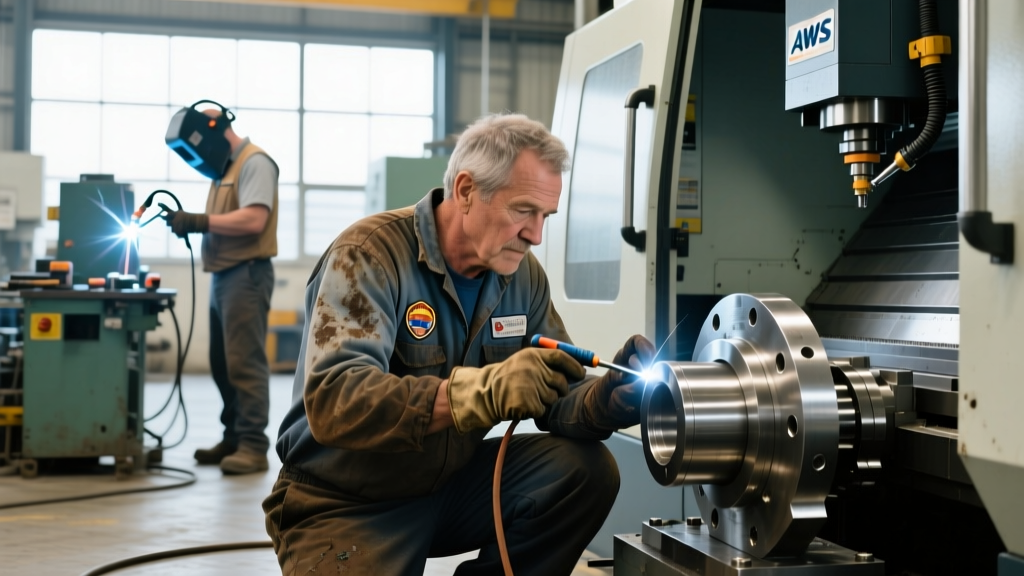
Heavy equipment repair frequently involves structural welding and hardfacing of high-wear components. The technical standard governing this work is AWS D14.3 (Specification for Welding Earthmoving and Construction Equipment).
Pre-Heat and Interpass Temperature Protocols
Union mechanics are formally trained in metallurgy, specifically regarding the Carbon Equivalent (CE) of high-strength low-alloy (HSLA) steels like T1 or AR400. When repairing a cracked excavator boom, a union tech will use a temperature-indicating crayon or infrared pyrometer to ensure the base metal is pre-heated to 250°F - 300°F before striking an arc. This prevents Hydrogen-Induced Cracking (HIC) in the Heat-Affected Zone (HAZ). They utilize Flux-Cored Arc Welding (FCAW) with E71T-1 wire for structural joints and specialized hardfacing wires (like Stoody 1186) for bucket teeth and rock breaker moils. Non-union environments, particularly smaller independent shops, often lack formal metallurgical oversight, leading to 'cold welds' that fail under cyclic dynamic loading in the field.
Hydraulic Circuit Testing and Schematic Literacy
Troubleshooting a load-sensing hydraulic system requires more than just checking fluid levels; it requires calculating volumetric efficiency and understanding pressure compensation. Union training programs mandate strict literacy in ISO 1219 hydraulic schematics. A union field mechanic will use a 6,000 PSI inline flow meter and pressure transducers to measure flow output at the pump versus flow output at the actuator under a simulated load. If a variable displacement pump is delivering 40 GPM at 1,000 RPM, but only 32 GPM at the cylinder under 4,500 PSI of load, the mechanic calculates an 80% volumetric efficiency, indicating internal bypassing and the need for a swashplate or piston shoe rebuild. Non-union training often bypasses this mathematical diagnostic approach in favor of simply swapping the main hydraulic pump, which can mask underlying issues like a scored cylinder barrel or a failing relief valve.
Decision Framework: Choosing Your Technical Path
Selecting between a union and non-union heavy equipment field mechanic career requires an honest assessment of your technical preferences and financial tolerance for tooling costs.
- Choose the Union Path If: You want to specialize in massive, high-horsepower mining or heavy civil equipment. You prefer employer-funded diagnostic software, structured AWS welding certifications, and a clear, standardized progression through powertrain and hydraulic rebuilding modules.
- Choose the Non-Union Path If: You thrive in a multi-brand, fast-paced environment where adaptability is key. You prefer the autonomy of owning your own high-end diagnostic scanners, are willing to finance your own tooling, and want the potential for rapid, merit-based promotion to field service management without seniority-based constraints.
Ultimately, the modern heavy equipment field mechanic is as much a software engineer and metallurgist as they are a wrench-turner. Aligning your career with the environment that provides the right technical infrastructure is the most critical diagnostic decision you will make.