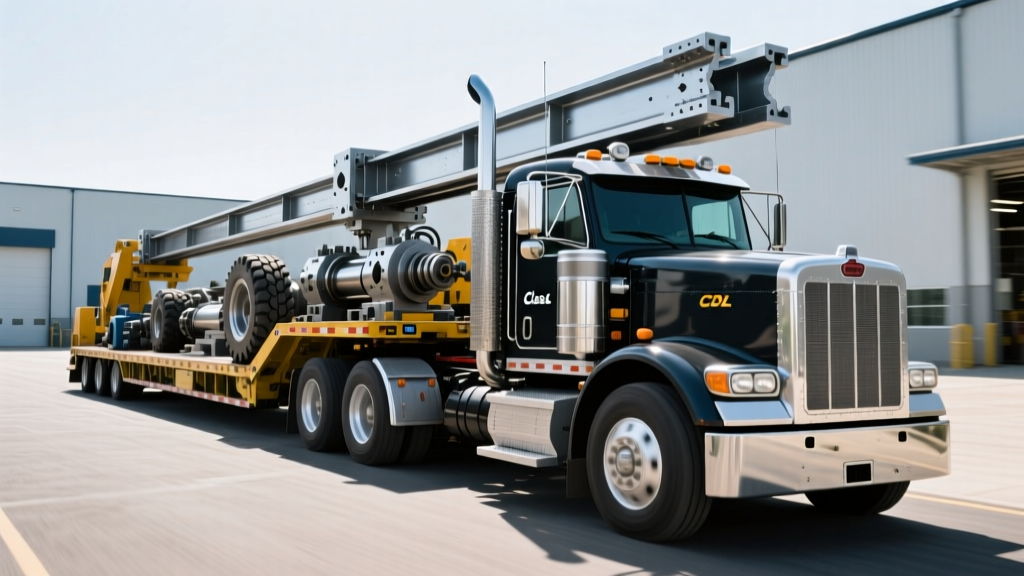
How Do I Get a Heavy Equipment License for Transport? CDL Guide
Learn how to get a heavy equipment license for transport. This guide covers Class A CDL requirements, lowboy trailers, and oversized load permits.
The Core Misconception: Operator Certs vs. Transport CDLs
When industry professionals ask, "how do I get a heavy equipment license," they are frequently conflating two entirely distinct career paths. Operating a 50-ton excavator on a job site requires certification from bodies like the National Commission for the Certification of Crane Operators (NCCCO) or specific OEM training. However, transporting that same excavator across state lines on a lowboy trailer falls strictly under the jurisdiction of the Federal Motor Carrier Safety Administration (FMCSA) and requires a Class A Commercial Driver's License (CDL).
⚠️ Critical Distinction: A heavy equipment operator license (e.g., NCCCO) legally permits you to dig, lift, or grade on a closed site. A Class A CDL with the correct endorsements and state-issued oversized permits legally permits you to haul that machinery on public highways. This guide focuses exclusively on the CDL and transport requirements.Step-by-Step: How Do I Get a Heavy Equipment License for Hauling?
To legally transport heavy machinery, you must obtain a Class A CDL. The FMCSA's Entry-Level Driver Training (ELDT) mandate dictates a strict, non-negotiable sequence for acquiring this credential. Here is the exact pathway to becoming a heavy haul transport specialist.
1. Secure Your DOT Medical Certificate
Before touching a steering wheel, you must pass a Department of Transportation (DOT) physical exam administered by a certified medical examiner. This evaluates cardiovascular health, vision (minimum 20/40 in each eye), and hearing. The resulting Medical Examiner's Certificate (MEC) is valid for up to 24 months and must be uploaded to your state's DMV portal.
2. Obtain a Commercial Learner's Permit (CLP)
Pass the written knowledge tests at your local DMV. For heavy equipment transport, you must pass the General Knowledge test and the Combination Vehicles test. If your target equipment requires air brakes (which 99% of heavy haul trucks do), you must also pass the Air Brakes test to avoid the "L" restriction on your license.
3. Complete ELDT Theory Training
You must complete FMCSA-approved theory training from a registered provider listed on the FMCSA Training Provider Registry. This covers advanced topics like hazard perception, whistleblower protections, and hours-of-service (HOS) regulations.
4. Behind-the-Wheel (BTW) Training
There is no minimum hour requirement for BTW training, but you must demonstrate proficiency to an approved instructor. For heavy haul, seek out a school that offers specialized lowboy and multi-axle trailer training, rather than standard dry van instruction. You must master backing a 53-foot spread-axle trailer into tight dock spaces and navigating off-road construction site entrances.
5. Pass the CDL Skills Test
The final hurdle consists of a pre-trip inspection, basic vehicle control (alley docking, offset backing), and an on-road driving test.
Weight Thresholds and Required Endorsements
Understanding why a Class A CDL is mandatory requires looking at the Gross Combination Weight Rating (GCWR). A Class A license is required when the GCWR is 26,001 pounds or more, provided the towed vehicle exceeds 10,000 pounds.
| Equipment Scenario | Truck Weight | Trailer Weight | Cargo Weight | Total GCWR | CDL Class Required |
|---|---|---|---|---|---|
| Skid Steer on Flatbed | 14,000 lbs | 4,000 lbs | 8,000 lbs | 26,000 lbs | Class B (or None) |
| Cat 320 Excavator on Lowboy | 18,000 lbs | 16,000 lbs | 52,000 lbs | 86,000 lbs | Class A |
| Volvo EC500E on Multi-Axle | 18,500 lbs | 24,000 lbs | 111,000 lbs | 153,500 lbs | Class A + Permits |
Case Study: Hauling a 111,000 lb Excavator Across State Lines
To understand the real-world application of heavy equipment transport, consider a logistics contract moving a Volvo EC500E crawler excavator from a dealership in Denver, Colorado, to a mining site in Cheyenne, Wyoming.
The Equipment and Rigging
The EC500E has an operating weight of roughly 111,000 lbs. A standard 2-axle lowboy will collapse under this load and violate federal bridge laws. The transport company dispatches a Kenworth W990 heavy haul tractor pulling a Trail King TK55M multi-axle lowboy trailer equipped with a flip axle and jeep dolly configuration. This spreads the weight across 11 axles total.
Route Planning and the Federal Bridge Formula
Heavy haul drivers cannot simply hop on the interstate. They must calculate weight distribution using the Federal Bridge Gross Weight Formula to ensure they do not overstress highway bridges. For the I-25 corridor, the driver must secure oversized/overweight permits from both Colorado and Wyoming DOTs at least 72 hours in advance. Because the loaded width exceeds 8.5 feet and the weight exceeds 80,000 lbs, the state mandates two pilot/escort vehicles.
Industry Insight: The most common failure mode for new heavy haul drivers is ignoring route surveys. A 16-foot high load will easily clear interstate overpasses, but taking a detour through a rural county road with low-hanging utility lines or unmapped weight-restricted wooden bridges can result in catastrophic infrastructure damage and six-figure fines.
Securing the Load: Chains, Binders, and Tension
Getting the CDL is only half the battle; keeping the equipment on the trailer is the other. Heavy equipment transport requires strict adherence to FMCSA cargo securement rules. A 50,000 lb machine requires a minimum working load limit (WLL) equal to 50% of its weight.
- Chain Grade: Only use Grade 70 or Grade 100 transport chains. Grade 43 (test chain) is illegal for heavy equipment securement.
- Binders: Ratchet binders are preferred over lever binders for heavy haul. Lever binders can snap back with lethal force if the tension releases suddenly, whereas ratchet binders provide controlled, high-tension securing (often up to 15,000 lbs WLL per chain).
- Attachment Points: Never chain around hydraulic cylinders or rubber tracks. Always use the OEM-designated heavy-duty tie-down eyes welded to the machine's mainframe.
Cost Breakdown and 2026 ROI for Heavy Haul Drivers
Pursuing a career in heavy equipment transport requires an upfront investment, but the financial returns in the current market are substantial due to a chronic shortage of specialized heavy haul drivers.
Estimated Training & Entry Costs (2026)
- Class A CDL School (Heavy Haul Focus): $5,500 - $8,500
- DOT Physical & DMV Fees: $150 - $250
- Specialized Gear (PPE, high-vis, steel toes): $200
- Total Initial Investment: $5,850 - $8,950
Salary Expectations
While standard over-the-road (OTR) dry van drivers average $65,000 to $75,000 annually, specialized heavy haul and oversized load drivers command a premium. First-year heavy haul drivers typically start between $85,000 and $95,000. Owner-operators or fleet drivers handling specialized mining and energy sector equipment frequently exceed $130,000 annually, factoring in per-diem and layover pay.
Frequently Asked Questions
Do I need a specific "heavy equipment endorsement" on my CDL?
No. The FMCSA does not issue a specific "heavy equipment" endorsement. You need a standard Class A CDL. However, depending on the specific machinery and trailer configuration, you may need a Doubles/Triples (T) endorsement if you are pulling specialized multi-trailer setups, though this is rare in heavy haul. The real legal requirement comes from state-issued oversized/overweight permits, not federal CDL endorsements.
Can I transport heavy equipment with a Class B CDL?
Only if the Gross Combination Weight Rating (GCWR) is under 26,001 lbs. This limits you to hauling mini-excavators, compact track loaders, or small skid steers on single-axle utility trailers. For 90% of commercial construction equipment (dozers, large excavators, wheel loaders), a Class A CDL is legally mandatory.
How long does it take to get licensed and start hauling?
From the day you schedule your DOT physical to the day you hold your Class A CDL in hand, expect the process to take 4 to 8 weeks. Following graduation, most heavy haul carriers require an additional 2 to 4 weeks of supervised "ride-along" training with a senior driver before you are cleared to haul oversized loads solo.