Government vs Private Heavy Equipment Mechanic Duties Compared
Compare government and private sector heavy equipment mechanic duties, salaries, and career paths to find the right municipal fleet role.
The Dichotomy of Public vs. Private Fleet Maintenance
When technicians evaluate career trajectories in diesel and heavy machinery, the split between private sector dealerships and government fleet facilities is stark. The daily heavy equipment mechanic duties in a municipal environment require a radically different skill set, administrative tolerance, and operational flexibility compared to private contracting or OEM dealership roles. While a private sector technician might spend their entire week diagnosing CAN bus faults on a fleet of identical Caterpillar 950M wheel loaders, a municipal master technician must pivot from repairing an Elgin Pelican street sweeper’s auxiliary hydraulic PTO (Power Take-Off) to winterizing Oshkosh H-Series snowplow brine systems before lunch.
Fleet Reality Check: The average mid-sized municipal fleet manages over 400 distinct asset classes, ranging from Class 8 refuse haulers to 3-ton utility UTVs. This extreme variance dictates the core heavy equipment mechanic duties in the public sector, prioritizing adaptability over hyper-specialization.Core Heavy Equipment Mechanic Duties in the Public Sector
In government and municipal facilities, the mandate is simple: keep the city running. This translates to a highly reactive, multi-disciplinary maintenance environment. Municipal mechanics are responsible for the lifecycle management of assets that private contractors rarely encounter.
Specialized Municipal Equipment Diagnostics
- Street Sweepers & Vacuum Systems: Troubleshooting centrifugal fan drives, water suppression pumps, and complex debris hopper hydraulic articulation on models like the Elgin Broom Bear or Schwarze sweepers.
- Winter Maintenance Gear: Calibration of automated anti-icing spreader controllers (e.g., Henderson or Viking-Cives), maintaining underbody scraper tension, and diagnosing PTO-driven hydraulic pump failures on dump trucks.
- Refuse & Recycling Automations: Repairing automated side-loader (ASL) arm linkages, joysticks, and onboard scale systems on chassis like the Mack LR or Peterbilt 520.
According to the U.S. Bureau of Labor Statistics, heavy vehicle and mobile equipment service technicians must continuously adapt to new mechanical and electronic systems, a reality amplified in government fleets where legacy 1990s mechanical diesels operate alongside 2026 zero-emission electric chassis.
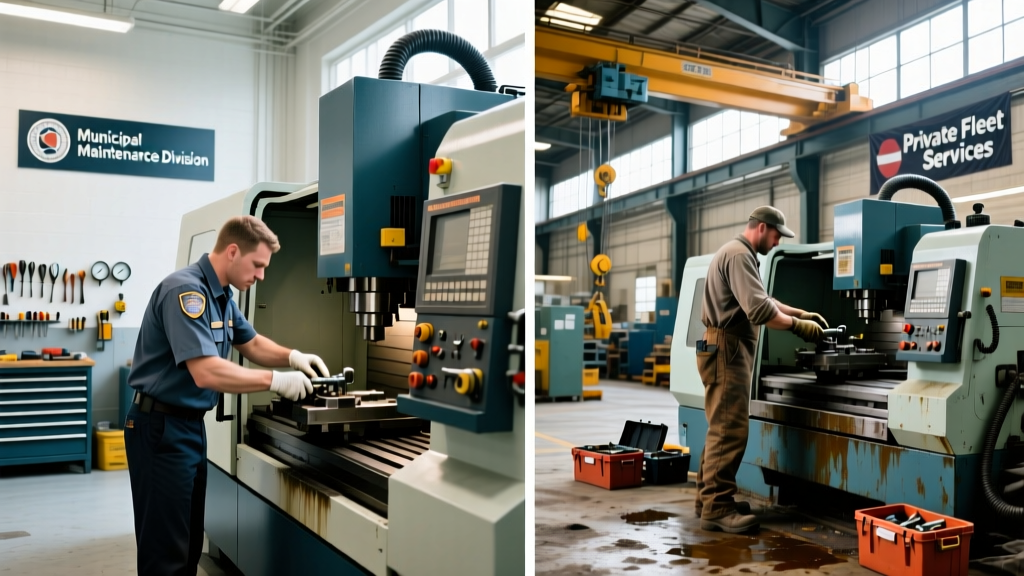
Workflow Comparison: Municipal vs. Private Sector
| Operational Metric | Municipal / Government Fleet | Private Dealership / Contractor |
|---|---|---|
| Equipment Variety | Extreme (Tractors, mowers, graders, ASL trucks) | Narrow (Specific OEM brand/line) |
| Parts Procurement | Bureaucratic; requires POs, bid compliance, and salvage fabrication | Direct OEM ordering; next-day dealer network delivery |
| Repair vs. Replace | Heavy emphasis on component rebuilding and fabrication | Modular swap-outs and OEM warranty replacements |
| Administrative Burden | High (Asset management software, municipal audits) | Moderate (Flat-rate time tracking, warranty claims) |
Government and Municipal Heavy Equipment Operator Roles: The Crossover
One of the most distinct aspects of government and municipal heavy equipment operator roles is the frequent blurring of lines between the mechanic and the operator. In the private sector, a technician rarely operates a 40-ton articulated dump truck outside of a 50-foot bay test drive. In municipal government, cross-utilization is often a contractual requirement.
The CDL Mandate and Emergency Deployment
Municipal heavy equipment mechanics are frequently required to hold a Class A or Class B Commercial Driver’s License (CDL) with air brake and tanker endorsements. This is not merely for moving equipment between depots. During extreme weather events—such as severe blizzards or flood responses—municipal mechanics are often legally classified as essential emergency personnel. You may be required to finish a hydraulic line repair on a John Deere 310SL backhoe, climb into the cab, and operate it for a 12-hour shift to clear storm drains or sandbag levees.
Warning for Applicants: If you are strictly a 'wrench-turner' who refuses to operate heavy machinery in hazardous public conditions, municipal fleet roles will lead to rapid friction with union stewards and public works directors. The operator-mechanic crossover is non-negotiable in most city charters.Certification Requirements: ASE and EVT
While private dealerships push OEM-specific certifications (e.g., CAT Certified Master Technician), government fleets rely on standardized, cross-brand credentials. The National Institute for Automotive Service Excellence (ASE) T-Series (Medium/Heavy Truck) and H-Series (Transit Bus) are baseline requirements. Furthermore, mechanics working on municipal fire apparatus and emergency rescue units must pursue certification through the Emergency Vehicle Technician Certification Commission (EVTCC). EVT certification covers specialized pump-and-roll hydraulics, aerial ladder torque verification, and high-voltage generator maintenance that standard diesel programs ignore.
The 2026 EV Municipal Fleet Transition
The most significant shift altering heavy equipment mechanic duties in local government is the aggressive adoption of zero-emission vehicles (ZEVs). Driven by state mandates and EPA grants, municipalities are integrating electric refuse trucks (like the Mack LR Electric) and battery-electric yard tractors into daily rotations.
This transition fundamentally changes the shop floor environment:
- High-Voltage LOTO: Mechanics must now execute strict Lockout/Tagout procedures on 600V+ DC battery systems before touching a chassis.
- Thermal Diagnostics: Routine PMs (Preventative Maintenance) now include using FLIR thermal imaging cameras to scan battery enclosures and high-voltage cable terminations for micro-resistance heat buildup.
- Software over Wrenches: Diagnosing an inverter fault on a BYD electric municipal chassis requires proprietary software laptops and network security clearances, shifting the mechanic's role closer to an IT systems analyst.
Compensation, Pensions, and Union Structures
Financially, the private sector almost always wins on gross annual income, but the municipal sector dominates in long-term wealth preservation and risk mitigation.
Salary and Benefit Matrix
- Private Sector Dealership: Master technicians operating on a flat-rate commission structure can gross $95,000 to $130,000+ annually. However, income is volatile, tied to shop volume, and benefits are standard 401(k) matches.
- Municipal / Government: Base salaries for journeyman mechanics typically cap between $75,000 and $92,000. However, this is supplemented by a Defined Benefit Pension (e.g., PERS or municipal retirement systems), which guarantees lifetime income post-retirement—a rarity in modern heavy industry.
Furthermore, government mechanics are usually represented by powerful public-sector unions like AFSCME (American Federation of State, County and Municipal Employees) or local Teamsters chapters. These contracts enforce strict overtime distribution, mandatory paid training hours, and rigorous workplace safety oversight that private contractors frequently bypass to meet project deadlines.
Decision Framework: Which Path is Right for You?
Choosing between government and private sector heavy equipment mechanic duties requires an honest assessment of your personality, financial goals, and tolerance for bureaucracy.
Choose the Municipal / Government Route If:
- You value a defined-benefit pension and absolute job security over immediate high-dollar commission checks.
- You enjoy extreme variety; you want to work on a grader in the morning and a hydraulic tree-spade in the afternoon.
- You are willing to embrace government and municipal heavy equipment operator roles during emergencies and do not mind operating machinery in adverse weather.
- You possess the patience to navigate municipal procurement red tape and legacy asset life-extension projects.
Choose the Private / Dealership Route If:
- Your primary goal is maximizing immediate annual cash flow via flat-rate efficiency bonuses.
- You prefer deep, hyper-specialized knowledge of a single OEM's proprietary electronic architecture.
- You want access to cutting-edge, factory-subsidized tooling and climate-controlled, state-of-the-art diagnostic bays.
- You have zero interest in operating the equipment you repair or interacting with the general public during emergency deployments.
Ultimately, municipal heavy equipment mechanic duties offer a uniquely stable, highly varied career path that serves as the invisible backbone of civic infrastructure. For the technician who values community impact, operational variety, and long-term retirement security, the public sector remains an unmatched alternative to the private dealership grind.