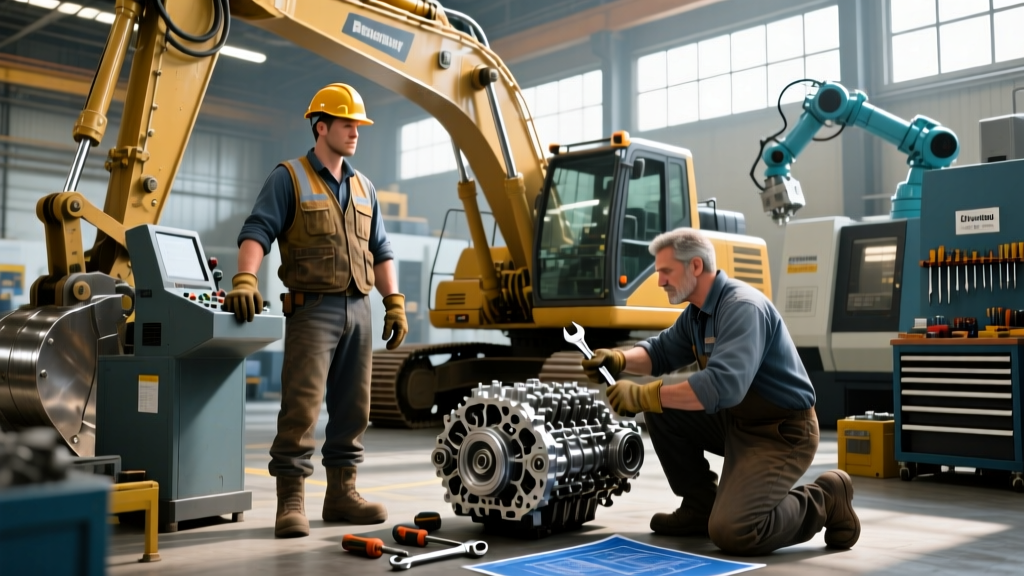
Mechanic vs Operator: How to Get a Heavy Equipment Operator License
Troubleshooting your career path? Compare heavy equipment mechanic vs operator roles, daily repair duties, and how to get a heavy equipment operator license.
Diagnostic Check: Is Your Career Path Misfiring?
Choosing between the cab and the shop floor is not just a preference test; it is a fundamental diagnostic of how you interact with heavy machinery. When a machine throws a fault code, the operator executes Level 1 field troubleshooting to minimize downtime, while the mechanic performs Level 2 and 3 deep-dive diagnostics to engineer a permanent fix. If you are trying to calibrate your career trajectory, you must understand the exact mechanical boundaries of both roles.
This guide breaks down the daily repair scopes, diagnostic tools, and financial ROI of both tracks, culminating in a step-by-step protocol on how to get a heavy equipment operator license if your diagnostic tree points you toward the operator seat.
Career DTC (Diagnostic Trouble Code): If you prefer tracing CAN bus wiring faults with a multimeter over calculating cut-and-fill grades on a 3D GPS system, your aptitude is aligned with the technician track. If you prefer spatial geometry, production quotas, and field-level mechanical triage, proceed to the operator licensing protocol below.The Operator’s Wrench: Field Troubleshooting vs. Deep Diagnostics
Modern heavy equipment operators are not just joystick pilots; they are the first line of defense against catastrophic mechanical failure. However, the scope of their 'wrench time' is strictly limited by manufacturer warranties and site safety protocols.
Operator Field Fixes (Level 1 Diagnostics)
An operator’s troubleshooting domain is confined to visual inspections, fluid top-offs, and minor component swaps that do not require breaking sealed hydraulic or emissions systems. Common daily operator repairs include:
- Track Tensioning: Adjusting the grease tensioner on a Doosan DX225LC excavator undercarriage to prevent de-tracking in abrasive trenching conditions.
- Hydraulic Hose Swaps (External): Replacing a blown return-line hose on a quick coupler. This requires safely relieving system pressure (lowering the boom to the ground, cycling the pilot controls) and using two wrenches to swap JIC fittings without introducing silica dust into the reservoir.
- DEF System Triage: Clearing basic Diesel Exhaust Fluid crystallization faults on a Cat 320 by performing a manual regen cycle or replacing a clogged DEF supply module filter, rather than flashing the ECM.
Mechanic Bench & Bay Repairs (Level 2-3 Diagnostics)
Heavy equipment mechanics (often titled Heavy Duty Technicians) handle the invasive, high-liability repairs. When an operator reports low hydraulic flow, the mechanic takes over.
- ECM Flashing & Calibration: Hooking up a laptop running CAT ET (Electronic Technician) or JPRO diagnostic software to read live data streams, adjust injector timing, or flash a new firmware map to a Cummins X15 engine.
- Hydraulic Pump Deadheading: Connecting a 60 GPM inline flow meter to the main hydraulic pump, deadheading the circuit to measure pressure-flow curves, and rebuilding the swashplate or torque control valve if the curve drops below OEM specifications.
- Tier 4 Final Emissions Overhauls: Dropping the Diesel Particulate Filter (DPF) for an ultrasonic ash cleaning or replacing a failed NOx sensor on a John Deere PowerTech engine.
Decision Matrix: Mechanic vs. Operator Daily Fault Codes
Use this comparison matrix to troubleshoot which career path aligns with your mechanical tolerance and daily work environment preferences.
| Diagnostic Parameter | Heavy Equipment Operator | Heavy Equipment Mechanic |
|---|---|---|
| Primary Domain | Production, grading, lifting, field triage | Component rebuilds, electrical diagnostics, emissions |
| Daily Tools | Grease gun, track tensioning tools, 3D GPS rovers | Multimeters, OEM diagnostic laptops, overhead cranes, torches |
| Downtime Tolerance | Low (Focus on quick patches to keep dirt moving) | High (Focus on root-cause analysis and permanent fixes) |
| Liability Scope | Site safety, load limits, trench shoring | Machine structural integrity, brake systems, high-pressure hydraulics |
| Physical Environment | Climate-controlled cabs, outdoor site exposure | Climate-controlled bays, welding fumes, heavy lifting |
How to Get a Heavy Equipment Operator License (The Pivot Protocol)
If your diagnostic checks confirm that you belong in the cab, you need to execute the licensing protocol. Unlike driving a commercial truck, there is no single federal 'heavy equipment license.' Instead, learning how to get a heavy equipment operator license requires navigating a matrix of state-specific DOT requirements, federal OSHA mandates, and third-party certifications.
Step 1: Clear the OSHA 10/30 Baseline
Before any union or private contractor will let you touch a machine, you must hold an OSHA 10-Hour or 30-Hour Construction Industry card. This is not a machine-specific license, but it is the prerequisite 'key' to enter the site.
- Cost: $60 - $150 via authorized online providers.
- Timeframe: 2 to 4 days.
Step 2: Secure State-Specific or NCCCO Certification
For general earthmoving (dozers, excavators, loaders), states like New York and California require specific municipal or state-level operator licenses, often requiring a written exam on soil mechanics and load charts. However, if you are operating lifting equipment (cranes, derricks), federal law (OSHA 1926.1427) mandates certification through an accredited body like the National Commission for the Certification of Crane Operators (NCCCO).
- NCCCO Mobile Crane Operator: Requires passing a written exam (covering load dynamics, rigging, and site setup) and a practical exam demonstrating precise load control.
- Cost: $250 - $450 for written and practical exams, plus travel to an accredited testing center.
Step 3: Obtain a CDL Class A (The Mobility Multiplier)
While a Commercial Driver's License (CDL) is not legally required to operate an excavator on a closed site, it is the most critical 'unofficial' license for career advancement. Operators who hold a CDL Class A can operate the lowboy trailers required to transport their own equipment. This dual-threat capability makes you immune to seasonal layoffs and drastically increases your hourly leverage.
Financial Teardown: ROI on Certifications vs. Licenses
When troubleshooting your career ROI, you must look at the 2026 compensation data. According to the Bureau of Labor Statistics (BLS), the median pay for construction equipment operators hovers around $55,000 to $78,000 annually, with prevailing wage (union) operators in infrastructure hubs easily clearing $95,000 with overtime.
Conversely, the BLS data for diesel engine specialists and heavy mechanics shows a higher base floor, typically ranging from $65,000 to $95,000, with Master Technicians capable of diagnosing complex Tier 4 emissions and high-voltage hybrid systems (like those in the new Cat 320F Electric) commanding upwards of $120,000. Organizations like the AED Foundation heavily subsidize technician training due to a critical industry shortage, meaning your path to becoming a mechanic may be partially or fully paid for by a sponsoring dealership.
Pro-Tip for Maximum ROI: The most lucrative path in the industry is the 'Operator-Mechanic Hybrid.' Operators who possess the mechanical aptitude to perform preventative maintenance (PM) and advanced field troubleshooting are frequently promoted to Fleet Foremen or Site Superintendents, where salaries routinely exceed $130,000.Final Calibration: Choosing Your Track
The choice between mechanic and operator is not about which job is 'better'; it is about matching your cognitive troubleshooting style to the machine's needs. If you thrive on spatial awareness, production pacing, and immediate, tangible results (moving 5,000 yards of dirt in a shift), pursue the operator license protocol. If you possess the patience for electrical schematics, fluid dynamics, and the satisfaction of bringing a dead $800,000 machine back to life, commit to the technician track. Diagnose your strengths accurately, secure the right credentials, and calibrate your career for long-term durability.