Industrial Food Processing Machinery: 2026 Cost & Budget Guide
Plan your 2026 budget with exact cost benchmarks, hidden CapEx traps, and ROI frameworks for industrial food processing machinery.
Allocating Capital for Industrial Food Processing Machinery
Allocating capital for industrial food processing machinery requires moving beyond brochure pricing. In 2026, the baseline cost of 316L stainless steel fabrication, advanced PLC automation, and hygienic design standards has permanently shifted the capital expenditure (CapEx) baseline upward. Plant managers and CFOs who budget strictly on equipment invoice prices routinely face 20% to 35% overruns due to facility integration, utility upgrades, and compliance retrofitting.
This guide provides a forensic breakdown of the true cost of ownership (TCO), specific 2026 pricing benchmarks for core processing lines, and a structural framework for budgeting your next facility expansion or equipment upgrade.
⚠️ The 30% Integration Trap: Industry data consistently shows that for every $100,000 spent on primary processing equipment, facilities must budget an additional $30,000 for auxiliary systems (CIP integration, pneumatic drops, electrical transformers, and hygienic flooring). Failing to model this multiplier is the primary cause of stalled commissioning phases.The True Cost of Ownership (TCO) Framework
When evaluating industrial food processing machinery, the purchase price represents only 30% to 40% of the first-year financial impact. A rigorous TCO model must account for four distinct capital phases:
- Acquisition CapEx: Base machine cost, freight (heavy-haul logistics for oversized vessels), and import duties.
- Integration CapEx: Rigging, floor reinforcement, utility drops (steam, water, 480V power), and PLC network mapping.
- Operational Expenditure (OpEx):strong> Energy consumption, water usage, preventive maintenance (PM) kits, and sanitation chemicals.
- End-of-Life Decommissioning: Equipment teardown, hazmat disposal (refrigerants, thermal fluids), and scrap recovery.
2026 CapEx Benchmarks: Core Processing Lines
The following table outlines current market pricing for high-capacity, continuous-run industrial food processing machinery. These ranges reflect fully automated, hygienic-grade configurations suitable for USDA and FDA-regulated environments.
| Equipment Category | Benchmark Model / Brand | Base Price Range (2026) | Est. Integration Multiplier |
|---|---|---|---|
| Thermoform Packaging | Multivac R535 | $280,000 - $360,000 | 1.25x |
| Centrifugal Separators | GEA Westfalia HSE | $140,000 - $195,000 | 1.40x |
| Aseptic Filling Systems | Tetra Pak A3/Flex | $850,000 - $1.2M | 1.50x |
| Automated CIP Systems | Alfa Laval ThinkTop | $95,000 - $160,000 | 1.35x |
| Industrial Homogenizers | SPX FLOW APV | $110,000 - $145,000 | 1.20x |
Facility Integration: The Hidden CapEx Drivers
Brochures do not mention the infrastructure required to run a continuous vacuum sealer or a high-pressure homogenizer. When budgeting for industrial food processing machinery, you must line-item the following facility upgrades:
1. Electrical and Pneumatic Upgrades
Most heavy-duty processing equipment requires 480V, 3-phase power. Dropping a new 480V line from the main switchgear, including the installation of a step-down transformer and localized disconnect switches, typically costs between $15,000 and $30,000 per drop. Furthermore, pneumatic actuators on packaging and sorting lines demand clean, dry air. If your existing plant air is saturated with moisture, you must install a desiccant air dryer ($8,000 - $14,000) to prevent valve corrosion and FDA compliance failures related to product contamination.
2. Hygienic Flooring and Drainage
Standard epoxy coatings degrade rapidly under the thermal shock of CIP washdowns and the lactic acid present in dairy or meat processing. Budget for urethane mortar flooring systems (e.g., Stonhard or Flowcrete), which cost $10 to $14 per square foot. Additionally, trench drains with stainless steel grates and sediment baskets must be sloped at a minimum of 1/4 inch per foot to prevent standing water, a critical control point for Listeria mitigation.
3. Clean-in-Place (CIP) Piping and Routing
Connecting new machinery to an existing CIP skid requires orbital welding of 316L stainless steel sanitary tubing. At current 2026 labor rates, sanitary piping installation averages $120 to $180 per linear foot, inclusive of materials, orbital welding, and passivation testing. If the new equipment exceeds the flow-rate capacity of your current CIP return pumps, budget an additional $25,000 for a variable frequency drive (VFD) booster pump.
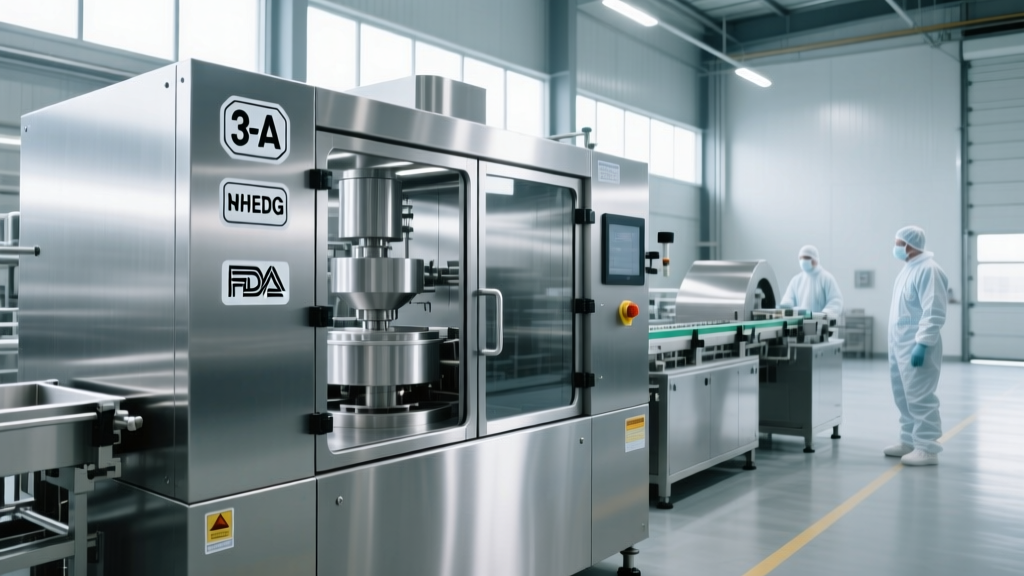
Regulatory Context: Under the FDA Food Safety Modernization Act (FSMA), preventive controls mandate that equipment design must not harbor pathogens. Budgeting for sub-standard materials or improper slope drainage will result in failed third-party GFSI audits (SQF/BRC), effectively halting your production before it begins.OpEx Realities: Energy, Water, and Maintenance
The operational footprint of industrial food processing machinery dictates your long-term margin viability. Consider the utility consumption of thermal processing versus cold-chain processing:
- Thermal Processing (Retorts, Pasteurizers): High natural gas and steam consumption. A continuous tubular pasteurizer running 16 hours a day can consume upwards of 4,000 lbs of steam per hour. Budget for a high-efficiency boiler and a steam condensate recovery system to reduce thermal OpEx by up to 22%.
- Cold-Chain & Freezing (Spiral Freezers, Chillers): High electrical draw. Industrial spiral freezers require massive compressor loads. Specifying equipment with EC (electronically commutated) fan motors and variable-speed compressors increases CapEx by 8% but reduces annual electrical OpEx by 15% to 18%.
- Water Usage: A single multi-stage CIP cycle can consume 1,500 to 3,000 gallons of water. Implementing water reclamation tanks and optimizing CIP conductivity sensors to cut rinse cycles short can save $40,000+ annually in municipal water and effluent discharge fees.
Financing vs. Leasing: A Decision Matrix
How you acquire the machinery impacts your tax liability and cash flow. Use this matrix to determine the optimal acquisition strategy for your 2026 budget:
Equipment Financing
Best for: Core machinery with a 10+ year lifespan (e.g., GEA separators, APV homogenizers).
Advantage: You own the asset. Qualifies for IRS Section 179 deductions or MACRS depreciation, significantly offsetting first-year tax burdens.
Operating Lease
Best for: Rapidly depreciating tech or secondary packaging equipment (e.g., checkweighers, vision inspection systems, robotics).
Advantage: Keeps debt off the balance sheet. Payments are fully deductible as operating expenses. Easy to upgrade at end-of-term.
Government Grants
Best for: Rural facilities or value-added agricultural processing expansions.
Advantage: Non-dilutive capital. Programs like the USDA Rural Business Development Grants can subsidize up to 50% of specialized processing equipment costs.
Step-by-Step Budget Allocation Strategy
To prevent capital bottlenecks during the commissioning phase, structure your equipment budget using this 5-step allocation model:
- Base Equipment (60%): The invoice price of the primary machinery, including standard PLC packages and base conveyors.
- Freight & Rigging (5%): Heavy-haul trucking, crane rentals for roof hatches, and specialized millwright labor for precision leveling.
- Utility & Infrastructure (15%): Electrical drops, steam piping, compressed air lines, and sanitary drainage modifications.
- Automation & Integration (10%): SCADA licensing, Ethernet/IP networking, MES (Manufacturing Execution System) API integration, and custom HMI programming.
- Contingency & Validation (10%): Reserved for FAT/SAT (Factory/Site Acceptance Testing) travel, IQ/OQ/PQ validation documentation, and unforeseen structural reinforcements.
"The most expensive mistake in food plant expansion isn't buying the wrong machine; it's failing to budget for the utility matrix that supports it. A $400,000 aseptic filler is useless if your facility's boiler cannot sustain the required 140°C steam sterilization cycle without dropping plant-wide pressure."
— Director of Engineering, Mid-Scale Dairy Cooperative
Finalizing Your 2026 Procurement Strategy
Budgeting for industrial food processing machinery demands a shift from simple price comparison to comprehensive systems engineering. By applying the 1.3x integration multiplier, specifying 316L hygienic standards, and modeling utility consumption against local municipal rates, you transform your CapEx request from a speculative expense into a predictable, ROI-driven investment. Secure your vendor lead times early, lock in your sanitary piping contractors, and ensure your facility infrastructure is prepared to support the machinery before it arrives on the dock.