Food Processing Machinery Troubleshooting: VFD and Motor Diagnostics
Diagnose VFD faults, prevent bearing fluting, and select IP69K washdown motors with this expert troubleshooting guide for food processing machinery.
Industrial food environments subject electric motors and Variable Frequency Drives (VFDs) to extreme thermal, chemical, and electrical stresses. When food processing machinery goes offline due to drive or motor failures, the resulting downtime can cost mid-sized processors between $10,000 and $25,000 per hour in lost throughput and spoiled product. Unlike standard manufacturing environments, food and beverage facilities require rigorous high-pressure washdowns using caustic sanitizers, creating a uniquely hostile operating environment for electrical components.
This guide provides advanced troubleshooting frameworks for diagnosing VFD faults, mitigating VFD-induced bearing fluting, and making data-driven repair versus replace decisions for washdown-rated motors.
The Washdown Crucible: Chemical Degradation of Seals and Enclosures
Motor failure in food processing machinery rarely originates from electrical winding burnout; it begins at the mechanical seal interface. High-pressure washdowns (often exceeding 1,500 PSI at 180°F) force moisture past degraded seals, leading to stator ground faults. The primary culprit is chemical incompatibility between the sanitizer and the elastomer seal material.
CRITICAL WARNING: Never use standard Buna-N (Nitrile) seals in food processing washdown zones. Buna-N swells and degrades rapidly when exposed to quaternary ammonium compounds (Quats) and peracetic acid (PAA), leading to catastrophic seal failure within 3 to 6 months.Elastomer Chemical Compatibility Matrix
| Sanitizer Chemical | EPDM (Ethylene Propylene) | Viton (FKM / Fluoroelastomer) | PTFE (Teflon) |
|---|---|---|---|
| Peracetic Acid (PAA) | Excellent (Recommended) | Poor (Degrades rapidly) | Excellent |
| Quaternary Ammonium (Quats) | Excellent | Fair to Good | Excellent |
| Chlorine Dioxide | Fair (Concentration dependent) | Good | Excellent |
| Caustic Soda (NaOH) | Excellent | Poor | Excellent |
Source: Data synthesized from 3-A Sanitary Standards, Inc. material compatibility guidelines for dairy and meat processing environments.
Diagnosing VFD Fault Codes in High-Moisture Zones
VFDs controlling food processing machinery are frequently housed in NEMA 4X or IP66 stainless steel enclosures. While these enclosures block water ingress, they trap internal condensation due to rapid temperature fluctuations between hot washdowns and cold ambient air. This internal moisture leads to intermittent ground faults and overcurrent trips.
According to the U.S. Department of Energy, improper VFD environmental controls account for nearly 30% of premature drive failures in heavy industry. In food processing, this number is significantly higher due to caustic aerosolization.
Common VFD Faults and Targeted Remediation
| Fault Type | Typical Code (Danfoss / ABB) | Root Cause in Food Processing | Actionable Fix |
|---|---|---|---|
| Earth/Ground Fault | Danfoss: Warning 14 ABB: F0004 |
Moisture ingress in the motor junction box or degraded cable insulation from caustic exposure. | Megger test the motor windings at 500V DC. Inspect cable glands for micro-cracks. Replace standard cables with VFD-rated, shielded cables with PUR (Polyurethane) jackets. |
| Overvoltage | Danfoss: Warning 5 ABB: F0002 |
Deceleration of high-inertia loads (e.g., industrial mixers, centrifuges) pushing regenerative energy back to the DC bus. | Increase deceleration ramp time (e.g., from 2s to 10s) or install a dynamic braking resistor rated for the specific inertia load. |
| Overcurrent | Danfoss: Warning 16 ABB: F0001 |
Mechanical binding in the driven equipment (e.g., seized conveyor bearings, product jam in a grinder) or sudden load spikes. | Disconnect the motor from the load. Spin the driven shaft manually. If binding is present, rebuild the mechanical drive. If free-spinning, check VFD IGBT modules for short circuits. |
The Silent Killer: VFD-Induced Bearing Fluting
When troubleshooting food processing machinery, maintenance teams often replace a failed motor bearing, only to see it fail again within 2,000 hours. If the motor is driven by a VFD, the root cause is likely Electrical Discharge Machining (EDM) bearing fluting.
VFDs output high-frequency Pulse Width Modulation (PWM) voltage waveforms. This creates a common-mode voltage that capacitively couples to the motor shaft. When the shaft voltage exceeds the dielectric breakdown threshold of the bearing lubricant film (typically 15 to 30 volts), micro-arcing occurs. This electrical discharge melts microscopic pits into the bearing raceway, eventually forming a washboard-like pattern known as fluting.
Mitigation Strategies and Cost Analysis
As outlined by the National Electrical Manufacturers Association (NEMA), mitigating shaft currents is essential for inverter-duty motors. You have two primary engineering solutions:
- Shaft Grounding Rings (e.g., AEGIS SGR): These rings feature conductive microfibers that encircle the motor shaft, providing a path of least resistance for shaft currents to bypass the bearings and return to the VFD ground.
- Cost: $120 - $250 per ring.
- Installation: Retrofitted on the drive end (DE) of the motor. Requires cleaning the shaft with emery cloth to ensure zero-resistance contact.
- Hybrid Ceramic Bearings: Replacing the standard steel ball bearings on the non-drive end (NDE) with silicon nitride (Si3N4) ceramic balls. Ceramic is a natural electrical insulator, completely blocking the current path.
- Cost: $400 - $850 per bearing (depending on frame size).
- Installation: Requires a motor shop to press out the old bearing and press in the hybrid bearing. Best specified as an OEM option when purchasing new motors.
The Optimal Configuration: For motors over 100 HP driving critical food processing machinery (like high-speed slicers or homogenizers), use a hybrid ceramic bearing on the NDE and a shaft grounding ring on the DE. This dual approach provides 100% protection against EDM fluting.
Repair vs. Replace Decision Matrix for Washdown Motors
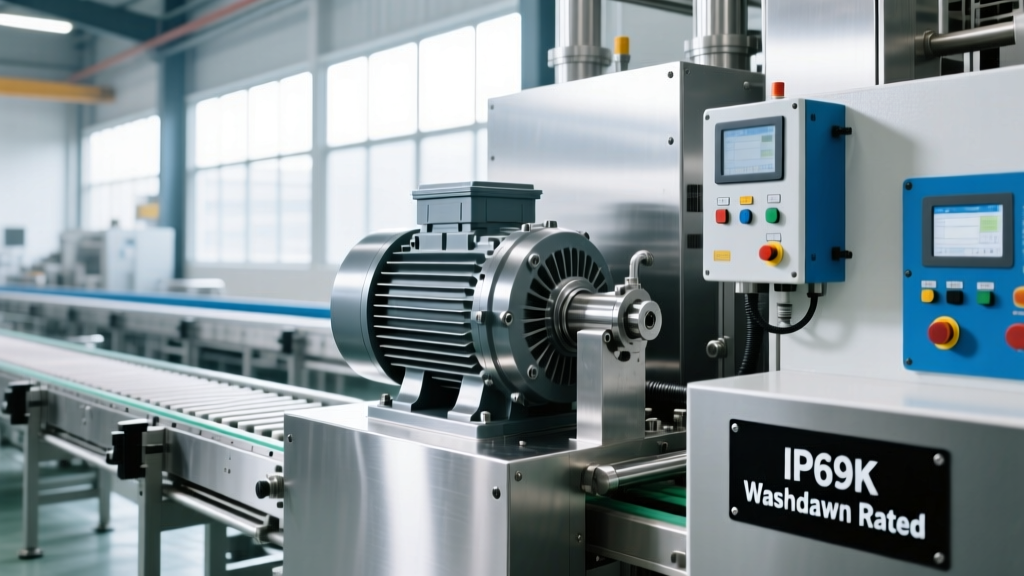
Deciding whether to rewind a failed washdown motor or replace it outright requires analyzing the enclosure rating and material composition. Standard NEMA 1 or NEMA 3R motors are easily rewound. However, IP69K and NEMA 4X stainless steel motors present unique financial challenges.
| Motor Specification | Estimated 2026 Replacement Cost | Rewind/Repair Viability | Strategic Recommendation |
|---|---|---|---|
| Cast Iron NEMA 4X (Epoxy coated) | $1,200 - $2,500 | High. Standard motor shops can rewind and re-coat with two-part epoxy. | Repair if under 50 HP. Replace if the cast iron housing shows severe pitting from acidic sanitizers. |
| 304 Stainless Steel NEMA 4X | $2,800 - $5,500 | Medium. Stator removal from 304 SS housings often damages the housing seal interfaces. | Replace. The labor cost of a specialized SS motor rewind often exceeds 75% of the cost of a new unit. |
| 316L Stainless Steel IP69K | $4,500 - $9,000+ | Low. 316L housings are precision-machined; rewind shops rarely have the tooling to reseal them to IP69K standards. | Always Replace. Attempting to rewind an IP69K motor voids the washdown integrity. Keep a critical spare on the shelf. |
Final Diagnostic Protocol
When a food processing motor trips the VFD, follow this exact sequence before authorizing a purchase order for a replacement:
- Step 1: Lockout/Tagout (LOTO) the VFD and disconnect the motor leads at the junction box.
- Step 2: Perform a 1-minute Megger test at 500V DC. Readings below 2 Megohms indicate moisture ingress or winding degradation.
- Step 3: If Megger is acceptable, perform a 100A micro-ohm surge comparison test to detect turn-to-turn shorts that a standard multimeter will miss.
- Step 4: Inspect the drive-end bearing for fluting. If fluting is present, mandate the installation of a shaft grounding ring upon reinstallation, regardless of whether the motor is rewound or replaced.
By shifting from reactive component swapping to root-cause electrical and chemical analysis, maintenance teams can extend the mean time between failures (MTBF) of food processing machinery by 40% or more, directly protecting the facility's bottom line.