Meat Processing Equipment Manufacturers: 2026 Technical Guide
Explore technical specifications, servo-drive engineering, and hygienic design standards from top meat processing equipment manufacturers in 2026.
Engineering the Modern Meat Processing Line
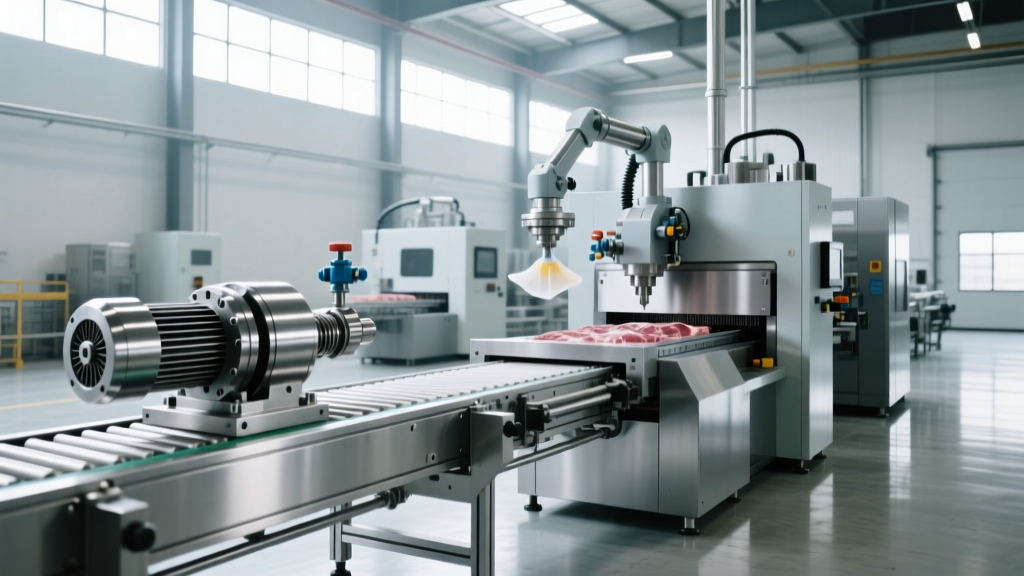
Selecting among meat processing equipment manufacturers requires looking past marketing brochures and evaluating the underlying mechanical engineering, metallurgy, and automation architecture. As of 2026, the industry has largely transitioned from hydraulic and pneumatic actuation to fully servo-driven, IoT-integrated systems. This shift has pushed Overall Equipment Effectiveness (OEE) in high-volume plants from an average of 65% to over 82%. This guide breaks down the technical specifications, failure modes, and hygienic design standards of the primary machinery categories produced by leading OEMs like Handtmann, Weber, Provisur, and Marel.
2026 Industry Baseline: Modern Tier-1 meat processing lines now mandate IP69K-rated control enclosures and 316L (1.4404) stainless steel for any zone exposed to curing salts or aggressive alkaline foaming detergents. Standard 304 stainless is no longer sufficient for high-chloride environments.Hygienic Design & Metallurgical Specifications
Before evaluating throughput, plant engineers must verify the hygienic engineering of the equipment. The North American Meat Institute (NAMI) established 10 Sanitary Design Principles that dictate modern OEM manufacturing. Furthermore, compliance with the FDA FSMA Preventive Controls requires equipment that prevents microbial harborage.
Surface Finish and Biofilm Prevention
Listeria monocytogenes biofilms can anchor to microscopic surface defects. Leading manufacturers now electropolish food-contact surfaces to achieve a surface roughness (Ra) of less than 0.8 µm. When evaluating a manufacturer's specs, request the mill certificates and surface profilometry reports. If a manufacturer only guarantees a standard 2B mill finish (which typically ranges from 1.0 to 1.5 µm Ra), the equipment will require more frequent chemical sanitation and carries a higher biological risk.
IP69K Washdown Ratings
IP69K is the highest ingress protection rating, certifying that electrical enclosures can withstand high-pressure (up to 100 bar), high-temperature (80°C) washdowns. In 2026, top-tier manufacturers integrate HMI touchscreens directly into IP69K-sealed stainless steel bezels, eliminating the gasket failures common in older drop-down pendant designs.
Vacuum Fillers & Continuous Stuffing Systems
Handtmann dominates the vacuum filler segment with its vane cell feed system. Unlike traditional piston stuffers that cause smearing and pressure spikes, the vane cell mechanism uses a rotating rotor with sliding vanes to transport the meat emulsion under a continuous vacuum.
| Specification | Standard Piston Stuffer | Vane Cell Vacuum Filler (e.g., Handtmann VF 800 Series) |
|---|---|---|
| Vacuum Level | Atmospheric / Low Vacuum | -0.8 to -1.0 bar (Adjustable) |
| Portioning Accuracy | ±5g to ±10g | ±1g at 1,000 portions/min |
| Emulsion Smearing | High (Pressure spikes at valve) | Minimal (Continuous flow) |
| Air Pocket Elimination | Poor | Excellent (Extends shelf life) |
| 2026 Pricing Range | $25,000 - $60,000 | $110,000 - $240,000 |
Failure Mode: Vacuum Pump Cavitation
A common edge case in vacuum fillers occurs when the product viscosity drops (e.g., high-fat emulsions at elevated temperatures). The liquid-ring vacuum pump can experience cavitation if the sealing water temperature exceeds 35°C. Engineers must ensure the OEM provides a closed-loop chilled water system for the vacuum pump to maintain the -1.0 bar vacuum required to extract trapped air from lipid-heavy formulations.
High-Speed Slicing: Servo vs. Hydraulic Actuation
Companies like Weber Maschinenbau and Provisur have entirely phased out hydraulic drives in their flagship slicers (such as the Weber I-Cut 910) in favor of multi-axis servo motors. Servo-driven blades offer precise torque control, allowing the blade to decelerate slightly during the cut of a dense frozen block and accelerate through softer fat layers, maintaining a uniform slice thickness from 0.5mm to 50mm.
Hydraulic Slicers (Legacy)
- Precision: Prone to thermal drift as hydraulic fluid heats up, altering slice thickness by up to 1.5mm over an 8-hour shift.
- Maintenance: High risk of hydraulic oil leaks contaminating the product zone.
- Energy: Constant pump run generates excess ambient heat in the slicing room.
Servo-Driven Slicers (2026 Standard)
- Precision: Optical encoders provide ±0.1mm thickness tolerance regardless of runtime temperature.
- Maintenance: Sealed gearboxes; zero risk of fluid contamination.
- Energy: Regenerative braking captures kinetic energy, reducing power draw by up to 22%.
Blade Deflection and Edge Geometry
When slicing partially frozen meat (-4°C to -2°C), lateral blade deflection causes 'shingling' and uneven weights. Top manufacturers utilize sickle-shaped blades with a specialized bevel geometry. The blade edge is ground to a 15-degree primary bevel with a micro-bevel of 22 degrees to prevent edge chipping when striking bone fragments or dense connective tissue. Expect to pay $180,000 to $350,000 for a fully automated, servo-driven slicer with integrated loading and interleaving systems.
Waterjet Portioning and 3D Vision Systems
For raw, boneless proteins where mechanical blades cause excessive yield loss through drag and tearing, manufacturers like Marel utilize high-pressure waterjet portioning. The European Hygienic Engineering & Design Group (EHEDG) recognizes waterjet cutting as a premier hygienic method because it eliminates the physical blade—a primary vector for cross-contamination.
Fluid Dynamics of Meat Cutting
Waterjet portioners operate by pressurizing water to 4,000 bar (approx. 58,000 psi) using intensifier pumps. The water is forced through a diamond orifice measuring just 0.15mm in diameter. Unlike industrial metal-cutting waterjets that use garnet abrasives, meat portioning relies on pure water. The kinetic energy of the supersonic water stream shears the protein matrix cleanly without transferring heat, ensuring the meat surface remains at its core temperature, which is critical for preventing bacterial proliferation prior to packaging.
"The integration of 3D laser scanning upstream of the waterjet nozzle allows the software to calculate the exact volumetric density of an irregularly shaped pork loin, adjusting the cut paths in real-time to guarantee fixed-weight portions with a yield loss of less than 1.5%."
Buyer’s Decision Framework: Matching OEM to Application
Do not default to the most expensive brand. Match the manufacturer's engineering focus to your specific product matrix.
- High-Volume Sausage & Emulsions (>5 tons/hour): Prioritize Handtmann or Vemag. Focus your evaluation on the vane cell wear-ring replacement intervals and the accuracy of the co-extrusion alginate casing systems.
- Delicatessen & Ultra-Thin Slicing (0.5mm - 2mm): Weber and Provisur are the technical leaders. Require a site acceptance test (SAT) measuring 'giveaway' (overweight portions) over a continuous 4-hour run.
- Raw Portioning & Yield Optimization: Marel and JBT FoodTech. Evaluate the refresh rate of their 3D vision cameras (must be >60 fps to handle high-speed conveyor throughput) and the maintenance schedule of the intensifier pumps.
Maintenance & IoT Predictive Analytics
In 2026, the differentiator among meat processing equipment manufacturers is not just the mechanical build, but the edge-computing capabilities embedded in the PLC. Modern slicers and fillers utilize high-frequency vibration sensors on main drive bearings. By analyzing the acoustic signature of the gearbox, the system can predict bearing failure 300 to 500 operating hours before catastrophic seizure. When issuing an RFP, mandate that the OEM provides open API access to these IoT telemetry streams so the data can be ingested directly into your plant's existing CMMS (Computerized Maintenance Management System) rather than being locked behind a proprietary, subscription-based OEM portal.
Related reading
Machinery CNC News Essentials: Precision, Automation, and Real-World Impact in Food Processing
2026 Budget Guide: Top European Bakery Equipment Manufacturers