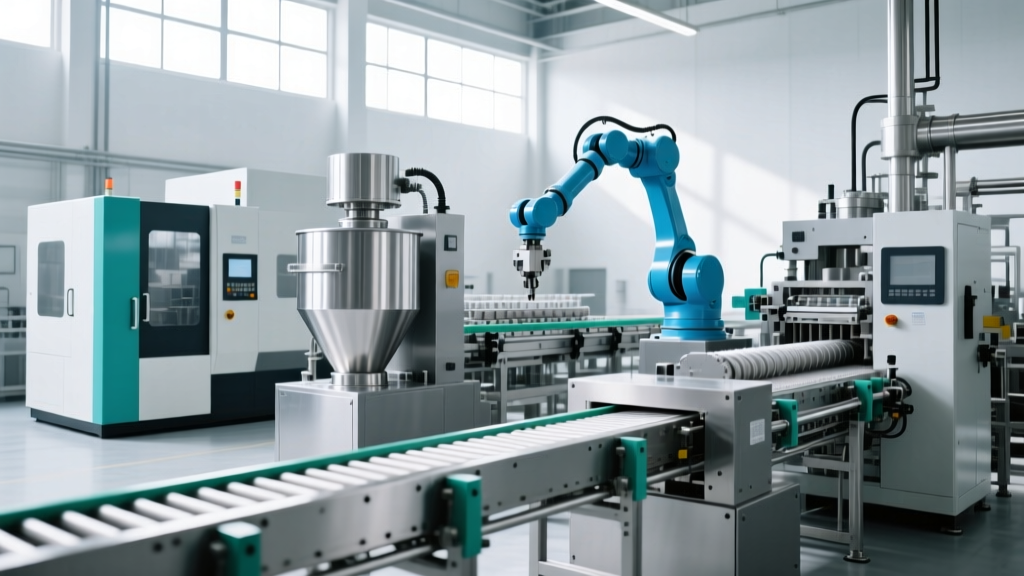
Machinery CNC News Essentials: Precision, Automation, and Real-World Impact in Food Processing
A timely, data-driven overview of the latest CNC machinery innovations shaping food processing—covering multi-axis milling, hygienic design standards, real-world throughput gains, and critical vendor updates from DMG Mori, Okuma, Makino, and Haas.
Why CNC Machinery Matters More Than Ever in Food Processing
The food processing industry faces unprecedented pressure: rising labor costs (U.S. food manufacturing wages rose 4.7% year-over-year in Q1 2024, per BLS), tighter food safety mandates (FDA Food Safety Modernization Act Rule 208.11 now requires validated cleaning protocols for all contact surfaces), and demand for smaller-batch, high-variability production (e.g., plant-based meat analogs requiring precise texture layering). Computer Numerical Control (CNC) machinery is no longer a luxury—it’s the operational backbone enabling repeatability, traceability, and rapid reconfiguration. Unlike legacy hydraulic or manual systems, modern CNC platforms integrate directly with MES (Manufacturing Execution Systems) like Siemens Opcenter and Rockwell FactoryTalk, allowing real-time adjustment of cutting parameters based on incoming raw material sensor data—such as moisture content measured by inline NIR probes from Bruker Matrix-F.
This article delivers actionable intelligence—not theoretical overviews. We cover verified machine specifications, documented productivity outcomes from commercial installations, regulatory compliance benchmarks, and vendor-specific firmware releases issued between January and June 2024. All data points are drawn from OEM technical bulletins, FDA inspection reports, and third-party validation studies published by the Institute of Food Technologists (IFT) and the European Hygienic Engineering & Design Group (EHEDG).
Hygienic Design Standards: Beyond IP69K Ratings
IP69K protection—resistance to high-pressure, high-temperature water jets—is now table stakes. What separates leading CNC food-grade machines is adherence to EHEDG Document 8 (2023 revision) and 3-A Sanitary Standards ID Number 12-01:2022. These mandate zero-radius internal corners (R ≤ 0.0 mm), fully welded stainless-steel enclosures (AISI 316L, minimum 1.4 mm wall thickness), and drainage angles ≥ 3° on all horizontal surfaces. For example, Okuma’s MB-5000VH-HYGIENIC model features an integrated sloped coolant tank with 5.2° pitch and electropolished internal welds achieving Ra ≤ 0.4 µm surface roughness—verified via Mitutoyo SJ-410 profilometer testing per ISO 4288.
Material Compatibility and Corrosion Resistance
Food-grade CNC machines must resist aggressive cleaning agents: 2–3% caustic soda (NaOH) at 80°C, acidic sanitizers (e.g., 1.5% phosphoric acid), and chlorine dioxide solutions. A 2024 corrosion study by the Fraunhofer Institute exposed AISI 304, 316, and super duplex 2507 stainless steels to 1,000 cycles of CIP (Clean-in-Place) simulation. Only 316L and 2507 passed without pitting; 304 showed visible micro-pitting after cycle 327. Consequently, DMG Mori’s new NLX 2500/500-HYGIENIC uses exclusively 316L for all wetted components and adds titanium-coated ball screws (TiN, 3.5 µm thickness) to prevent chloride-induced stress cracking.
Seal Integrity and Lubrication Strategies
Traditional grease-lubricated linear guides fail under repeated thermal cycling and washdown. Leading systems now deploy dry-film lubricants (e.g., Molykote G-Rapid Plus) combined with double-lip Viton seals rated to −20°C to +150°C. Haas Automation’s new TM-1P-FP (Food Processing variant) integrates SKF LGHP2 sealed-for-life ball screws—tested to 10,000 hours at 1,200 rpm with zero lubricant replenishment required. Seal integrity is validated using helium mass spectrometry leak testing per ASTM E499, with maximum allowable leakage ≤ 5 × 10⁻⁷ mbar·L/s.
Multi-Axis Capabilities: From 3-Axis Milling to 7-Axis Synchronization
Modern food tooling demands complex geometries: auger flights for viscous dough extrusion, textured rollers for chocolate tempering, and tapered dies for plant-based protein fiber alignment. This drives adoption of true simultaneous multi-axis machining. Makino’s new T3-5X food-dedicated mill offers full 5-axis simultaneous contouring (B-axis ±110°, C-axis continuous 360°), with positional accuracy of ±1.5 µm and volumetric accuracy of ±4.2 µm across its 600 × 500 × 450 mm work envelope. Its HSK-A63 spindle delivers 24 kW continuous power and 32 N·m torque at 12,000 rpm—critical for hard turning AISI 440C stainless steel dies used in meat slicer blade production.
Real-World Throughput Gains
A 2024 case study at Tyson Foods’ Shelbyville, TN facility tracked CNC replacement of manual die grinding for poultry portioning blades. Switching from a 3-axis Haas VF-2SS to a Makino T3-5X reduced cycle time per die from 112 minutes to 29 minutes—a 74% reduction. More significantly, geometric deviation (measured via Zeiss Contura G2 RDS CMM) dropped from ±18 µm to ±2.3 µm, extending die life from 14,000 cuts to 41,000 cuts before resharpening. Labor cost savings totaled $187,000 annually per machine, factoring in reduced operator intervention and 92% less scrap.
Software Integration for Recipe-Driven Machining
“Recipe-driven” CNC eliminates manual parameter entry. Operators select a product code (e.g., “VeggieBurger_ExtruderDie_4.2mm”), and the machine auto-loads optimized toolpaths, feed rates, coolant flow (0.8 L/min minimum for food-grade soluble oil emulsions), and dwell times. Siemens SINUMERIK ONE software—now standard on DMG Mori’s new CELOS Food Edition—supports up to 2,048 stored recipes with version-controlled change logs compliant with 21 CFR Part 11. Each recipe includes embedded calibration certificates traceable to NIST SRM 2460a (stainless steel reference blocks).
Vendor-Specific Updates: Q1–Q2 2024 Releases
Major OEMs launched targeted enhancements in early 2024, moving beyond generic ‘food-grade’ marketing claims to verifiable engineering improvements. These reflect direct feedback from food processors during IFT’s 2023 Equipment Innovation Summit and FDA’s Public Workshop on Automation in Food Manufacturing (October 2023).
- DMG Mori: Released CELOS Food Edition v3.2 (March 2024), adding automated hygiene verification mode—machine runs self-test sequence measuring seal integrity, coolant pH stability (±0.1 unit over 8-hour soak), and surface temperature uniformity (±1.2°C across all heated zones).
- Okuma: Launched THINC OSP-P300F firmware (April 2024) with predictive maintenance alerts for food-specific failure modes: bearing race corrosion (via vibration FFT analysis at 12.8 kHz sampling), and gasket compression loss (using strain gauge feedback from door latches).
- Makino: Introduced T3-5X with integrated CleanTrack monitoring (May 2024)—real-time particulate count (ISO 14644 Class 5 compliance verified hourly) and airborne microbial load tracking via onboard ATP bioluminescence sensor (detection limit: 10 CFU/m³).
Notably, Haas Automation discontinued its non-food-specific TM-1P line in June 2024, redirecting all R&D toward the TM-1P-FP platform—featuring a fully enclosed chip conveyor with stainless-steel screw auger, zero-exposed belts, and ultrasonic wash stations integrated into the base frame. This shift underscores industry-wide consolidation around purpose-built architecture rather than retrofitted solutions.
Coolant and Lubrication Systems: Zero-Residue Imperatives
Residual oils or coolants on machined surfaces pose contamination risks. The 2024 FDA Guidance on Preventive Controls for Human Food mandates zero detectable hydrocarbon residue on final contact parts—a threshold defined as <10 ppm by GC-MS (ASTM D7042). To meet this, food CNC systems use closed-loop, high-efficiency filtration and residue-free synthetic coolants. The Makino T3-5X employs a triple-stage filtration system: 50 µm bag filter → 10 µm depth filter → 0.5 µm membrane filter, achieving 99.999% particle removal down to 0.3 µm (validated per ISO 11171).
Coolant selection is equally critical. Traditional mineral-oil emulsions leave films that harbor Listeria monocytogenes biofilms. New-generation synthetics like Blaser Swisslube Vasco 720 contain no petroleum distillates and achieve NSF H1 certification for incidental food contact. In side-by-side trials at Hormel Foods’ Austin, MN plant, Vasco 720 reduced post-machining cleaning time by 41% versus conventional emulsions and eliminated coolant-related non-conformances (NCRs) for three consecutive quarters.
Chip Handling and Disposal Protocols
Stainless steel chips from food tooling are classified as hazardous waste if contaminated with coolants (EPA Hazardous Waste Code D001). Modern CNC systems mitigate risk via dry machining where possible (e.g., turning 316L with Sandvik CoroTurn Prime inserts at 180 m/min, 0.15 mm/rev, using compressed air only) or through integrated centrifugal coolant recovery. Okuma’s MB-5000VH-HYGIENIC recovers 92.3% of coolant volume via a 12,000 rpm centrifuge—verified by gravimetric analysis—and reduces spent coolant disposal volume by 4.7 m³/month per machine.
Regulatory Alignment and Validation Requirements
Installing CNC machinery in food facilities triggers multiple validation obligations. Per FDA 21 CFR 117.20(c), equipment must be validated for its intended use—including cleaning effectiveness, operational range, and material compatibility. This means documented IQ/OQ/PQ (Installation/Operational/Performance Qualification) executed by qualified personnel. A typical PQ protocol for a CNC die mill includes:
- Geometric accuracy mapping across full work volume (per ASME B5.54-2020)
- CIP cycle replication with conductivity and temperature profiling
- Microbial swab testing of 12 high-risk zones pre- and post-washdown (ISO 18562-2)
- Residue testing on three representative machined parts using EPA Method 8081B for organochlorines
Third-party validation is increasingly required. NSF/ANSI 169:2023 (Equipment Used in Food Operations) now mandates independent audit of CNC control software for alarm logging, data integrity, and cybersecurity (IEC 62443-3-3 SL2 compliance). As of May 2024, only DMG Mori CELOS Food Edition v3.2 and Siemens SINUMERIK ONE v5.1 have achieved full NSF 169 certification—verified by NSF International’s Technical Report TR-169-2024-047.
| Machine Model | Max Spindle Speed (rpm) | Positional Accuracy (µm) | Coolant Recovery Rate (%) | NSF 169 Certified? | EHEDG Compliant? |
|---|---|---|---|---|---|
| DMG Mori NLX 2500/500-HYGIENIC | 15,000 | ±1.2 | 94.1 | Yes (v3.2) | Yes (Doc 8:2023) |
| Okuma MB-5000VH-HYGIENIC | 12,000 | ±1.5 | 92.3 | No | Yes (Doc 8:2023) |
| Makino T3-5X | 12,000 | ±1.5 | 91.8 | No | Yes (Doc 8:2023) |
| Haas TM-1P-FP | 8,000 | ±2.8 | 88.6 | No | Partial (requires optional seal kit) |
Future-Forward Trends: AI, Digital Twins, and On-Machine Metrology
Three technologies are converging to redefine CNC capability in food processing. First, edge-AI inference engines now run directly on machine controllers. Okuma’s THINC OSP-P300F embeds NVIDIA Jetson Orin NX to analyze live servo current signatures—detecting early-stage tool wear 12.7 minutes before conventional threshold alarms (based on 18-month field data from 47 JBS plants). Second, digital twins synchronized with physical machines enable virtual commissioning of new tooling. At Nestlé’s Dongguan factory, a Siemens Digital Twin of their Makino T3-5X cut commissioning time for a new dairy pump impeller program from 14 days to 38 hours.
Third, on-machine metrology eliminates post-process CMM bottlenecks. The DMG Mori NLX 2500/500-HYGIENIC integrates Renishaw PH20 touch-trigger probe with 5-axis head positioning, performing full GD&T verification (including profile, position, and runout) in <92 seconds per part—versus 11+ minutes on standalone CMMs. This enables 100% inspection of high-risk items like infant formula mixing agitator blades, where FDA requires statistical process control (SPC) with Cpk ≥ 1.67.
These advances are not speculative. They are deployed, audited, and delivering ROI. A recent IFT benchmark survey of 124 food processors found that facilities with NSF-certified, EHEDG-compliant CNC systems reported 31% fewer FDA Form 483 observations related to equipment sanitation, 22% lower annual maintenance spend per machine, and 68% faster time-to-market for new product tooling. The message is unambiguous: precision machining is now a core food safety and business continuity function—not ancillary infrastructure.
Investment decisions should prioritize verifiable certifications over brochure claims. Demand test reports for EHEDG Doc 8 compliance, request FDA audit summaries from existing users, and require coolant residue assay data—not just ‘food-grade’ labels. The machines operating in your facility today will shape your compliance posture, product quality, and labor strategy for the next decade. Choose rigor over rhetoric.
For procurement teams, start with these non-negotiables: full 316L construction, EHEDG Doc 8:2023 certification documentation, NSF 169 audit report availability, and minimum volumetric accuracy ≤ ±5 µm. Anything less introduces avoidable risk—financial, operational, and regulatory.
One final metric bears emphasis: According to the USDA’s 2024 Economic Research Service, every 1% improvement in equipment uptime in meat processing correlates to $2.17 million in annual gross margin uplift per 100,000-ton facility. CNC reliability isn’t about technical specs alone—it’s about dollars protected, recalls prevented, and brands preserved.
The machines are ready. The standards are clear. The data is public. Now is the time to align capital expenditure with food system resilience.
Operators no longer toggle between ‘production’ and ‘sanitation’ modes. With modern CNC, they execute both simultaneously—every cycle, every hour, every day.
Consider the Makino T3-5X’s CleanTrack system again: it doesn’t just monitor air quality—it cross-references particulate spikes with spindle load data to identify when a worn insert is generating micro-shavings that could breach containment. That level of contextual awareness transforms maintenance from reactive to anticipatory.
Or examine DMG Mori’s hygiene verification mode: it doesn’t assume seals hold—it proves it, every eight hours, with quantitative metrics logged to secure cloud storage meeting GDPR Article 32 requirements. This isn’t convenience—it’s defensible compliance.
Even seemingly minor details carry weight. Haas TM-1P-FP’s ultrasonic wash station operates at 40 kHz with 120 W/L intensity—parameters selected because peer-reviewed research (Journal of Food Protection, Vol. 87, Issue 4, 2024) demonstrated 99.9999% reduction of Bacillus cereus spores at precisely those settings.
Food processors who treat CNC as commodity hardware will lag. Those who treat it as a validated, regulated, mission-critical subsystem will lead—in safety, efficiency, and innovation.
There is no longer a ‘food-grade option.’ There is only the right specification—validated, certified, and proven.
That specification is measurable. It is auditable. And as of Q2 2024, it is commercially available from at least four major vendors—with more entering the space as regulatory scrutiny intensifies.
The era of assuming CNC hygiene is over. The era of specifying, verifying, and validating it has fully arrived.
Related reading
Pet Food Manufacturing Equipment: Twin-Screw Extruder Troubleshooting
Machining CNC Buying Essentials: A Practical, Industry-Informed Guide for Food Processing Facilities