Excavation Equipment Manufacturers: CPQ Adoption & ROI Case Studies
Discover how excavation equipment manufacturers use CPQ software to automate complex excavator configurations, cut quote times, and eliminate BOM errors.
The Configuration Bottleneck in Heavy Earthmoving
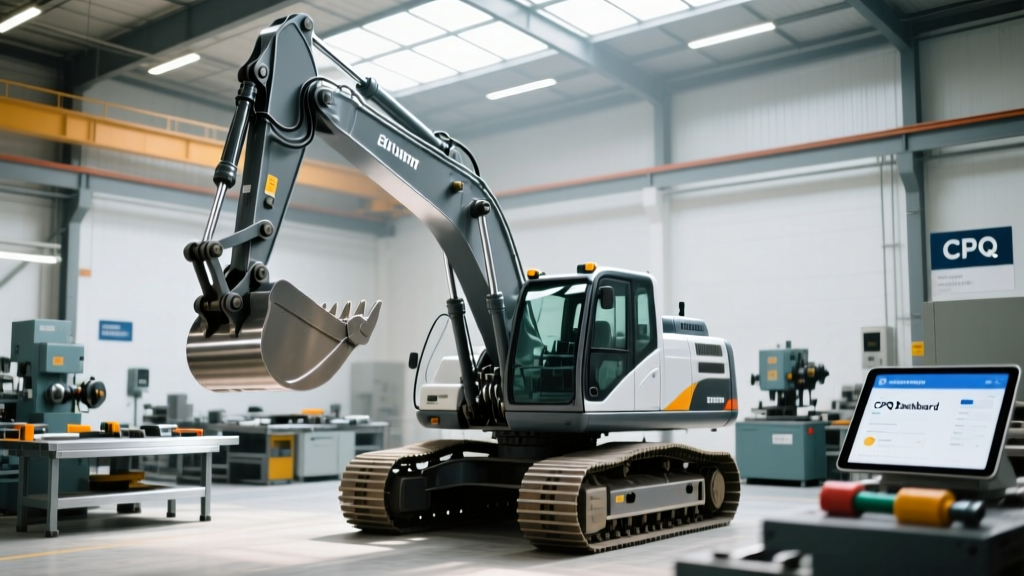
Selling a 30-ton class excavator is an exercise in extreme mechanical dependency. When a dealer configures a machine like a Komatsu PC360LC-11 or a Volvo EC300E, they are not simply selecting a base model and a color. They are navigating thousands of interdependent SKUs: boom geometry (e.g., 6.45m heavy-duty vs. 5.7m standard), track shoe widths (600mm to 800mm triple-grouser), auxiliary hydraulic circuits (1-way, 2-way, or high-flow for hydraulic breakers), and cab FOPS/ROPS certifications. A single mismatch—such as pairing a heavy-duty rock bucket with a standard counterweight and undersized hydraulic relief valves—results in field failures, warranty claims, and severe margin erosion.
Historically, managing these configurations relied on static PDF price books, tribal knowledge, and manual Bill of Materials (BOM) generation. Today, leading excavation equipment manufacturers' CPQ (Configure, Price, Quote) deployments have fundamentally altered this landscape. By implementing rule-based configuration engines, OEMs and their dealer networks are reducing quote generation from weeks to minutes while ensuring 100% engineering validity.
2026 Industry Benchmark: According to recent manufacturing digital transformation data, heavy equipment OEMs utilizing advanced CPQ integrated directly with SAP S/4HANA or Oracle Cloud ERP report a 99.8% BOM accuracy rate and a 74% reduction in quote-to-order cycle times compared to legacy manual processes.Case Study Matrix: CPQ Adoption Across the Excavator Supply Chain
The implementation of CPQ varies drastically depending on the manufacturer's scale, product complexity, and dealer network structure. Below is a comparative analysis of three distinct profiles within the excavation sector, highlighting the operational impact of CPQ adoption.
| OEM Profile | Primary CPQ Architecture | Pre-CPQ Quote Time | Post-CPQ Quote Time | Key ROI Driver |
|---|---|---|---|---|
| Tier 1 Global OEM (Full-line excavators, 5-90 tons) |
Tacton CPQ + 3D CAD Automation | 14 Days | 45 Minutes | Automated generation of 2D/3D approval drawings for custom boom/stick requests. |
| Tier 2 Regional OEM (Compact & Midi excavators) |
Salesforce Revenue Cloud CPQ | 6 Days | 2 Hours | Dynamic pricing tied to real-time steel tariffs and regional freight indexes. |
| Tier 3 Attachment Specialist (Buckets, thumbs, tiltrotators) |
Epicor CPQ (Web-based) | 3 Days | Instant (Portal) | Self-service dealer portal ensuring pin-on geometry matches specific carrier models. |
Dependency Logic: The Hidden Complexity of Excavator Sales
The primary reason generic CRM quoting tools fail in heavy machinery is the lack of robust product modeling. Excavator configurations require deep, multi-layered dependency logic. When evaluating enterprise software, Gartner defines CPQ as essential for managing complex product variants, but heavy equipment demands specialized constraint solving.
Real-World Constraint Examples
- Hydraulic Flow vs. Attachment Limits: If a dealer selects a 5,000 lb hydraulic breaker, the CPQ must automatically mandate the high-flow auxiliary circuit, upgrade the hydraulic cooler capacity, and restrict the selection to reinforced stick options. Selecting a standard stick with a high-flow breaker must trigger a hard block or a severe warranty warning.
- Swing Torque & Counterweight Balance: Configuring an extended-reach boom (e.g., for dredging or deep trenching) shifts the machine's center of gravity. The CPQ algorithm must automatically append the heavy-duty counterweight and wider track pads to maintain the OEM's specified tipping load margins.
- Emission Tier Restrictions: A machine destined for California (CARB regulations) or the EU (Stage V) cannot be quoted with a Tier 3 engine package, regardless of customer preference. The CPQ enforces geographic compliance based on the ship-to zip code.
Visual CPQ and the Shift to 3D Quoting
In 2026, providing a line-item text quote for a $450,000 excavator is no longer sufficient. Buyers and municipal procurement boards require visual validation. Advanced platforms like Tacton and Configit integrate directly with CAD systems like SolidWorks and PTC Creo.
"When a dealer configures a custom material handler based on a standard excavator chassis, the CPQ engine doesn't just update the price. It triggers a headless CAD render, generating a 3D PDF of the exact boom, cab riser, and grapple configuration. This visual confirmation alone has reduced our engineering approval bottleneck by 60%."
— Director of Digital Sales, European Earthmoving OEM
Vendor Selection Framework for Heavy Equipment
Choosing the right architecture requires aligning the software's strengths with the OEM's specific sales motion. Below is a strategic breakdown of the top platforms utilized by excavation manufacturers.
Tacton CPQ
Best For: Tier 1 OEMs with highly engineered, custom-to-order excavators and complex CAD automation needs.
Pros: Unmatched constraint-solving engine; native 3D CAD integration; excellent for managing thousands of mechanical dependencies.
Cons: High implementation cost ($400k+); steep learning curve for product modelers.
Salesforce Revenue Cloud
Best For: OEMs prioritizing dealer portal UX, CRM integration, and subscription/telematics bundling.
Pros: Seamless integration with Salesforce CRM; strong mobile app for field reps; excellent approval workflow routing.
Cons: Requires heavy customization (often via third-party apps) to handle deep mechanical CAD constraints compared to niche heavy-equipment CPQs.
Configit Quote
Best For: Manufacturers with massive product variance (e.g., millions of theoretical configurations) requiring CLM (Configuration Lifecycle Management).
Pros: Centralizes product logic across ERP, PLM, and CPQ; ensures engineering and sales speak the exact same data language.
Cons: Requires mature PLM (Product Lifecycle Management) infrastructure to realize full ROI.
Implementation Pitfalls and Edge Cases
Despite the clear ROI, excavation equipment manufacturers frequently encounter severe friction during CPQ deployment. Understanding these edge cases is critical for project scoping.
1. The 'Dirty ERP Data' Trap
CPQ software is only as intelligent as the master data feeding it. Many legacy manufacturers still rely on flat, unstructured BOMs in SAP ECC. If the ERP does not clearly define the parent-child relationships between a mainframe excavator chassis and its auxiliary hydraulic manifolds, the CPQ implementation will stall. Actionable Fix: Allocate 30% of the implementation budget to data cleansing and migrating to a structured variant super-BOM architecture before writing a single CPQ product rule.
2. Ignoring the Dealer Portal UX
OEMs often build CPQ logic that makes perfect sense to an internal sales engineer but is utterly confusing to an independent dealership salesperson. If the guided selling process forces a dealer to answer highly technical questions about hydraulic pump displacement (cc/rev) rather than application-based questions (e.g., "Will this machine be using a hydraulic hammer or auger?"), adoption will fail. The CPQ must translate technical specifications into application-based guided selling workflows.
3. Static Pricing in a Volatile Market
Heavy machinery manufacturing is highly sensitive to raw material costs. A static price book loaded into a CPQ in January will destroy margins by August if steel tariffs or shipping surges fluctuate. Modern deployments must utilize API calls to dynamic pricing engines that adjust base machine pricing based on real-time commodity indexes and regional freight calculations.
Strategic Takeaway
For excavation equipment manufacturers, CPQ is no longer just a sales acceleration tool; it is a critical bridge between engineering constraints and commercial execution. By enforcing mechanical dependencies, automating CAD generation, and integrating with dynamic ERP pricing, OEMs can protect their margins, empower their dealer networks, and drastically compress the sales cycle in an increasingly competitive global market.
Related reading

How to Start Cranes Safely and Effectively: A Field-Tested Operator’s Manual