Excavation Heavy Equipment Specs: Hydraulics & Powertrain Mechanics
Explore the technical specifications of excavation heavy equipment. Learn how load-sensing hydraulics and Tier 4 engines dictate dig force and cycle times.
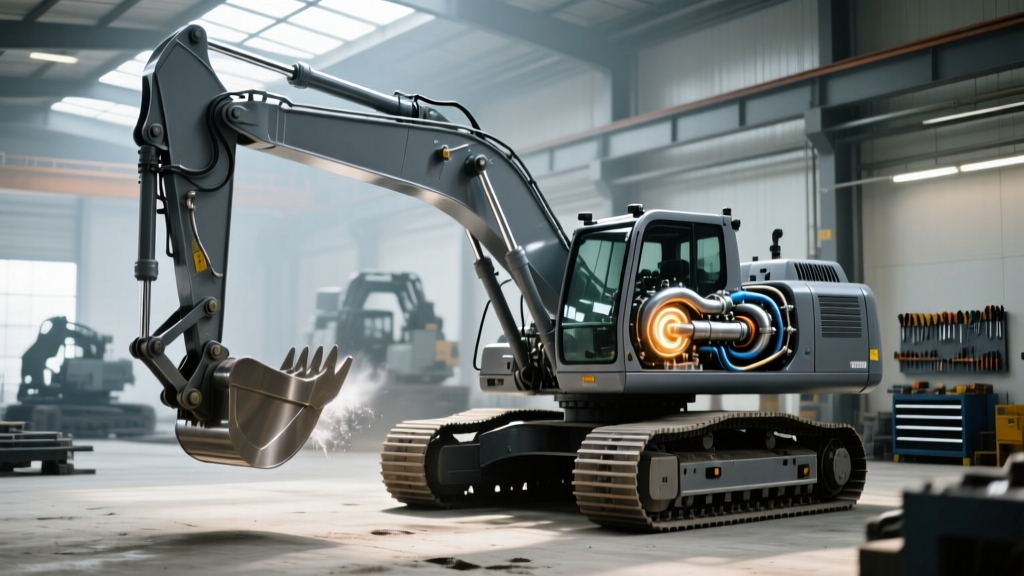
The 20-ton class represents the operational backbone of global excavation heavy equipment. Machines in this category, such as the Caterpillar 320 and Komatsu PC210LC-11, balance transportability with the sheer hydraulic force required for deep trenching, mass earthmoving, and heavy lifting. Understanding the technical specifications of these machines requires looking past the brochure horsepower and examining the fluid dynamics, kinematic geometry, and powertrain integration that dictate real-world cycle times and fuel burn.
20-Ton Class Benchmark Specs (2026 Market Standard)Operating Weight: 20,000 - 22,500 kg
Engine Power Output: 120 - 130 kW (160 - 175 hp)
Standard Bucket Capacity: 0.8 - 1.2 m³
Average Capital Cost: $175,000 - $215,000 USD
Powertrain Dynamics: Tier 4 Final and Stage V Integration
Modern excavation heavy equipment relies on 4.4L to 6.7L displacement turbocharged diesel engines. To meet EPA Tier 4 Final and EU Stage V emission standards, manufacturers have moved away from purely mechanical fuel injection to high-pressure common rail (HPCR) systems operating at injection pressures exceeding 2,000 bar (29,000 psi). This atomizes the fuel more completely, yielding a 5-8% thermal efficiency gain over previous Tier 3 iterations.
However, the integration of Diesel Particulate Filters (DPF) and Selective Catalytic Reduction (SCR) introduces specific operational constraints. According to the EPA's emission standards reference guide, nonroad diesel engines must maintain strict exhaust gas temperature (EGT) thresholds to trigger passive DPF regeneration. In excavation applications characterized by low-load, high-idle scenarios (such as waiting for dump trucks or performing fine grading), EGTs often fail to reach the 250°C (482°F) required for soot oxidation. This forces active regeneration cycles, which inject raw diesel into the exhaust stream, temporarily increasing fuel consumption by up to 4% and requiring the operator to monitor the soot load percentage on the cab display to prevent engine derating.
Load-Sensing Hydraulics: The Muscle Behind the Boom
The defining characteristic of modern excavation heavy equipment is the load-sensing (LS) hydraulic system. Unlike older open-center gear pump systems that constantly dumped excess flow over a relief valve (generating massive heat waste), LS systems utilize variable-displacement axial piston pumps.
Variable Displacement and Swashplate Mechanics
When the operator moves a joystick, a pilot pressure signal is sent to the main control valve. The valve spool shifts, creating a pressure differential between the pump outlet and the load. This differential is fed back to the pump's pressure compensator, which physically alters the angle of the internal swashplate. If the load requires high force (e.g., breaking through caliche soil), the swashplate angle increases, maximizing the stroke of the pistons and delivering maximum flow. If the operator feathers the joystick for fine pipe-laying, the swashplate flattens, reducing flow to near zero while maintaining standby pressure (typically 2,500 kPa or 360 psi) to ensure instant response.
| Hydraulic Parameter | Standard Flow Setup | Heavy Lift / High-Flow Setup |
|---|---|---|
| Main Pump Flow (x2) | 2 x 200 L/min | 2 x 240 L/min |
| Implement Relief Pressure | 35,000 kPa (5,076 psi) | 38,000 kPa (5,511 psi) |
| Travel Circuit Pressure | 35,000 kPa | 37,500 kPa |
| Boom Regeneration Flow | Internal Spool | Dedicated Regen Valve |
Translating Specs to Dig Force: Breakout vs. Arm Force
Brochures often highlight 'bucket breakout force,' but excavation heavy equipment performance relies on the interplay between bucket breakout and arm (stick) crowd force. Breakout force is generated by the bucket cylinder and is measured at the cutting edge of the bucket teeth. In a 20-ton class machine, this typically peaks between 145 kN and 160 kN (32,600 to 36,000 lbf).
Kinematic Trade-off: Specifying a longer arm (e.g., 2.9m vs 2.4m) increases your reach and trench depth but fundamentally reduces the arm crowd force due to the increased moment arm distance from the boom-stick pivot pin. If your primary application is loading blasted rock in a quarry, choose the shorter arm for maximum crowd force. If you are digging deep utility trenches, the longer arm is mandatory despite the 10-15% drop in stick force.
Arm force, usually ranging from 105 kN to 120 kN, is what pulls the bucket through the dirt after the teeth have penetrated. If the arm force is too low relative to the breakout force, the bucket teeth will stall in dense clay, and the machine will attempt to pull the entire chassis forward rather than curling the bucket.
Swing Drive and Undercarriage Mechanics
The upper structure rotates on a slewing ring—a large cross-roller or ball bearing bolted to the mainframe. The swing drive utilizes a hydraulic axial piston motor mated to a planetary gear reduction, delivering swing torques of 60 to 75 kNm. Modern systems employ swing priority valves that divert hydraulic flow from the boom cylinder to the swing motor during simultaneous boom-up and swing operations, preventing the upper structure from jerking to a halt when the boom reaches its mechanical limit.
Ground Pressure and Track Tension
Undercarriage specifications directly dictate the machine's viability in soft soils. According to safety and stability guidelines outlined by OSHA's excavation standards, ground bearing capacity must be carefully managed to prevent trench edge collapse or machine roll-overs. A standard 20-ton excavator with 600mm (24-inch) triple-grouser shoes exerts approximately 45 kPa (6.5 psi) of ground pressure. By upgrading to 800mm (31-inch) wide swamp pads, that pressure drops to roughly 34 kPa (4.9 psi), allowing operation over peat or high-moisture clay without sinking.
⚠️ Critical Maintenance: Track Tension SagTrack tension is adjusted via a grease cylinder pushing the front idler outward. The correct tension requires exactly 25mm to 40mm (1 to 1.5 inches) of vertical sag measured between the front idler and the first track roller. Over-tensioning creates extreme internal friction in the track chain, accelerating bushing wear and increasing fuel consumption by up to 6% during travel. Under-tensioning leads to 'de-tracking' (the chain slipping off the idler) when side-hilling on slopes exceeding 15 degrees.
Real-World Failure Modes: Hydraulic Cavitation
The most common catastrophic failure in the hydraulic systems of excavation heavy equipment is cavitation, specifically in the boom cylinders. When an operator drops the boom rapidly using only gravity, the fluid demand on the rod side of the cylinder exceeds the supply from the hydraulic pump. This creates a localized vacuum, causing dissolved air in the hydraulic oil to boil and form micro-bubbles.
When the cylinder abruptly stops or the load shifts, the pressure spikes, causing these bubbles to implode with localized shockwaves exceeding 1,000°C and 5,000 bar. This micro-dieseling effect pits the cylinder walls, destroys the bronze slipper pads in the main pump, and degrades the hydraulic oil's viscosity index. To prevent this, all modern 20-ton class excavators are equipped with boom regenerative circuits that route the fluid exiting the head side of the cylinder directly into the rod side, bypassing the main control valve and maintaining positive pressure. Operators must ensure regen valves are cleaned and tested during the 2,000-hour major service interval.
Decision Framework: Sizing Equipment for Soil Mechanics
Selecting the right configuration for excavation heavy equipment requires matching the machine's hydraulic relief pressure to the shear strength of the target material. For standard topsoil and sand (unconfined compressive strength < 500 kPa), standard bucket widths (1.0m³) and standard relief pressures (35,000 kPa) are optimal for maximizing volume per cycle. For heavily cemented till or soft sandstone (1,500 - 3,000 kPa), operators must spec narrow rock buckets (0.6m³) with specialized V-profile teeth, and activate the machine's 'Power Mode' to temporarily bump the main relief pressure to 38,000 kPa, trading cycle speed for the necessary breakout force to fracture the material matrix.
Related reading
How To Start Heavy Parts: A Practical Field Guide for Excavator Operators and Maintenance Technicians

Excavator Automation Readiness Checklist: A Field-Tested Implementation Framework