Safety Standards Governing Components of CNC Lathe Machine
Ensure OSHA and ANSI compliance for critical components of CNC lathe machine. Learn guarding specs, interlock retrofits, and safety standards.
The Regulatory Baseline: ANSI B11.9 and OSHA 1910.212
Operating a turning center without verified safety mechanisms exposes facilities to catastrophic kinetic hazards and severe regulatory penalties. Under OSHA 29 CFR 1910.212, all machine guarding must be secured to the machine where possible. For CNC turning, the industry-specific benchmark is ANSI B11.9 (Safety Requirements for Lathes) and ISO 23125. Compliance is not a one-time installation; it requires continuous validation of the specific components of CNC lathe machine systems, from hydraulic workholding to polycarbonate enclosures.
⚠️ 2026 Compliance Warning: OSHA's maximum penalty for a single willful or repeated machine guarding violation now exceeds $165,000. Bypassing door interlocks or operating with degraded chuck guards are the most frequently cited willful violations in metal removal facilities.Hydraulic Chuck and Workholding Interlocks
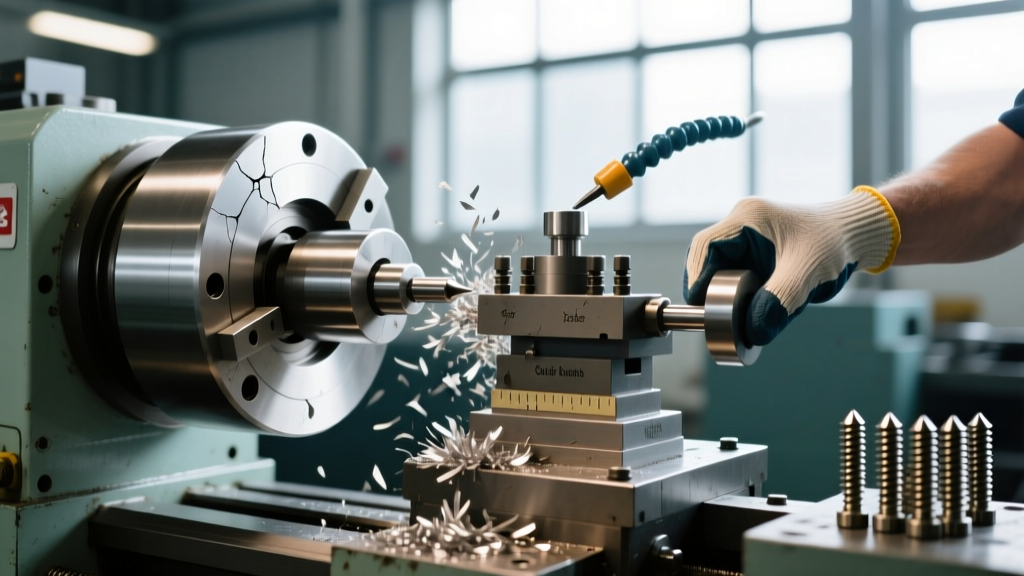
The chuck is the primary kinetic hazard on any lathe. Modern safety standards mandate that the spindle cannot rotate unless the chuck is fully clamped, and the chuck cannot unclamp while the spindle is rotating. This requires a closed-loop hydraulic pressure monitoring system.
Pressure Switch Calibration and Failure Modes
Standard hydraulic power units operate between 400 and 600 PSI. Safety compliance requires a secondary pressure switch set to trigger an emergency stop (E-stop) if pressure drops below a critical threshold—typically 250 to 300 PSI, depending on the workpiece mass and maximum RPM.
- Component Requirement: Use redundant, SIL-2 rated pressure transducers (e.g., Gems Sensors or Turck) rather than simple mechanical switches to prevent contact welding failures.
- Response Time: The PLC must halt spindle rotation within 0.5 seconds of a pressure drop signal. Verify this latency annually using an oscilloscope on the spindle drive enable circuit.
- Edge Case: When machining heavy, unbalanced forgings at low RPM, centrifugal force on the chuck jaws is minimal, but sudden hydraulic hose rupture can cause instantaneous workpiece ejection. Hard-piping hydraulic lines through the spindle using rotary unions (e.g., Deublin Series 111) mitigates hose-burst risks.
Polycarbonate Enclosures and Coolant Degradation
Flying chips and high-pressure coolant (often exceeding 1,000 PSI in modern turning centers) require robust physical barriers. The most critical failure point in lathe guarding is the transparent viewing window.
Acrylic (PMMA) is strictly prohibited by ANSI B11.9 for lathe windows due to its brittle shatter characteristics upon impact. Facilities must use Polycarbonate (PC). However, standard PC rapidly degrades, crazes, and weakens when exposed to synthetic and semi-synthetic metalworking fluids.
| Guarding Material | Impact Resistance (Notched Izod) | Coolant Resistance | Compliance Status (ANSI B11.9) |
|---|---|---|---|
| Acrylic (PMMA) | 0.4 ft-lb/in | Excellent | Prohibited (Shatters on impact) |
| Standard Polycarbonate (Lexan) | 12.0 ft-lb/in | Poor (Crazes within 6 months) | Conditional (Requires strict replacement schedule) |
| Chemical-Resistant PC (Makrolon AR) | 11.5 ft-lb/in | Excellent (Hard-coated) | Fully Compliant (Recommended for 2026 builds) |
| PETG | 2.0 ft-lb/in | Good | Conditional (Only for low-speed/low-mass applications) |
Actionable Specification: Specify 0.375-inch to 0.500-inch thick Makrolon AR (Abrasion Resistant) for all lathe doors. Budget $45 to $60 per square foot for material. Mandate a documented replacement cycle every 24 months for any polycarbonate exposed to mist, regardless of visible crazing, as internal micro-fractures compromise ballistic integrity.
Door Interlock Systems: Solenoid vs. Magnetic
Physical barriers are useless if operators can bypass them. According to NIOSH machining safety guidelines and ISO 14119, interlocking devices must be designed to defeat-resistant standards.
Upgrading to Coded Magnetic and Solenoid Locks
Legacy mechanical tongue interlocks (e.g., standard limit switches with a bent piece of steel) are easily defeated with tape or zip-ties, leading to immediate OSHA citations. Modern compliance requires RFID-coded magnetic switches or solenoid locking interlocks.
- RFID-Coded Switches (e.g., Schmersal RSS260): These use a unique cryptographic handshake between the actuator and sensor. An operator cannot bypass the system by holding a piece of steel or a magnet near the sensor. Cost: ~$250 per door.
- Solenoid Guard Locks (e.g., Fortress Ambriston): Required for lathes where the spindle coast-down time exceeds 10 seconds. The solenoid physically locks the door shut until the PLC confirms the spindle has reached 0 RPM via the encoder feedback loop. Cost: $450–$800 per door.
Light Curtains and Bar Feeder Integration
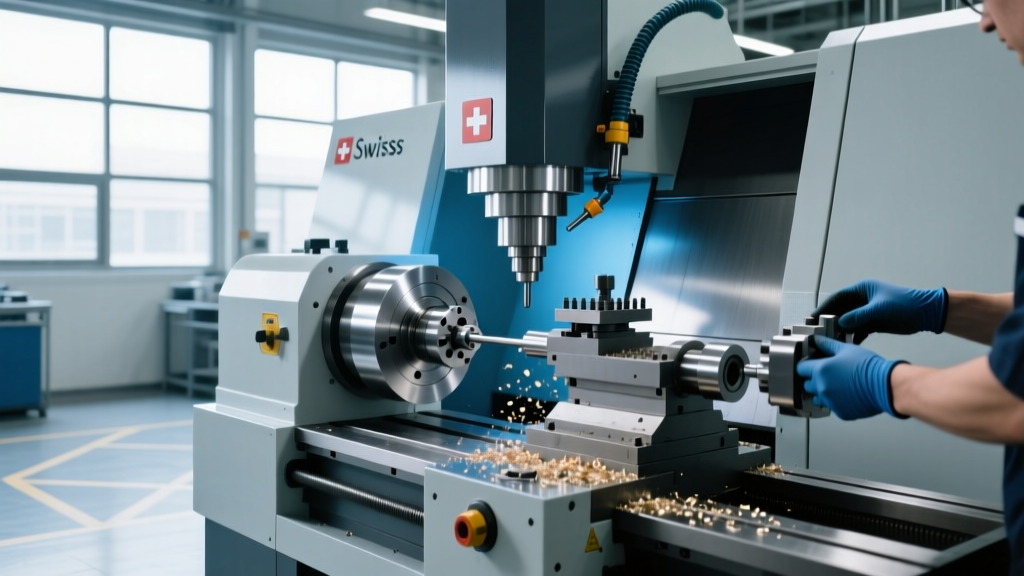
For Swiss-type lathes or open-architecture turning centers utilizing automated bar feeders, physical guarding is often impractical at the material loading zone. Here, Type 4 presence-sensing devices (light curtains) are mandatory.
💡 Muting and Blanking Protocols: When integrating a light curtain (such as the SICK C4000 or Keyence GL-R series) with a bar feeder, you must utilize "muting" sensors. Muting allows the raw bar stock to pass through the light curtain without triggering an E-stop, while maintaining the protective field around the human operator. Ensure muting sensors are arranged in a cross-pattern to prevent a single sensor failure from bypassing the safety logic.Position the light curtain at the calculated safe distance based on the machine's stopping time. Use the formula: Ds = (K × Ts) + Dpf, where K is the hand speed constant (63 inches/second per OSHA), Ts is the total machine stop time, and Dpf is the penetration depth factor of the light curtain resolution.
Step-by-Step: Retrofitting a Legacy Lathe for 2026 Compliance
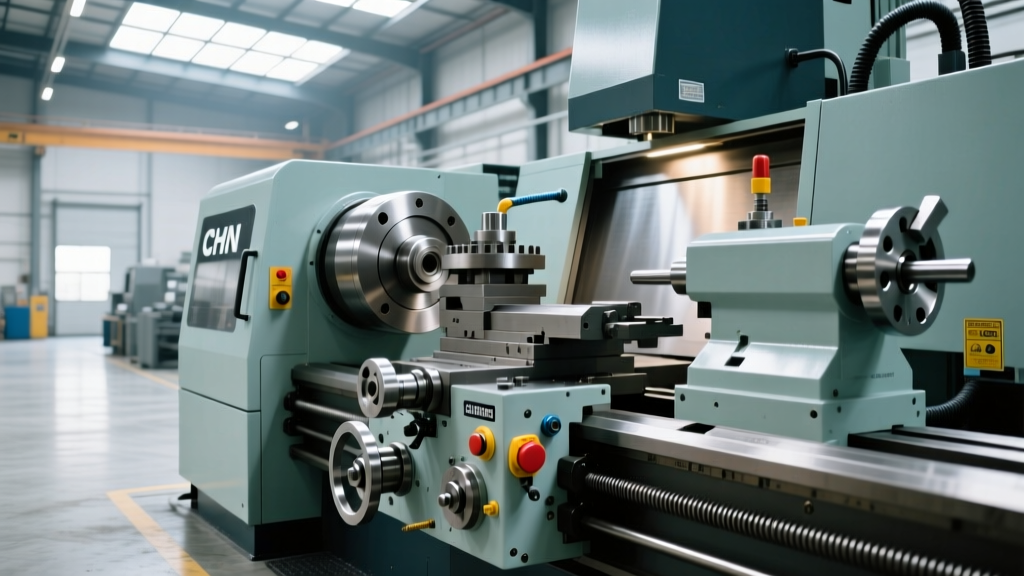
Upgrading an older turning center (e.g., a 2012 Mori Seiki NLX or Haas ST-series) requires a systematic approach to the components of CNC lathe machine safety circuits:
- Audit the Control Logic: Verify if the existing CNC controller supports dual-channel safety I/O (e.g., FANUC Dual Check Safety or Siemens Safety Integrated). If not, install a standalone safety relay module (e.g., Pilz PNOZsigma).
- Replace Chuck Proximity Switches: Remove mechanical jaw-stroke limit switches and replace them with inductive proximity sensors (e.g., IFM Efector) mounted directly on the hydraulic rotary union to verify clamp/unclamp states.
- Install Solenoid Door Locks: Wire the new solenoid locks into the safety relay's safe-delay-off circuit, ensuring the door cannot unlatch until the spindle encoder reads absolute zero.
- Upgrade E-Stop Circuits: Ensure all E-stop buttons are hardwired in a Category 3 or Category 4 architecture, utilizing dual normally-closed (NC) contacts to detect wiring faults.
Tailstock Quill and Steady Rest Collision Avoidance
While not traditionally viewed as a "guarding" component, the programmable tailstock and hydraulic steady rest are critical safety elements in modern long-shaft turning. Unintended retraction of a steady rest during heavy cutting can cause the workpiece to whip, shattering the polycarbonate enclosure and causing fatal injuries.
Compliance Requirement: Steady rests must be equipped with redundant pressure sensors and physical proximity switches confirming the closing fingers are fully engaged with the workpiece. The CNC macro program must include a mandatory dwell and pressure-verification loop (e.g., IF [#1001 LT 300] THEN #3000 = 1 (ALARM: STEADY REST PRESSURE LOW)) before allowing the spindle to accelerate above 500 RPM.
"Machine guarding is only as effective as its maintenance log. A cracked polycarbonate window or a defeated interlock switch transforms a compliant machine into an uncontained ballistic hazard. Documenting weekly guard inspections is your primary legal defense during an OSHA incident investigation." — Director of Safety Compliance, Tier-1 Aerospace Machine Shop
Mandatory Inspection Matrix for Lathe Components
To maintain continuous compliance with ANSI B11.9 and OSHA regulations, facility safety managers must implement the following inspection cadence for the critical components of CNC lathe machine systems:
- Daily (Operator): Visual inspection of polycarbonate windows for new crazing, deep gouges, or chemical clouding. Verify E-stop button physical actuation and reset function.
- Weekly (Maintenance): Test door interlock defeat-resistance. Attempt to open the door while the spindle is in coast-down mode; verify solenoid holds until 0 RPM. Check hydraulic chuck pressure gauges against PLC HMI readouts for calibration drift.
- Annually (Safety Engineer): Measure polycarbonate window thickness with ultrasonic gauges to detect thinning from coolant abrasion. Perform a full spindle stop-time test using a tachometer to recalculate light curtain safe-distance positioning. Replace all hydraulic workholding hoses older than 5 years.