CNC Turning Machining vs. Swiss-Type & Turn-Mill Alternatives
Compare CNC turning machining with Swiss-type lathes and turn-mill centers. Analyze costs, cycle times, and L/D ratios to select the right machine.
Selecting the Right Rotational Manufacturing Process
Selecting between standard CNC turning machining, Swiss-type lathes, and multi-axis turn-mill centers dictates profitability and part quality in precision manufacturing. While all three processes remove material from rotating bar stock or billets, their mechanical architectures solve entirely different engineering problems. A standard 2-axis or 3-axis lathe excels at high-torque chuck work, whereas Swiss-type machines eliminate deflection on micro-diameter long shafts, and turn-mill centers consolidate complex milled features into a single setup.
Making the wrong equipment choice results in catastrophic cycle times, excessive scrap, or secondary-operation bottlenecks. This analysis breaks down the mechanical realities, true costs, and operational constraints of each platform to provide a concrete decision framework for job shops and production facilities.
Quick Decision Matrix: Which Platform Fits Your Part?
- Standard CNC Turning Machining: Length-to-Diameter (L/D) ratio under 3:1. Flanges, short shafts, housings, and heavy chuck work requiring high spindle torque.
- Swiss-Type Lathe: L/D ratio greater than 4:1. Micro-diameter pins, medical bone screws, and long connectors requiring sub-micron concentricity without tailstock support.
- Multi-Axis Turn-Mill Center: Complex rotational parts with off-center milled pockets, angled ports, or sculpted contours that would otherwise require 3+ secondary setups on a VMC.
Standard CNC Turning Machining: The Baseline for Chuck Work
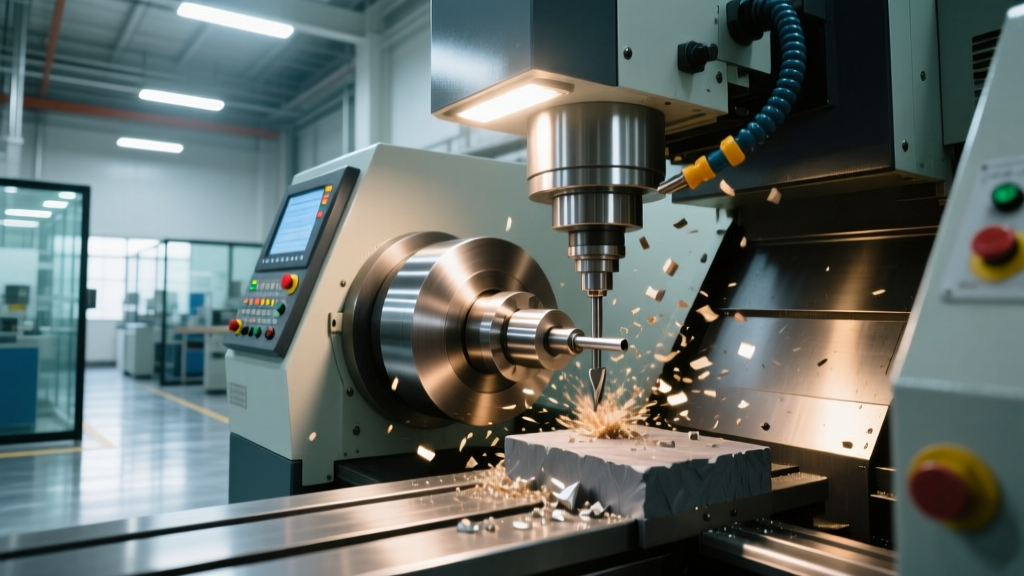
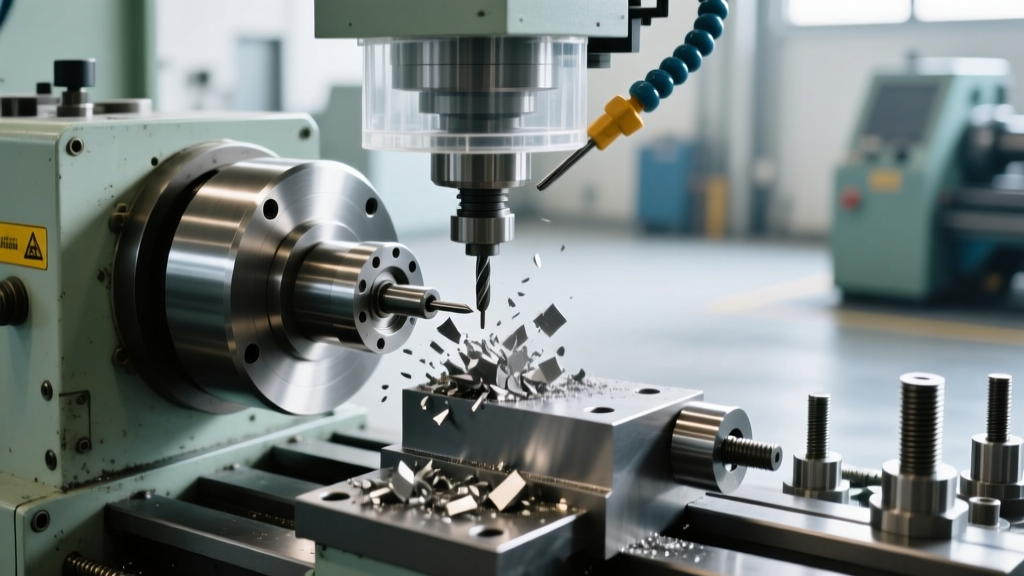
Standard CNC turning machining relies on a stationary cutting tool fed into a rotating workpiece held by a chuck or collet. Modern platforms like the Haas ST-20Y or Doosan Lynx 2100 series represent the industry baseline. These machines typically feature a main spindle, a single turret (often with live tooling and a Y-axis), and sometimes a sub-spindle for back-working.
Capabilities and Economic Realities
The primary advantage of standard CNC turning machining is the low barrier to entry and rapid setup. A standard 2-axis lathe costs between $80,000 and $140,000. Setup involves loading soft jaws, indicating the part, and touching off 8 to 12 standard VDI or BOT toolholders. Cycle times for simple rotational geometry are exceptionally fast due to high rapid traverse rates and aggressive material removal rates (MRR).
However, standard turning faces severe physics limitations. When machining a shaft with an L/D ratio exceeding 3:1 without a tailstock, radial cutting forces cause the workpiece to deflect away from the tool. This results in a tapered diameter and poor surface finish. While adding a steady rest or tailstock mitigates this, it adds setup time and restricts toolpath clearance, making standard CNC turning machining unsuitable for long, slender, high-precision components.
Swiss-Type Lathes: The Guide Bushing Advantage
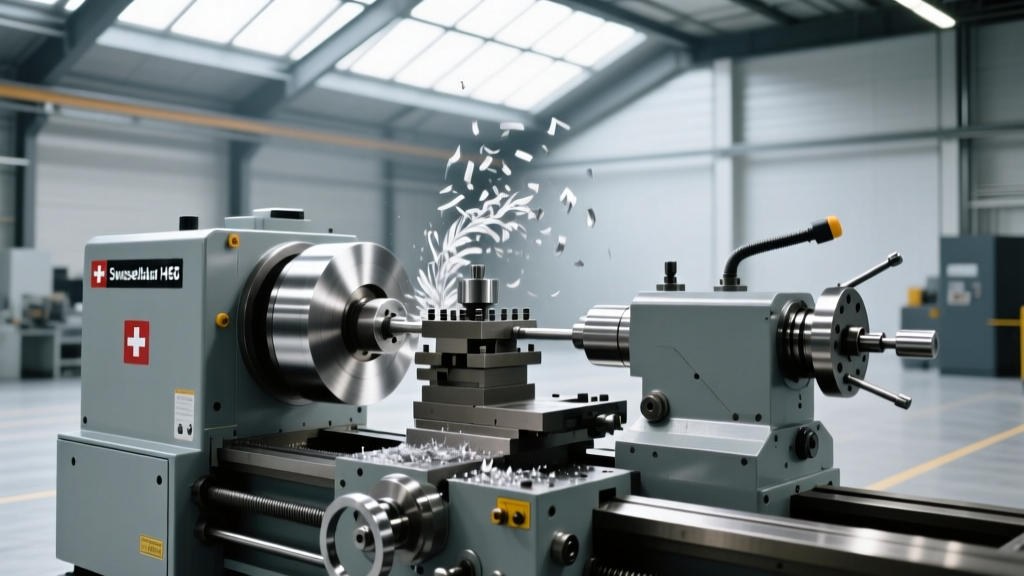
Swiss-type lathes, originally developed for the Swiss watchmaking industry, solve the deflection problem through a fundamentally different kinematic approach. Instead of holding the material in a stationary chuck and moving the tool, the material is clamped in a sliding headstock and pushed through a guide bushing. The cutting tools operate within 1mm to 2mm of the bushing support, completely neutralizing radial deflection regardless of the part's length.
The Hidden Costs of Swiss Machining
While machines like the Citizen L20XII or Tsugami BE20 offer unparalleled precision for long, thin parts, they introduce strict operational constraints. First, the capital expenditure is steep, typically ranging from $220,000 to over $350,000 for a fully loaded B-axis Swiss machine.
Second, Swiss machining mandates the use of precision-ground bar stock. The bar must slide smoothly through the guide bushing, requiring an h6 or h7 diameter tolerance (typically within +0/-0.0005 inches). Using standard cold-drawn bar stock will gall the bushing and cause feeding failures.
Third, the 'remnant' problem is a major source of material waste. Because the sliding headstock requires space to retract and the pusher collet needs room to re-grip, the last 150mm to 200mm of every bar cannot be machined and is scrapped. For expensive aerospace alloys like titanium or Inconel, this remnant waste drastically inflates the per-part material cost.
Multi-Axis Turn-Mill Centers: Done-in-One Complexity
For parts that combine heavy turning with complex 3D milling, multi-axis turn-mill centers are the definitive alternative. Platforms such as the Mazak INTEGREX i-200 or DMG MORI NTX series integrate a high-torque turning spindle with a full 5-axis B-milling spindle and a lower turret.
Consolidating the Manufacturing Footprint
The economic argument for turn-mill centers is the elimination of secondary operations. An aerospace hydraulic fitting that requires turning, cross-drilling, off-center port milling, and contouring might require a lathe, a 3-axis VMC, and a 5-axis mill in a traditional workflow. This introduces multiple setups, cumulative tolerancing errors, and massive work-in-progress (WIP) queues.
A turn-mill center completes the part in a single chucking. However, the programming complexity is exponential. Generating collision-free toolpaths for a B-axis milling spindle operating simultaneously with a lower turret requires advanced CAM software like Mastercam Mill-Turn or ESPRIT. Furthermore, the machine footprint and cost ($450,000 to $800,000+) demand high utilization rates to justify the investment. If a shop uses a $600,000 turn-mill center strictly for 2-axis facing and turning, the overhead cost per part will destroy profit margins.
Cycle Time, Cost, and Waste Comparison Matrix
The following matrix compares the three platforms based on a hypothetical production run of 1,000 precision stainless steel shafts (0.500' diameter, 3.000' length, featuring two cross-drilled holes).
| Metric | Standard CNC Turning | Swiss-Type Lathe | Turn-Mill Center |
|---|---|---|---|
| Estimated Machine Cost | $115,000 | $280,000 | $550,000 |
| Setup Time | 1.5 Hours | 4.0 Hours | 6.5 Hours |
| Cycle Time (Per Part) | 4m 15s (Requires 2nd op for cross-holes) | 2m 10s (Done-in-one) | 2m 45s (Done-in-one) |
| Material Requirement | Standard Cold-Drawn Bar | Precision Ground Bar (h7) | Standard Bar or Billet |
| Bar End Remnant Waste | ~25mm (Standard bar feeder) | ~180mm (Guide bushing constraint) | ~25mm (Standard bar feeder) |
| Programming Complexity | Low (2-Axis + simple C-axis) | Medium (Kinematic sync, guide bushing offsets) | High (B-axis 3D toolpaths, collision checks) |
Tooling, Coolant, and Setup Realities
Beyond the machine chassis, the tooling ecosystems for these three processes are vastly different. Standard CNC turning machining utilizes robust 3/4-inch or 25mm shank turning tools, heavy-duty boring bars, and standard ER collet systems for live tooling. Coolant pressures typically range from 300 to 500 PSI, which is sufficient for chip evacuation in standard steel and aluminum cutting.
Swiss-type machines operate in a highly confined workspace. Tooling is restricted to 12mm or 16mm shank micro-tools. Because the cutting action occurs so close to the guide bushing, chip evacuation is a constant threat. Swiss machining mandates high-pressure coolant (HPC) systems delivering 1,000 to 2,000 PSI directly to the cutting edge to break chips into manageable 'C' shapes. Without HPC, long stringy chips will wrap around the guide bushing, snapping micro-drills and crashing the machine.
Turn-mill centers rely on modularity. They utilize Coromant Capto (C4, C5, or C6) quick-change tooling interfaces on both the main spindle and the B-axis milling spindle. This allows operators to swap a heavy roughing turning tool for a precision finishing endmill in seconds without losing tool center point (TCP) accuracy. According to manufacturing resources cataloged by SME (Society of Manufacturing Engineers), the adoption of quick-change polygon interfaces has reduced turn-mill setup times by up to 40% over the last decade.
FAQ: Edge Cases and Operational Constraints
Can standard CNC turning machining handle medical bone screws?
Generally, no. Bone screws typically feature deep, aggressive threads on a slender shaft (L/D ratio often exceeding 6:1). Attempting this on a standard lathe will cause severe deflection, resulting in out-of-tolerance thread pitch and diameter variations. Swiss-type lathes are the mandatory choice here, as the guide bushing supports the material directly behind the thread-whirling or single-point threading tool.
Is it worth buying a turn-mill center if 80% of our work is simple 2-axis turning?
No. The hourly shop rate required to amortize a $550,000 turn-mill center will make you entirely uncompetitive for simple 2-axis chuck work. Turn-mill centers should be purchased specifically to target high-margin, complex 'done-in-one' contracts (e.g., aerospace fittings, complex medical implants) where the elimination of secondary VMC setups justifies the machine's overhead.
How do we mitigate the 180mm remnant waste on a Swiss-type lathe?
Many modern Swiss machines offer a 're-machining' or 'remnant processing' function. The machine cuts off the usable parts, then the sub-spindle grabs the 180mm remnant, pulls it back into the working zone, and machines smaller secondary parts (like pins or spacers) out of the scrap before finally dropping the unusable stub. This requires advanced CAM programming but can recover thousands of dollars in exotic alloy waste annually.