CNC Swiss Machine Maintenance: The Ultimate Service Schedule
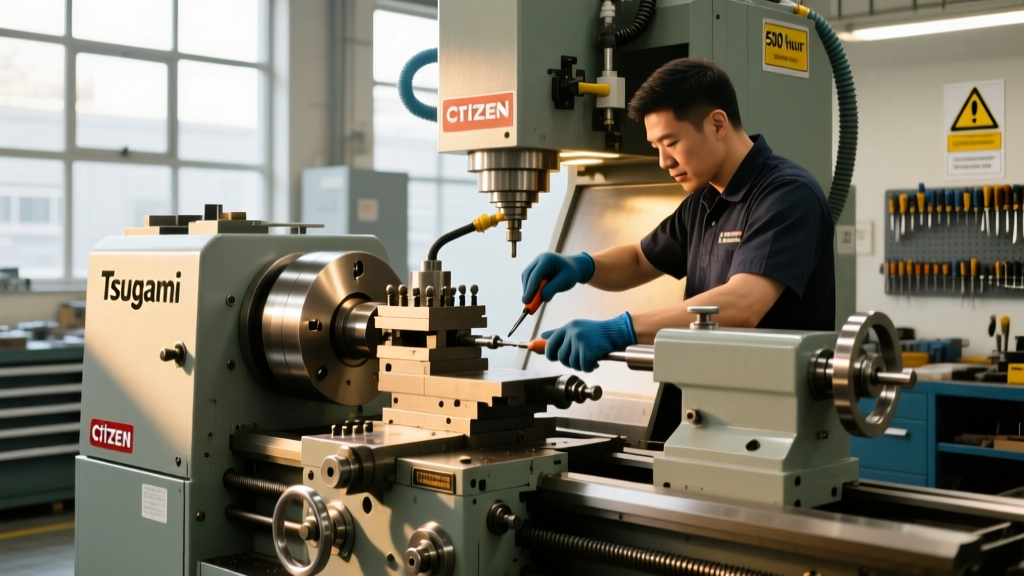
CNC Swiss machine maintenance schedule: daily, 500-hour, and annual intervals for Tsugami and Citizen lathes to prevent downtime and guide bushing wear.
The Hidden Cost of Swiss Machine Neglect
A CNC Swiss machine operates on fundamentally different mechanical principles than a standard chucking lathe. The sliding headstock and guide bushing configuration required for machining long, slender parts introduces unique friction, thermal, and alignment challenges. When maintenance is deferred on models like the Tsugami B012-V or Citizen L12-XII, the result is rarely a gradual decline in quality; it is usually a catastrophic crash or a scrapped batch of micro-precision medical components.
Unplanned downtime on a fully loaded Swiss-type lathe costs between $150 and $300 per hour in lost production, not including the cost of replacing a shattered main spindle or a scored guide bushing. This guide provides a rigid, engineering-grade maintenance schedule designed to protect your capital investment and maintain sub-micron tolerances.
WARNING: The Guide Bushing Tolerance TrapThe clearance between your bar stock and the guide bushing must be strictly maintained between 0.005 mm and 0.01 mm. If operators use worn bushings to save time, the bar will whip at high RPMs, causing chatter marks on the part and transferring destructive harmonic vibrations directly into the main spindle bearings. Always match the bushing to the exact bar diameter tolerance.
Daily Operator Maintenance (Shift Start)
Daily maintenance on a CNC Swiss machine must be executed before the first spindle start. This 15-minute routine is non-negotiable for preserving the sliding headstock ways and high-pressure coolant systems.
- Coolant Concentration and pH Check: Swiss machines demand higher coolant concentrations than standard lathes due to the intense heat generated at the guide bushing interface. Maintain a concentration of 8% to 10% and a pH between 8.8 and 9.2. Refer to the OSHA Metalworking Fluids guidelines for proper handling and concentration limits to prevent both bacterial growth and operator dermatitis.
- High-Pressure Coolant Filter Inspection: Modern Swiss lathes utilize 1,000 to 2,000 PSI coolant pumps for chip breaking. Check the pressure gauge on the main filter housing. A pressure drop of more than 15 PSI indicates a clogged 10-micron filter element. Bypassing this filter will send abrasive carbide fines directly into the sliding headstock way covers, destroying the ball screws.
- Way Lube System Verification: Cycle the manual way lube pump and visually confirm that oil is reaching the Z-axis sliding headstock way covers. The oil should be ISO VG 68 way oil, which contains tackifiers to prevent it from being washed away by the heavy coolant shower.
- Chip Conveyor and Trough Clearance: Swiss machines produce long, stringy chips (especially in 303 stainless steel). Clear the guide bushing housing of any wrapped chips that could restrict bar feed movement.
Fluid & Lubricant Specifications Matrix
Using the wrong fluid grade in a Swiss-type lathe will cause thermal growth and axis stiction. Below are the baseline OEM specifications for the three dominant brands in the market.
| Machine Brand | Spindle Oil | Way Lube | Hydraulic Oil |
|---|---|---|---|
| Tsugami (e.g., B012) | ISO VG 32 Spindle | ISO VG 68 Way | ISO VG 32 Hydraulic |
| Citizen (e.g., L12) | ISO VG 10 Spindle | ISO VG 68 Way | ISO VG 32 Hydraulic |
| Star (e.g., SR-20) | ISO VG 32 Spindle | ISO VG 68 Way | ISO VG 46 Hydraulic |
The 500-Hour Sliding Headstock Service
At the 500-hour mark (roughly every three months on a two-shift schedule), the machine requires deeper mechanical inspection. This service window focuses on the components that endure constant linear motion and high-pressure exposure.
Way Cover and Wiper Inspection
Retract the sliding headstock to its full Z-axis limit. Inspect the telescopic way covers for dents or debris buildup. The polyurethane wipers at the edges of these covers are the only defense against coolant ingress into the ball screws. If the wipers show signs of cracking or hardening, replace them immediately. A compromised wiper will allow tramp oil and water-soluble coolant to mix inside the ball nut, leading to emulsification and eventual screw seizure.
Tool Magazine and Live Tooling Alignment
Swiss machines feature dense tool zones. Check the mounting bolts on the cross-drilling and live tooling spindles. Vibrations from heavy milling operations can loosen these bolts, causing tool runout. Use a dial indicator to check the live tooling spindle runout; it must not exceed 0.003 mm. Torque all tool block clamping screws to the specific OEM Newton-meter rating.
PRO-TIP: Bar Feeder SynchronizationAt 500 hours, verify the synchronization between the bar feeder pusher and the main spindle feed rate. If the bar feeder pushes faster than the spindle draws, the bar will bow inside the guide tube, creating a whiplash effect that destroys the feed tube liner. Adjust the feeder servo gain to match the machine Z-axis feed profile perfectly.
Troubleshooting Swiss-Specific Failure Modes
When precision degrades, operators often blame the tooling. However, 80% of Swiss machining defects stem from neglected machine geometry or fluid dynamics. Use this matrix to diagnose issues accurately.
| Symptom | Root Cause | Corrective Action |
|---|---|---|
| Chatter marks on turned OD | Guide bushing clearance too large; worn bushing liner. | Install new carbide-lined guide bushing matched to bar stock diameter. |
| Sub-spindle pick-off crash | C-axis synchronization drift between main and sub-spindle. | Recalibrate spindle sync parameters; check spindle encoder coupling. |
| Z-axis dimensional drift | Thermal growth in sliding headstock ball screw. | Implement warm-up macro; verify way lube flow to Z-axis nut. |
| Poor surface finish on milling | Backlash in Y-axis or cross-axis ball screws. | Run ballbar test; update backlash compensation parameters in CNC control. |
Annual Calibration & Sub-Spindle Sync
Once a year, or every 4,000 operating hours, the CNC Swiss machine requires comprehensive geometric calibration. This is not a task for the shop floor operator; it requires a certified technician or metrology equipment.
The most critical annual check is the sub-spindle alignment relative to the main spindle. If the sub-spindle centerline is off by even 0.01 mm, the pick-off collet will apply lateral stress to the part during the transfer, bending micro-shafts and accelerating collet wear. Technicians should use a precision test mandrel and dial indicators to verify X and Y alignment, adjusting the sub-spindle mounting screws as necessary.
Furthermore, annual laser interferometry testing should be performed on the Z-axis. Because the sliding headstock moves the material rather than the tool, any pitch error in the Z-axis ball screw directly translates to part length errors. Technicians can map these errors and input pitch compensation tables into the Fanuc or Mitsubishi control. For standardized calibration protocols, shops should refer to the NIST Calibration Services framework to ensure traceability, especially when machining aerospace or medical implants.
"Thermal stabilization is the invisible enemy of Swiss machining. A machine that has been idle over the weekend will produce out-of-tolerance parts for the first 45 minutes of operation as the spindle bearings and ball screws reach their operating temperature of roughly 38 degrees Celsius. Always program a 20-minute thermal warm-up macro that cycles all axes and spindles before the first production cut." - Senior Applications Engineer, Swiss Turn Division.
High-Pressure Coolant System Overhaul
The high-pressure coolant pump is the unsung hero of the CNC Swiss machine, enabling the aggressive chip breaking required in deep-hole drilling and stainless steel turning. Annually, the pump reservoir must be completely drained, flushed, and refilled with fresh hydraulic fluid (typically ISO VG 32 or 46, depending on the pump manufacturer like Enerpac or Oilgear). The inline high-pressure filters must be replaced, and the pump relief valve should be tested to ensure it opens at the designated maximum PSI to prevent hose rupture.
For deeper insights into optimizing these systems, industry professionals frequently consult resources on SME CNC Machining Technologies, which publish ongoing research on fluid dynamics and tool life extension in Swiss-type turning.
ROI of Preventive Swiss Maintenance
Cost Analysis: Preventive vs. Reactive
Annual Preventive Maintenance Cost: ~$2,500 (Fluids, filters, wipers, annual laser calibration labor).
Cost of a Single Unplanned Spindle Crash: $12,000 to $18,000 (Replacement main spindle assembly, housing machining, 48 hours of downtime).
Cost of Scrapped Medical Batch: $5,000 to $25,000 (Material costs, lost cycle time, FDA traceability documentation delays).
Verdict: A strict adherence to the daily and 500-hour maintenance schedule yields an ROI of over 400% in the first year alone by preventing a single major mechanical failure.
Maintaining a CNC Swiss machine requires discipline and an understanding of the unique forces at play. By adhering to these strict fluid, mechanical, and calibration schedules, manufacturing facilities can ensure their sliding headstock lathes operate at peak precision for decades, securing profitability in the most demanding precision machining sectors.