Optimizing CNC Lathe Machine Operation for Titanium Medical Parts
Explore real-world CNC lathe machine operation case studies for titanium medical implants, detailing speeds, feeds, and mill-turn cycle time reductions.
The Reality of CNC Lathe Machine Operation in Medical Manufacturing
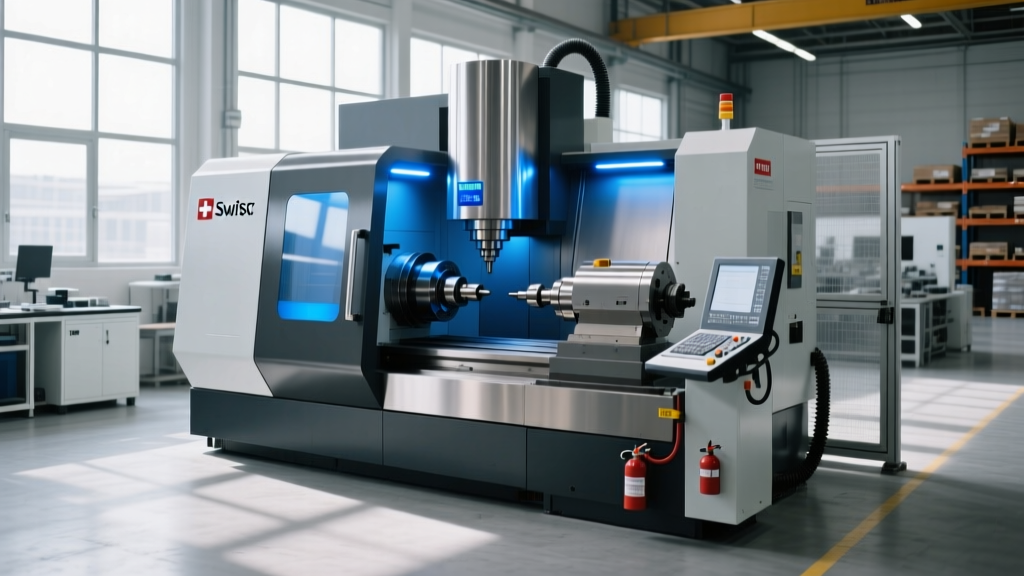
Machining medical implants from Ti-6Al-4V (Grade 5 Titanium) and PEEK polymers represents one of the most demanding environments for CNC turning. Unlike high-volume automotive production, where cycle time is the primary metric, medical CNC lathe machine operation prioritizes surface integrity, strict geometric tolerances (often ±0.005 mm), and absolute traceability. In 2026, the shift toward multi-axis mill-turn centers and advanced Swiss-type lathes has fundamentally altered how shops approach orthopedic and spinal components.
This analysis examines two distinct production scenarios—Swiss-type turning for spinal screws and 5-axis mill-turn operations for knee joint baseplates—providing exact operational parameters, tooling economics, and failure mode troubleshooting derived from current shop-floor data.
Case Study 1: Swiss-Type Turning for Polyaxial Spinal Screws
Spinal screws require complex threading, deep undercutting, and precise spherical head geometries. A leading Tier-1 medical supplier transitioned their 4.5mm x 45mm Ti-6Al-4V spinal screw production from a standard 2-axis CNC lathe to a Tsugami B038-V Swiss-type automatic lathe. The base machine investment was approximately $285,000, excluding the high-pressure coolant chiller and bar feeder.
Machine & Setup Specifications
- Guide Bushing Clearance: Set to 0.005 mm (0.0002 in) to prevent bar deflection during heavy threading cuts.
- Main Spindle Speed: 4,200 RPM (Surface speed limited to ~60 m/min for titanium roughing).
- Live Tooling Speed: 10,000 RPM for cross-drilling the screw head polyaxial capture slots.
- Coolant Delivery: 70 bar (1,000 psi) through-tool for the main turning operations; flood coolant for chip flushing in the sub-spindle transfer.
By utilizing the Swiss-type sliding headstock, the distance between the cutting tool and the guide bushing remained constant at less than 2 mm throughout the entire part profile. This eliminated the harmonic chatter that previously scrapped 4% of parts on the 2-axis lathe. The cycle time stabilized at 118 seconds per part, a 15% increase over the previous machine, but the scrap rate dropped to 0.2%, yielding a net positive ROI within 14 months.
Case Study 2: 5-Axis Mill-Turn for Orthopedic Tibial Baseplates
Tibial baseplates feature complex organic topographies that traditionally required milling, followed by secondary turning operations for the central keel and taper bores. By consolidating this into a single DMG MORI NTX 1000 2nd Generation mill-turn center (priced around $680,000 in 2026), a mid-sized orthopedic manufacturer eliminated three secondary setups.
| Metric | Legacy Process (Mill + 2-Axis Lathe) | NTX 1000 Mill-Turn (Single Setup) |
|---|---|---|
| Total Cycle Time | 24.5 minutes (across 2 machines) | 9.2 minutes |
| Concentricity (Keel to Bore) | ±0.025 mm | ±0.008 mm |
| Work-in-Progress (WIP) Inventory | High (requires queuing between ops) | Zero (finished part off machine) |
| Tool Change Overhead | 14 manual/semi-auto changes | Fully automated via B-axis turret |
The critical operational advantage here is the B-axis contouring capability. Instead of using standard static turning tools for the taper bore, the machine utilizes a driven spindle with a Sandvik Coromant Capto C4 interface, allowing the insert to interpolate the bore geometry while maintaining optimal rake angles. This reduced taper bore cycle time from 3.5 minutes to 45 seconds.
Critical Operational Variables for Ti-6Al-4V Turning
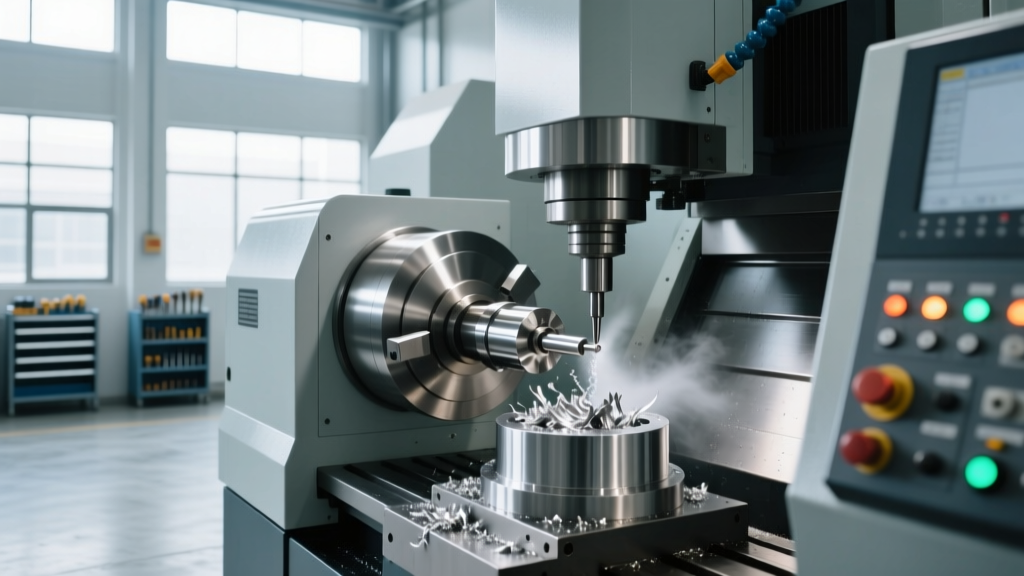
Titanium's low thermal conductivity means 80% of the heat generated during cutting stays in the tool and the chip, rather than dissipating into the workpiece. CNC lathe machine operation parameters must be strictly controlled to prevent rapid insert degradation.
- Cutting Speed (Vc): Keep roughing speeds between 45 and 60 m/min. Exceeding 70 m/min with standard PVD-coated inserts causes catastrophic plastic deformation of the cutting edge.
- Feed Rate (fn): Maintain a minimum feed of 0.08 mm/rev. Feeding too lightly causes the tool to rub rather than cut, accelerating flank wear and inducing work hardening in the titanium surface.
- Depth of Cut (ap): Always ensure the depth of cut exceeds the work-hardened layer generated by the previous pass (typically minimum 0.5 mm for roughing).
- Coolant Concentration: Use a semi-synthetic coolant mixed to 9-11% concentration. Standard 5% mixtures lack the extreme pressure (EP) additives required to prevent built-up edge (BUE) on titanium.
"The most common mistake operators make with titanium is trying to run it like stainless steel. If you aren't seeing thick, dark blue or purple chips, your surface speed is too high or your feed is too light. You want to pull the heat out in the chip, not bake it into the insert." — Lead Manufacturing Engineer, Tier-1 Orthopedic Supplier
Tooling Economics and Edge Cases in Medical Turning
Tooling costs in medical titanium turning can account for up to 18% of the total cost-per-part. Selecting the correct insert geometry and grade is non-negotiable. For finishing operations requiring an Ra 0.4 µm surface finish, wiper geometry inserts (such as the Sandvik GC1125 grade with a -PM geometry) are mandatory. The wiper flats effectively double the feed rate capability without sacrificing surface finish, allowing feeds up to 0.25 mm/rev during finishing.
⚠️ Warning: Notch Wear at Depth of Cut Line
When turning forged or cast titanium medical blanks, the outer scale causes severe notch wear exactly at the depth-of-cut line. To mitigate this, implement Variable Depth of Cut (VDOC) strategies in your CAM software (e.g., Mastercam Dynamic Roughing or ESPRIT ProfitTurning). This continuously shifts the Z-axis contact point, distributing the wear across the entire cutting edge rather than concentrating it at a single notch point.
Troubleshooting Common CNC Lathe Operation Failures
1. Chip Bird-Nesting in Swiss-Type Sub-Spindles
Symptom: Long, stringy chips wrap around the sub-spindle collet, causing transfer failures and machine alarms.
Root Cause: Incorrect chip breaker selection or lack of through-tool coolant pressure during sub-spindle cutoff.
Fix: Switch to a specialized titanium chip breaker geometry (e.g., ISCAR's GTIR geometry) designed to force tight 'C' shaped chips. Increase cutoff tool coolant pressure to a minimum of 120 bar (1,740 psi) to mechanically break the chip at the shear zone.
2. Harmonic Chatter During Deep Boring
Symptom: Visible oscillation marks on the inside diameter of taper bores; audible high-pitch squealing.
Root Cause: Overhang-to-diameter ratio of the boring bar exceeds 4:1, combined with standard steel shanks.
Fix: Replace standard steel or carbide boring bars with anti-vibration (damped) boring bars featuring internal tuned mass dampers. These allow overhang ratios up to 10:1 while maintaining surface finishes below Ra 0.8 µm.
3. Built-Up Edge (BUE) on PEEK Polymers
Symptom: Material smearing and poor dimensional accuracy when machining PEEK insulators or spinal cages.
Root Cause: Using standard titanium turning inserts with negative rake angles, generating excessive friction and melting the polymer.
Fix: Utilize uncoated, razor-sharp CVD diamond (PCD) or highly polished uncoated carbide inserts with positive rake angles (minimum 15°). Reduce coolant pressure to avoid thermal shock, which can cause micro-cracking in semi-crystalline PEEK.
Final Operational Directives
Mastering CNC lathe machine operation for medical applications requires abandoning general-purpose machining habits. Success in 2026 relies on leveraging high-pressure coolant systems, strictly adhering to titanium-specific speed/feed thresholds, and investing in mill-turn architectures that eliminate secondary setups. For further reading on advanced Swiss-type techniques, refer to industry analyses from Modern Machine Shop and explore integrated manufacturing workflows via DMG MORI's medical technology resources.