Troubleshooting Automotive CNC Machining: In-House vs Outsourcing
Diagnose automotive CNC machining defects and decide when to repair in-house or outsource production to an IATF-certified contract shop.
The Production Bottleneck Diagnostic Tree
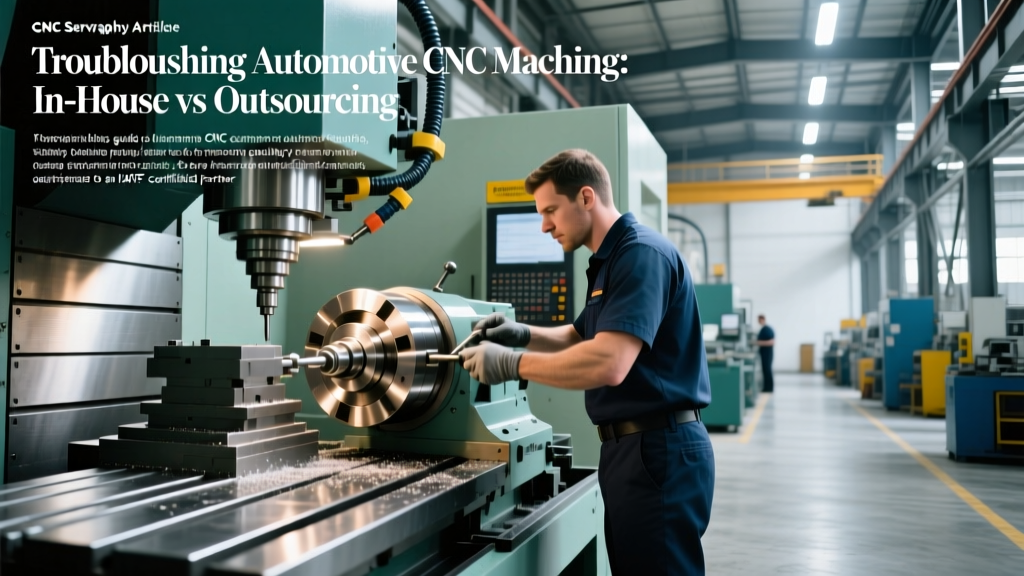
Automotive CNC machining demands uncompromising precision. When manufacturing 800V EV inverter housings from 6061-T6 aluminum or active suspension uprights from 4140 alloy steel, a scrap rate exceeding 2% signals a systemic failure. As a production manager, your first instinct is to troubleshoot the toolpath or tooling. However, when root-cause analysis points to fundamental equipment or environmental limitations, the ultimate troubleshooting step is deciding whether to overhaul your in-house capabilities or outsource to a specialized contract machine shop.
Use this diagnostic decision tree to identify the root cause of your machining defects and determine the correct operational pivot:
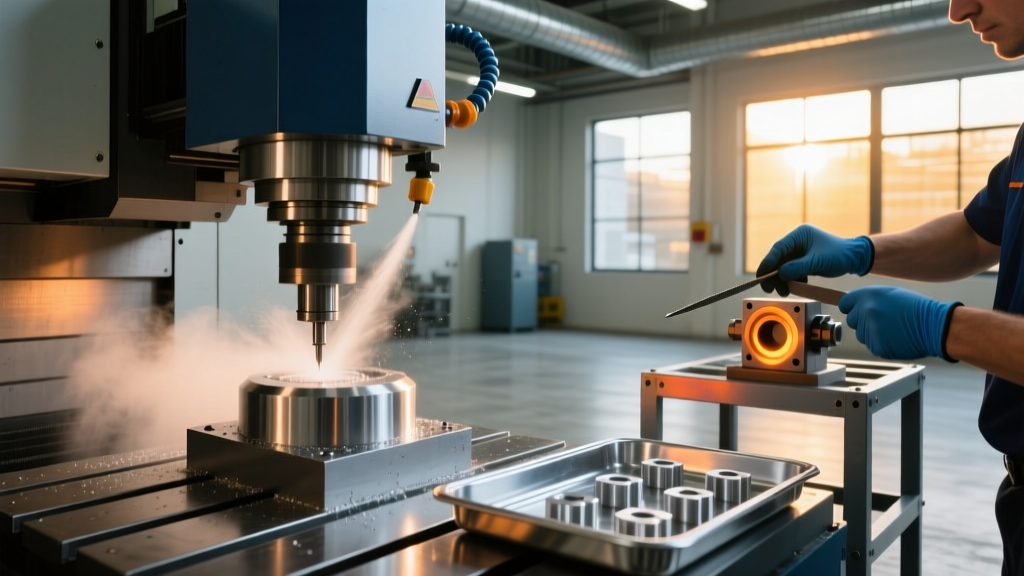
- Symptom: Chatter marks and poor surface finish (Ra > 32 µin) on deep-pocket milling of EV motor housings.
Check 1: Tool stick-out and harmonic dampening. Are you using variable-flute end mills?
Check 2: Spindle runout. Test with a dial indicator; it must be < 0.0002".
Decision Point: If spindle bearings are degraded, a replacement costs $12,000–$18,000 and requires 3–5 weeks of downtime. Fix: Outsource the current batch to a 5-axis specialist to protect OEM delivery schedules while awaiting internal repairs. - Symptom: Geometric drift and True Position failures (falling outside the 0.0015" tolerance at MMC) on transmission valve bodies.
Check 1: Workholding clamping forces causing part distortion upon release.
Check 2: Ambient shop temperature. Are machines located near loading dock doors or direct sunlight?
Decision Point: Aluminum expands at roughly 13 ppm/°F. If your shop cannot maintain 68°F ± 2°, your CMM data will always be compromised. Fix: Transition the part to an outsourced partner with an ISO-class 7 climate-controlled metrology lab.
Purchasing a new 5-axis CNC (e.g., Haas UMC-500SS or DMG MORI DMU 50 3rd Gen) to fix capacity bottlenecks requires a capital expenditure of $175,000–$280,000 in 2026. Factoring in CAM programming software licenses ($15,000+/year), skilled 5-axis operator salaries ($95,000–$120,000), and workholding tooling, the break-even point for bringing complex automotive prototypes in-house often exceeds 18 months. For short-run production, outsourcing remains the mathematically superior troubleshooting fix.
Troubleshooting Common Automotive CNC Defects
Before signing a purchase order with a contract manufacturer, verify that the defect isn't a simple programming or fixturing error that can be resolved internally.
Porosity and Tool Wear on Cast Aluminum (A380 vs. 6061-T6)
Many automotive Tier 2 suppliers attempt to machine cast A380 aluminum for transmission cases, only to experience severe carbide insert chattering and micro-porosity leaks during pressure testing. A380 contains high silicon (8-10%), which is highly abrasive. If your in-house shop is running standard uncoated carbide at 800 SFM, your tool life will plummet to under 40 parts. The internal fix: Switch to CVD diamond-coated inserts and flood coolant at 8-10% concentration. The outsourcing trigger: If the OEM design allows, outsource to a shop that can negotiate a material change to 6061-T6 or A356-T6, which machines cleaner and yields better anodized finishes for EV battery enclosure sealing flanges.
CMM Discrepancies and GD&T Misinterpretation
A frequent bottleneck occurs when in-house CMM reports pass a part, but the OEM's receiving inspection fails it. This is rarely a machine error; it is a GD&T (ASME Y14.5-2018) datum alignment issue. If your in-house metrology team lacks expertise in establishing tertiary datums for complex cast geometries, you will continuously chase false failures. Outsourcing to a partner equipped with a Zeiss CONTURA or Mitutoyo Crysta-Apex CMM, paired with automated PC-DMIS programming, eliminates datum alignment discrepancies and shifts the quality liability to the contract shop.
The In-House vs. Outsourcing Decision Matrix
Use this matrix to evaluate whether a specific automotive part family should remain on your shop floor or be transitioned to a contract machining service.
| Evaluation Metric | In-House Production | Outsourced CNC Services |
|---|---|---|
| Setup & NRE Costs | High (Custom fixtures, CAM programming, internal CMM validation) | Moderate ($2,000–$5,000 NRE, amortized across the PO volume) |
| Lead Time (Prototypes) | 1–3 Days (Immediate machine access) | 5–10 Days (Queue times, onboarding, PPAP generation) |
| Scalability (EV Ramp-Up) | Poor (Limited by physical spindle count and floor space) | Excellent (Contract shops can dedicate 10+ pallet pools to your part) |
| Quality Certifications | ISO 9001 (Typically) | IATF 16949:2016, ISO 13485, Nadcap (Often required for Tier 1) |
| IP & Design Security | Maximum (Files never leave the local server) | Managed via strict NDA, ITAR compliance, and air-gapped networks |
Transitioning to a Contract Machine Shop: The PPAP Protocol
If troubleshooting dictates that outsourcing is the only viable path to meet automotive tolerances, you cannot simply email a STEP file and request a quote. Automotive contract machining requires rigorous adherence to the Production Part Approval Process (PPAP). According to the American Society for Quality (ASQ) PPAP Guidelines, failing to provide complete documentation will result in delayed tooling and rejected first-article inspections (FAI).
When packaging your outsourced RFQ, include the following troubleshooting data to prevent the contract shop from repeating your internal mistakes:
- 3D CAD & 2D Drawings: Ensure 2D PDFs include explicit GD&T callouts per ASME Y14.5-2018. Do not rely on the 3D model's default tolerances.
- Known Failure Modes: If your in-house team struggled with tool deflection on a specific thin-wall rib (e.g., walls under 0.080"), explicitly flag this in the RFQ notes so the contract shop's CAM engineers can utilize adaptive clearing toolpaths.
- Material Certifications: Specify if you require mill certs (MTRs) for traceability, which is mandatory for safety-critical automotive components like steering knuckles and brake calipers.
"In the 2026 automotive supply chain, resilience is built through strategic redundancy. Relying solely on in-house machining for complex EV drivetrain components creates a single point of failure. Partnering with IATF-certified contract shops acts as an operational shock absorber against spindle failures, labor shortages, and sudden OEM volume spikes."
— Manufacturing Strategy Report, NIST Manufacturing Extension Partnership (MEP)
Vetting an Outsourced Automotive CNC Partner
Not all machine shops are equipped for automotive production. A shop that excels at aerospace titanium or commercial aluminum extrusions may fail at the high-volume, tight-tolerance demands of automotive CNC machining. Use this strict vetting checklist before finalizing an outsourcing agreement:
1. IATF 16949:2016 Certification
This is the global technical specification and quality management standard for the automotive industry. As outlined by the IATF Global Oversight body, this certification ensures the shop utilizes Advanced Product Quality Planning (APQP) and Failure Mode and Effects Analysis (FMEA). If a shop only holds ISO 9001, they are not statistically prepared for automotive zero-defect mandates.
2. Automated Pallet Pooling & Lights-Out Machining
Automotive margins are razor-thin. To ensure competitive per-part pricing, the contract shop must utilize Horizontal Machining Centers (HMCs) with automated pallet pools (e.g., Makino a61nx or Mazak HCN-5000). This allows for lights-out machining over the weekend, drastically reducing the labor cost burden passed on to your bottom line.
3. In-House Metrology Capabilities
Troubleshooting quality issues across a supply chain is impossible if the vendor relies on third-party CMM inspection. Verify that the shop possesses in-house, temperature-controlled CMMs and optical comparators, and ask for a sample of their automated inspection reports generated via PC-DMIS or Calypso software.
✅ Summary Action PlanStop burning capital on endless spindle repairs and scrapped EV housings. Run the diagnostic tree. If the root cause is environmental (thermal drift) or structural (machine rigidity for 4140 steel), pivot immediately. Package your CAD data with explicit GD&T and PPAP requirements, and target an IATF 16949-certified contract partner with 5-axis HMC automation to stabilize your automotive production line.