Evaluating Titanium CNC Machining Services for 5-Axis Complex Parts
Learn how to evaluate titanium CNC machining services for complex 5-axis geometries, including machine specs, tooling, and 2026 shop rate benchmarks.
Sourcing complex aerospace or medical components from Ti-6Al-4V (Grade 5) requires far more than a standard machine shop. Titanium's low thermal conductivity (6.7 W/m-K) and high tensile strength (~130 ksi) mean that cutting forces and heat concentrate directly at the tool edge. When these material challenges intersect with complex 5-axis geometries—such as blisks, impellers, or orthopedic implants—evaluating titanium CNC machining services demands a rigorous technical audit of the vendor's equipment, tooling, and engineering frameworks.
The Physics of Ti-6Al-4V: Why 5-Axis Demands Specialized Equipment
Unlike aluminum, where heat dissipates rapidly into the chip, titanium retains heat in the cutting zone. In 5-axis simultaneous machining, tool engagement angles constantly shift, creating varying cutting forces that induce chatter and work hardening if the machine lacks dynamic rigidity. A shop running complex titanium geometries on a standard light-duty 5-axis mill will experience rapid tool deflection, built-up edge (BUE), and catastrophic surface finish failures.
Critical Failure Mode: Work Hardening. If a cutter rubs instead of shearing due to insufficient rigidity or incorrect feed rates, the titanium surface work-hardens. Subsequent passes will destroy the cutting tool, induce micro-fractures, and scrap the part entirely.Machine Tool Specifications: What to Look for in a Vendor's Fleet
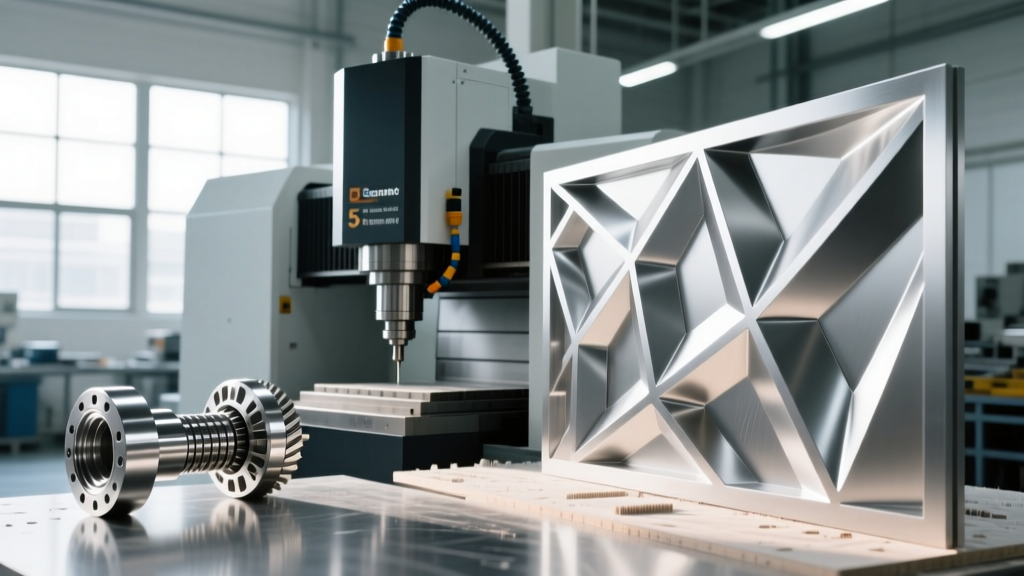
When auditing a prospective supplier, request a detailed list of their 5-axis equipment. You are looking for high-mass, high-torque machines specifically configured for hard-metal milling. Top-tier shops invest in platforms like the DMG MORI monoBLOCK series, Makino D500, or Hermle C400.
Non-Negotiable Machine Metrics for Titanium
- Machine Mass: Minimum 12,000 kg to 15,000 kg. High mass dampens the high-frequency vibrations inherent in titanium milling.
- Spindle Torque: Minimum 300 Nm at low RPMs (400–800 RPM). Titanium requires high torque at low speeds, especially when using large-diameter face mills or drilling deep bores.
- Guideway Type: Hardened box ways or high-load roller linear guides. Standard ball-type linear guides will deflect under heavy titanium roughing loads.
- Toolholding Interface: HSK-A63 or Capto C6 tapers are mandatory. Standard CAT40/V-flange tapers lack the radial accuracy and pull-out retention needed for heavy titanium side-milling.
- Thermal Compensation: Active spindle and ball-screw cooling systems are required to maintain tight tolerances during 10+ hour cycle times.
Toolpath Dynamics: Trochoidal Milling and Adaptive Clearing
Traditional offset toolpaths fail in titanium because they maintain constant radial engagement, causing heat spikes when the tool enters corners. Advanced shops utilize adaptive clearing and trochoidal milling strategies. By maintaining a constant, low radial stepover (typically 10% to 15% of the tool diameter), the machine can utilize much higher axial depths of cut (up to 2x the tool diameter) and faster feed rates. This keeps the cutting temperature stable and maximizes metal removal rates (MRR) without overloading the spindle.
Tooling and High-Pressure Coolant (HPC) Strategies
The Society of Manufacturing Engineers (SME) consistently highlights that toolpath and coolant delivery are just as critical as the machine tool itself. For complex 5-axis titanium parts, standard flood coolant is entirely insufficient.
The 1000 PSI Minimum Rule
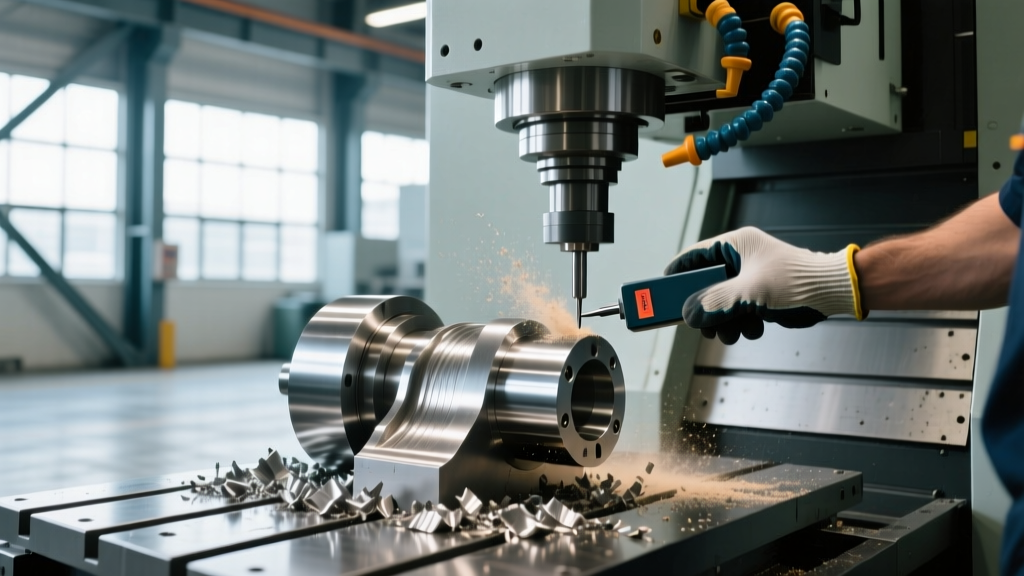
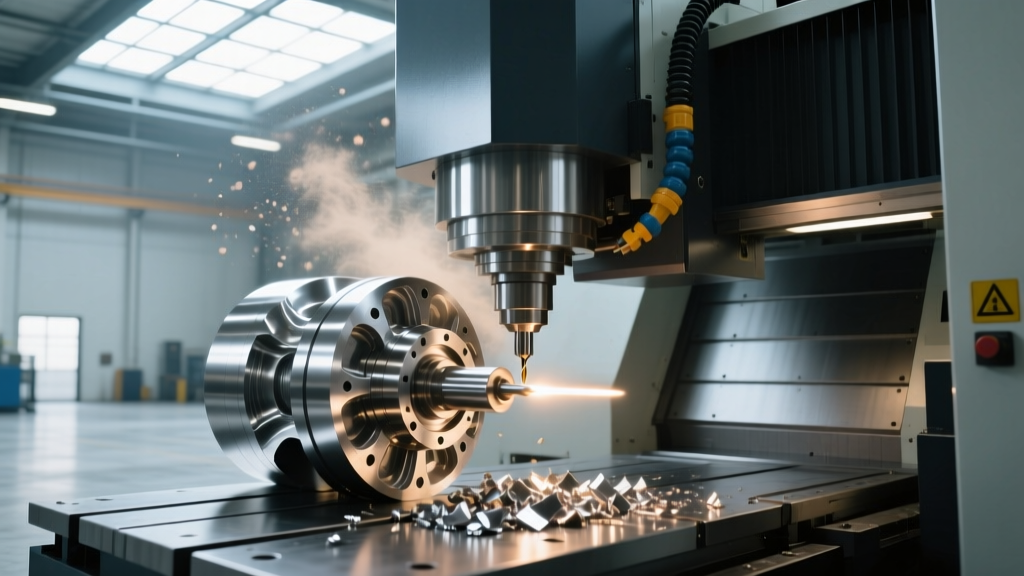
Shops must utilize through-tool High-Pressure Coolant (HPC) systems delivering a minimum of 70 bar (1000 psi), with advanced facilities pushing 150 bar (2200 psi). This extreme pressure pierces the vapor barrier created by the heat of the cut, forces chips out of deep 5-axis pockets, and prevents chip re-welding to the cutter flutes.
Tooling Selection
Look for shops utilizing variable-helix and variable-pitch solid carbide end mills (from brands like Harvey Tool or Kennametal). The uneven spacing breaks the harmonic frequencies that cause chatter. Furthermore, cutters must feature advanced AlTiN (Aluminum Titanium Nitride) or nACo (Nano-Composite) coatings to withstand the 800°C+ temperatures generated at the shear zone.
Decision Matrix: 3+2 Axis vs. Simultaneous 5-Axis vs. Mill-Turn
Not every complex titanium part requires full simultaneous 5-axis machining. A competent engineering team will select the optimal kinematic approach based on the part's geometry and production volume.
| Approach | Best Application | Setup Time | Geometric Limitation | Cost Impact |
|---|---|---|---|---|
| 3+2 Axis (Indexed) | Prismatic parts with angled features, valve bodies. | Low | Cannot machine complex organic contours or undercuts continuously. | Lowest hourly rate; higher setup if multiple angles needed. |
| Simultaneous 5-Axis | Blisks, impellers, aerospace structural ribs, orthopedic implants. | High (Complex fixturing/CAM) | None. Full spatial access. | Highest hourly rate ($180-$240/hr); lowest per-part cost at volume. |
| 5-Axis Mill-Turn | Cylindrical parts with off-center radial features (e.g., landing gear actuators). | Medium | Requires part symmetry or chuckable geometry. | Reduces secondary operations; high capital cost passed to part price. |
2026 Pricing Benchmarks and Supplier Qualification
As of 2026, the baseline shop rate for 5-axis titanium CNC machining services ranges from $175 to $245 per hour, depending on the machine's work envelope and the shop's overhead. However, the hourly rate is only one variable. Complex 5-axis parts require sophisticated workholding, which drives up Non-Recurring Engineering (NRE) costs.
Workholding and Fixturing Costs
Titanium requires immense clamping force during roughing, but complex aerospace parts often feature thin walls that deform under pressure. Expect to pay $2,500 to $6,000 in NRE for custom fixturing. Advanced shops utilize phase-change fixturing alloys (like Cerrocast) or custom 3D-printed soft jaws to support thin walls during finishing passes without inducing residual stress.
Quality Assurance and Metrology
Machining a complex 5-axis titanium part is only half the battle; proving it meets AS9100 Rev D or ISO 13485 standards is the other. Standard calipers and micrometers are useless for organic 5-axis contours.
Metrology Requirement: Ensure the shop utilizes a 5-axis continuous scanning CMM (Coordinate Measuring Machine), such as the Zeiss Contura or Renishaw REVO system. Optical scanning (e.g., GOM ATOS) should be used for first-article inspection (FAI) to generate full color-map deviations against the CAD model.Non-Destructive Testing (NDT)
For critical flight hardware, surface integrity is paramount. Verify that the vendor has in-house capabilities for Fluorescent Penetrant Inspection (FPI) to detect micro-cracks induced by aggressive milling parameters, and that they maintain proper NADCAP accreditation for these special processes.
The Vetting Checklist
Before issuing a Purchase Order, require the shop to answer the following:
- CAM Software: Do they use advanced 5-axis CAM (e.g., hyperMILL, Mastercam 5-Axis) with specialized titanium roughing strategies?
- Tool Life Management: How do they track tool wear? (Shops should be replacing solid carbide end mills after 40-60 minutes of active cutting time in Ti-6Al-4V, not running them to failure).
- Certifications: Are they audited to AS9100 for aerospace or ISO 13485 for medical? Verify their FAA production approvals or equivalent quality management system documentation.
- Material Traceability: Do they provide full mill certifications (MTRs) and perform ultrasonic testing (UT) on raw titanium billets to detect internal voids before machining begins?
Final Procurement Strategy
Selecting a partner for titanium CNC machining services is an exercise in risk mitigation. The lowest bidder rarely possesses the high-mass 5-axis equipment, 2000 psi HPC systems, and advanced metrology required to deliver complex Ti-6Al-4V geometries reliably. Prioritize shops that can demonstrate their toolpath strategies, show proof of high-torque machine investments, and provide transparent metrology reports on their first-article runs.