Low Volume CNC Machining: Navigating ISO & AS9100 Specs
Explore how ISO 9001 and AS9100 certifications dictate technical specs, metrology, and quality control in low volume CNC machining operations.
When sourcing low volume CNC machining for critical applications—such as aerospace structural brackets, medical implant prototypes, or semiconductor test fixtures—a machine shop’s Quality Management System (QMS) dictates the physical reality of the parts you receive. Certifications like ISO 9001:2015 and AS9100 Rev D are not merely administrative badges; they are rigid technical frameworks that govern toolpath verification, material traceability, and metrology calibration.
In low volume CNC machining, the cost of a single scrapped part is exponentially higher than in mass production. A 10-part run of 5-axis Inconel 718 turbine blades leaves zero margin for setup errors or tool deflection miscalculations. Understanding how top-tier machine shops leverage QMS certifications to engineer certainty into short-run production is essential for procurement and engineering teams.
The Technical Anatomy of ISO 9001:2015 in Short-Run Production
ISO 9001:2015 serves as the baseline QMS for general manufacturing. For low volume CNC machining, the most critical technical enforcement occurs under Clause 8.5.1 (Control of Production and Service Provision). In a certified environment, this clause mandates that every short-run job is governed by a controlled, version-locked routing traveler.
Setup Validation and Toolpath Verification
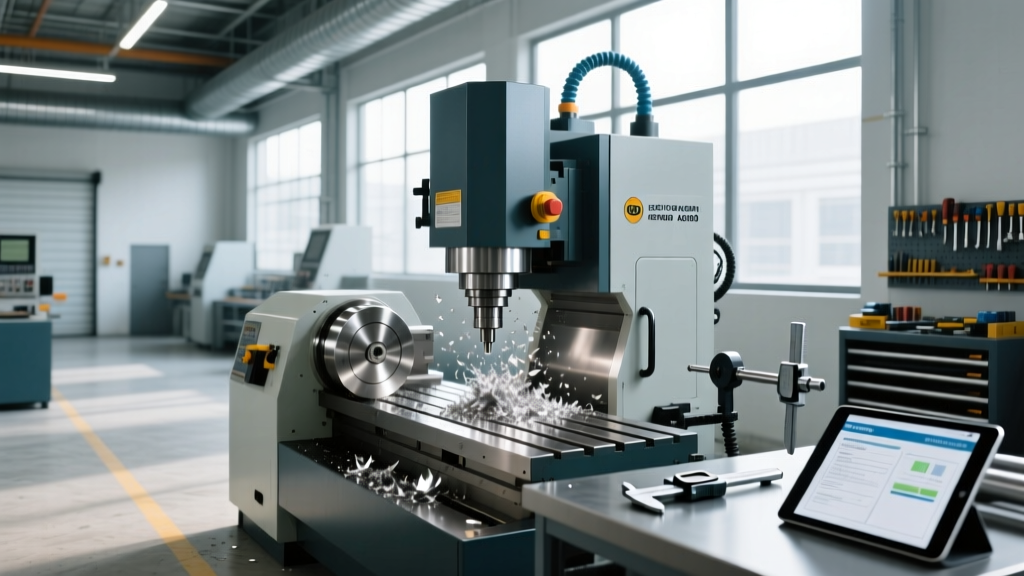
Under ISO 9001, a shop cannot simply load a G-code program and hit cycle start. The technical workflow requires:
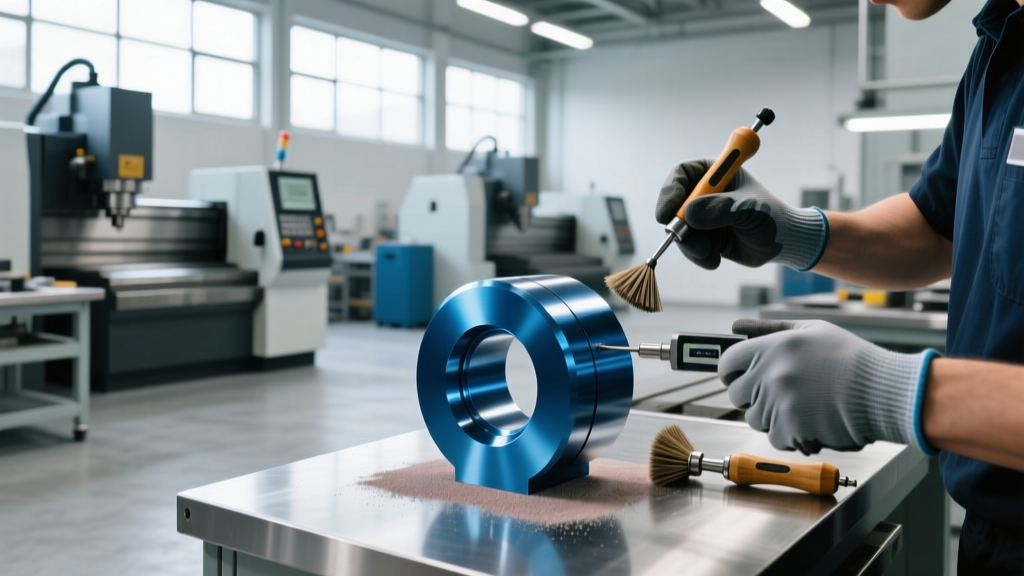
- Tool Presetting: Using optical presetters (e.g., Zoller VENTION) to measure exact tool length and radius offsets before the tool enters the machine spindle, eliminating first-part crash risks.
- Dry-Run Verification: Executing a 100% graphical simulation and physical air-cut with the Z-axis shifted by +5.000mm to verify rapid traverse clearances.
- First-Off Inspection: The machine operator must pause production after the first part is machined to verify critical-to-quality (CTQ) dimensions using calibrated micrometers or bore gauges before the router traveler is signed off for the remaining 9 parts.
"In low-volume runs, setup time often exceeds actual cycle time. ISO 9001 forces shops to document the exact fixture layout and vise jaw configurations, ensuring that if a secondary operation is required on a different machine, the datum references remain mathematically identical."
AS9100 Rev D: Aerospace Rigor for Low Volume CNC Machining
While ISO 9001 ensures basic process control, AS9100 Rev D introduces severe technical constraints specific to aerospace and defense. When you require low volume CNC machining for flight-critical hardware, AS9100 mandates strict adherence to configuration management and advanced traceability.
⚠ Warning: The "Paper-Only" AS9100 ShopMany machine shops hold AS9100 certification but only apply its rigor to their high-volume production lines. For low-volume prototype runs, verify that the shop applies Clause 8.5.1.1 (Production Process Verification) to short runs. If they do not perform a full First Article Inspection (FAI) on a 5-part prototype run, they are treating your aerospace parts like commercial job-shop work.
Material Traceability and DFARS Compliance
In AS9100-certified low volume CNC machining, raw material must be tracked from the mill to the final part. For specialty metals (titanium, Inconel, aerospace-grade aluminum like 7075-T73), the shop must maintain Mill Test Reports (MTRs) verifying chemical composition and heat treatment. Furthermore, defense contracts require compliance with DFARS 252.225-7009, ensuring no specialty metals are melted or manufactured in non-compliant countries. A certified QMS automatically flags non-compliant material certs in the ERP system before the stock is ever cut.
ISO 9001 vs. AS9100: Technical Requirements Matrix
The table below illustrates how technical requirements scale between standard commercial machining and aerospace-certified low volume CNC machining.
| Technical Parameter | ISO 9001:2015 (Commercial) | AS9100 Rev D (Aerospace) |
|---|---|---|
| First Article Inspection (FAI) | Recommended; basic dimensional check | Mandatory per AS9102; requires Forms 1, 2, and 3 |
| Material Traceability | Supplier certificate of conformance (C of C) | Full MTR with heat/lot traceability to final part |
| CNC Machine Calibration | Annual laser calibration | ISO 230 geometric testing + ballbar circularity checks |
| Non-Conforming Material | Scrap or rework bin | Quarantined cage; MRB (Material Review Board) process |
Metrology and Calibration: The Hidden Cost of Compliance
A certification is only as effective as the metrology equipment validating it. In low volume CNC machining, you cannot rely on statistical process control (SPC) because the sample size is too small to establish a bell curve. Instead, 100% inspection of CTQ features is required.
Certified shops invest heavily in Coordinate Measuring Machines (CMMs) equipped with scanning probes (e.g., Renishaw REVO or Zeiss VAST). To maintain ISO/IEC 17025 accreditation for their internal calibration labs, shops must adhere to strict environmental controls:
- Thermal Stabilization: Parts must acclimate in a temperature-controlled metrology lab (20°C ± 1°C) for a minimum of 4 hours before CMM inspection to prevent thermal expansion errors in materials like aluminum.
- Probe Qualification: CMM stylus tips must be qualified against a NIST-traceable master sphere before every new low-volume inspection program is run.
- Surface Plate Calibration: Granite surface plates used for manual height-gauge inspections must be recalibrated every 6 months for flatness and repeat-readability.
Step-by-Step: Tracing a 25-Part CNC Run Through a Certified QMS
To understand the operational friction—and resulting reliability—of certified low volume CNC machining, follow the lifecycle of a 25-part run of 17-4 PH stainless steel valve bodies:
- Order Review & DFARS Check (Day 1): Engineering reviews the 3D STEP file and 2D PDF. The ERP system verifies that the specified 17-4 PH Condition H1150 material is sourced from a DFARS-compliant domestic mill.
- CAM Programming & Toolpath Simulation (Day 2): The CAM programmer generates the toolpaths using Mastercam. A collision detection simulation is run, and the setup sheet is generated, specifying exact vise jaw part numbers and torque wrench settings for the fixture.
- Material Issue & Setup (Day 4): The raw bar stock is issued from the material cage. The MTR heat number is laser-etched onto the raw stock. The operator sets the work coordinate system (WCS) using a Renishaw spindle probe.
- First Article & In-Process Inspection (Day 5): Part #1 is machined. It goes to the CMM for a full AS9102 FAI. Once approved, parts #2 through #25 are run. The operator performs in-process checks on critical bore diameters every 5 parts using a calibrated air gauge.
- Final QA & Documentation (Day 7): All 25 parts undergo final visual and dimensional inspection. The shipping package includes the dimensional inspection report, the raw material MTR, the C of C, and a copy of the AS9102 FAI report.
Medical Device Low-Volume Machining: The FDA Factor
While AS9100 governs aerospace, low volume CNC machining for medical devices (such as surgical robot end-effectors or orthopedic trial kits) falls under the FDA’s Quality System Regulation (21 CFR Part 820). The technical focus here shifts from material traceability to process validation and bioburden control.
For short-run medical machining, shops must validate their CNC processes (IQ/OQ/PQ) even for low volumes. Furthermore, the cutting fluids and rust preventatives used during the machining of 316L stainless steel or PEEK must be documented and compatible with the customer's final passivation and sterilization processes. A shop lacking 21 CFR 820 compliance risks introducing microscopic contaminants that can compromise the biocompatibility of the final implant.
Financial Impact: Pricing Certified Low Volume CNC Machining
Engineering teams must budget accurately for the overhead that QMS compliance introduces to short-run production. Expect the following cost drivers when moving from a non-certified job shop to an ISO 9001/AS9100 certified facility:
Cost Breakdown Variables
- FAI Programming: Creating a CMM program for a complex 5-axis part adds $400 to $1,200 in non-recurring engineering (NRE) costs.
- Documentation Overhead: Compiling MTRs, C of Cs, and inspection reports typically adds 10-15% to the total administrative cost of the lot.
- Scrap Allowance: Certified shops will often mandate a 10-20% material overage for low-volume runs to account for setup parts, destructive testing coupons, and tensile test samples required by aerospace specs.
Ultimately, low volume CNC machining governed by ISO 9001 and AS9100 certifications is not about paying a premium for paperwork. It is about purchasing a mathematically verified manufacturing process. By enforcing strict adherence to setup validation, NIST-traceable metrology, and absolute material traceability, these QMS frameworks ensure that a 10-part prototype run is held to the exact same physical tolerances as a 10,000-part production contract.