Titanium CNC Machining: Oil & Gas Equipment Selection Guide
Discover the best equipment and tooling for titanium CNC machining in oil and gas. Learn spindle specs, coolant choices, and rigidity requirements.
Machining titanium for oil and gas is not a standard milling operation. Components like subsea wellhead systems, downhole logging housings, and high-pressure valve bodies require Ti-6Al-4V (Grade 5) for its superior resistance to hydrogen sulfide (H2S) and chloride-induced stress corrosion cracking. However, titanium CNC machining introduces severe thermal and mechanical challenges that standard vertical machining centers (VMCs) simply cannot handle. Procurement managers and shop owners must select equipment engineered specifically for low thermal conductivity and high chemical reactivity.
Critical Material Constraint: Titanium has a thermal conductivity roughly 1/16th that of carbon steel. In titanium CNC machining, up to 80% of the cutting heat transfers directly into the cutting tool rather than the chip, accelerating tool wear and risking catastrophic spindle bearing failure if the machine lacks proper thermal management and rigidity.Spindle Architecture: Torque vs. RPM in Ti-6Al-4V
The most common mistake shops make when buying equipment for energy sector components is prioritizing high RPM over low-end torque. Titanium requires aggressive material removal rates (MRR) at relatively low spindle speeds to prevent work hardening and tool edge chipping.
Standard 12,000 or 15,000 RPM direct-drive spindles often lack the continuous torque required below 4,000 RPM. For heavy roughing of oil and gas forgings, you need a gear-driven spindle or a high-torque direct-drive system capable of delivering a minimum of 250 Nm to 300 Nm of continuous torque at 3,000 RPM. Machines like the DMG MORI DMU 50 3rd Generation or Makino's horizontal machining centers offer specialized high-torque spindle options specifically designed for these hard-to-machine aerospace and energy alloys.
Target Spindle Specifications for Roughing Titanium
- Continuous Torque: ≥ 250 Nm at 3,000 - 4,000 RPM
- Maximum RPM: 8,000 - 10,000 RPM (sufficient for finishing passes)
- Bearing Configuration: Oversized, pre-loaded ceramic hybrid bearings to handle high radial cutting forces without thermal seizure.
Machine Rigidity: Dampening the Chatter
Titanium's low modulus of elasticity (approximately 114 GPa compared to steel's 200 GPa) causes significant "springback" during cutting. The workpiece deflects away from the tool and snaps back, creating severe chatter, poor surface finishes, and rapid insert failure. To counteract this, the machine structure must possess exceptional dynamic damping.
Evaluating Cast Iron vs. Polymer Concrete Beds
While high-grade Meehanite cast iron is the industry standard, shops dedicated to titanium CNC machining should strongly consider machines utilizing polymer concrete (e.g., Granitan) bases. Polymer concrete offers up to 10 times better vibration dampening characteristics than cast iron. This superior damping absorbs the high-frequency harmonics generated during titanium milling, extending tool life by 20-30% and allowing for deeper axial depths of cut without chatter.
High-Pressure Coolant Delivery Systems
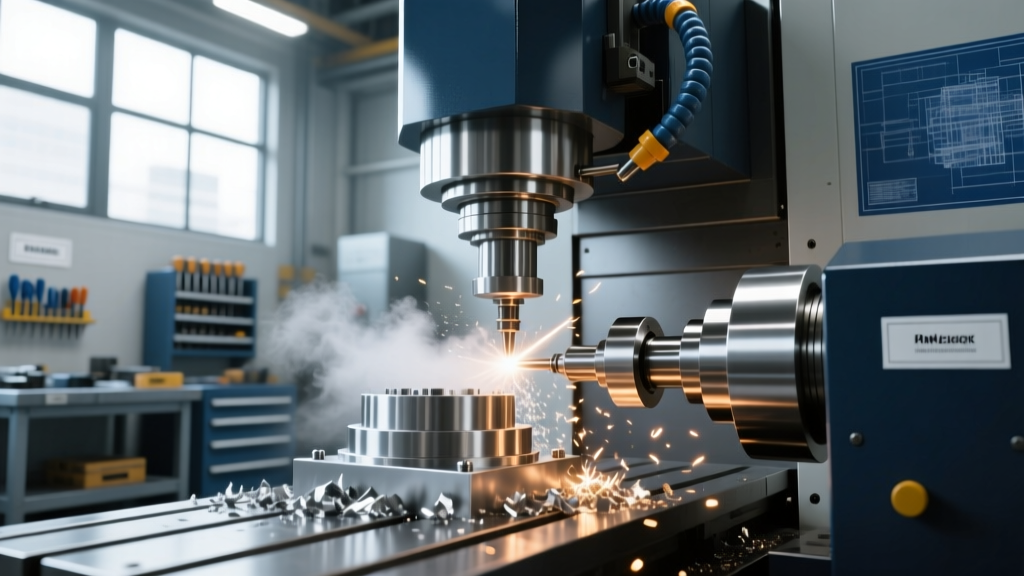
Flood coolant is virtually useless in deep-cavity titanium machining for downhole tools. Because the heat remains trapped in the cutting zone, standard flood coolant simply boils upon contact, creating a steam barrier that accelerates tool wear. Equipment selection must prioritize high-pressure Through-Tool Coolant (TTC) systems.
According to technical guidelines from the Sandvik Coromant Knowledge Hub, effective chip evacuation and thermal management in titanium require coolant pressures that physically break the chip at the shear zone. You must specify machines with integrated high-pressure pumps capable of 70 bar (1,000 psi) as a baseline, with 150 bar (2,175 psi) preferred for deep-hole drilling and complex 5-axis contouring.
| Operation Type | Minimum Coolant Pressure | Nozzle Type Required | Primary Objective |
|---|---|---|---|
| Heavy Roughing | 70 bar (1,000 psi) | Standard Through-Tool | Heat extraction and bulk chip evacuation |
| Finishing / Profiling | 100 bar (1,450 psi) | Precision adjustable nozzles | Chip thinning and surface burn prevention |
| Deep Hole Drilling | 150+ bar (2,175+ psi) | High-pressure coolant inducers | Forced chip breaking to prevent fluting jams |
Workholding and Tooling Integration
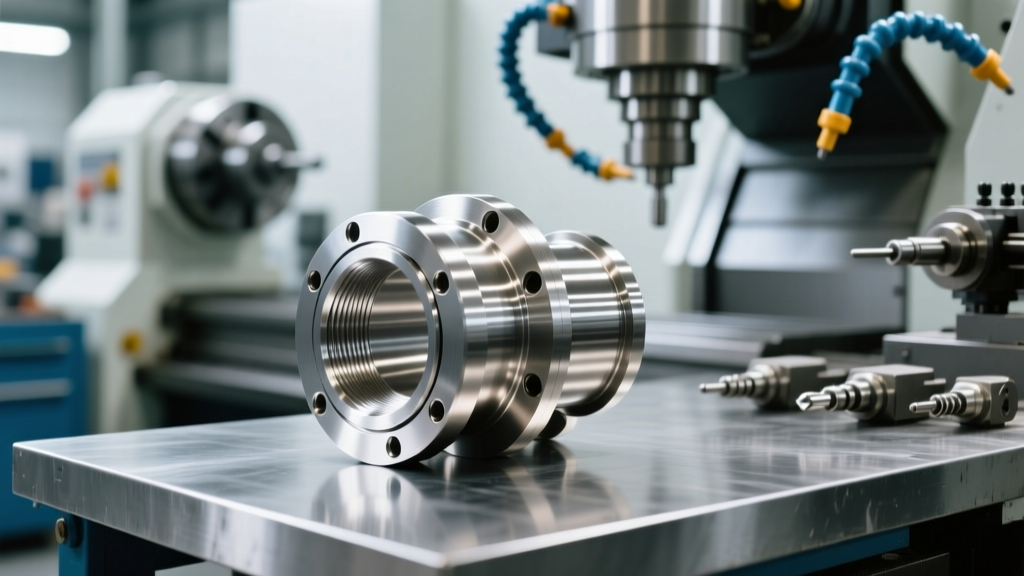
The machine is only half the equation. Oil and gas components often feature complex geometries like intersecting bores in valve bodies, requiring 5-axis simultaneous machining. When buying a 5-axis platform for titanium, evaluate the workholding interface.
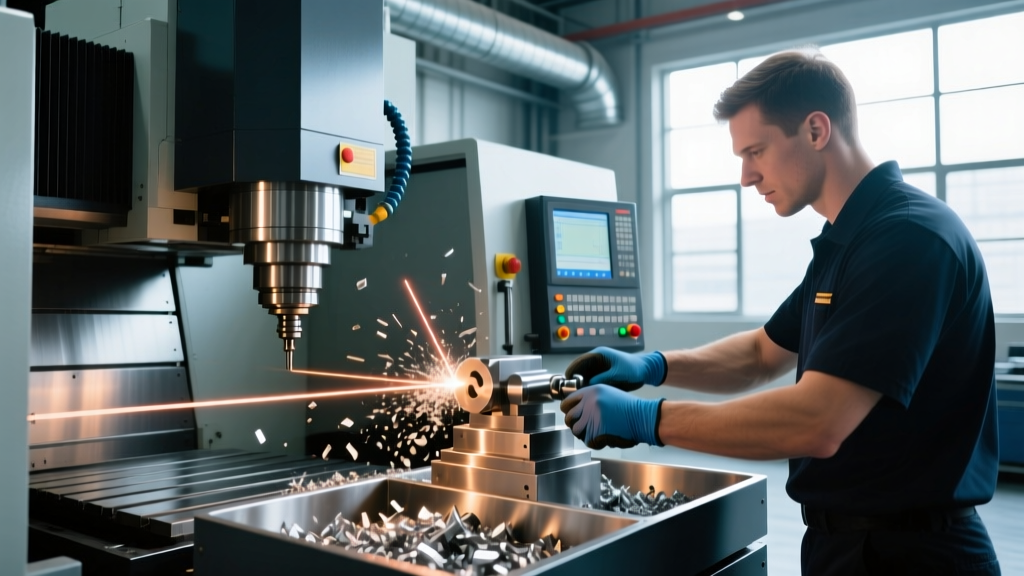
Standard manual vises will fail under the cutting forces required for titanium. Procure machines equipped with high-clamping-force hydraulic tombstones or automated pallet changers (APCs) with integrated hydraulic manifolds. Furthermore, as noted by the International Titanium Association, energy sector applications demand strict adherence to NACE MR0175/ISO 15156 standards for sour gas environments. This means the machined surface must be free of smeared material or micro-cracks, which is only achievable with rigid workholding and specialized AlTiN-coated micro-grain carbide tooling that prevents chemical welding to the titanium workpiece.
The Buying Framework: 5-Point Checklist for Oil & Gas Shops
Use this procurement checklist when evaluating RFQs from machine tool builders for titanium-specific cells:
- Verify Low-End Torque Curves: Do not accept peak torque ratings. Demand the continuous torque curve graph and verify it holds above 250 Nm at 3,500 RPM.
- Audit Coolant Plumbing: Ensure the machine's internal rotary union and spindle nose are rated for continuous 150 bar operation without seal degradation.
- Assess Structural Damping: Request tap-test data or finite element analysis (FEA) reports from the builder demonstrating dynamic stiffness at the tool center point (TCP).
- Thermal Compensation Systems: Titanium cuts slowly. The machine will run for hours. Verify the spindle and ball screws have active thermal growth compensation sensors mapped to the CNC controller.
- Chip Management: Titanium chips are stringy and can wrap around tooling. Ensure the machine features a steeply sloped bed and high-volume hinge-belt conveyors to prevent chip re-cutting.
Capital Expenditure vs. Operational ROI
Upgrading to a titanium-optimized machine requires significant capital. However, the ROI is realized in tooling savings and cycle time reductions. Advanced machining strategies detailed in Harvey Tool's In The Loupe technical library demonstrate that optimized high-pressure setups can increase insert life by over 40%.
| Cost Factor | Standard VMC (Non-Optimized) | Titanium-Optimized HMC / 5-Axis |
|---|---|---|
| Base Machine Capital Cost | $140,000 - $180,000 | $450,000 - $850,000 |
| High-Pressure Coolant Upgrade | $15,000 (Aftermarket) | Included (OEM Integrated) |
| Monthly Carbide Tooling Spend | $12,000 (High wear rate) | $6,500 (Optimized chip load/heat) |
| Scrap Rate (Surface Finish Fails) | 8% - 12% | < 2% |
| Estimated ROI Payback Period | N/A | 14 - 18 Months (Based on 2 shifts/day) |
Selecting the right equipment for titanium CNC machining in the oil and gas sector is an exercise in managing thermal and mechanical extremes. By prioritizing low-end spindle torque, polymer concrete damping, and integrated high-pressure coolant, machine shops can secure a distinct competitive advantage in producing high-integrity downhole and subsea components.