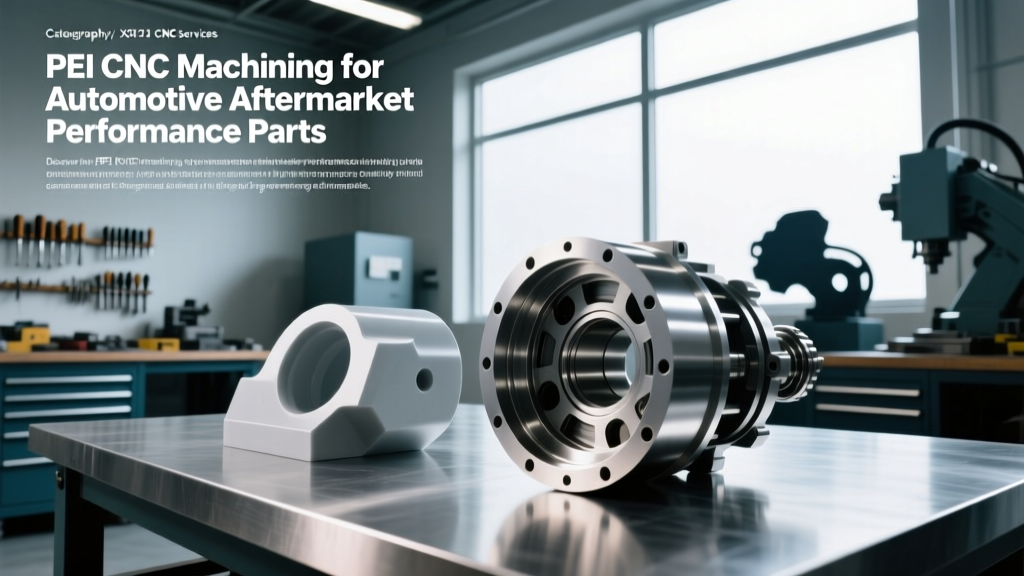
PEI CNC Machining for Automotive Aftermarket Performance Parts
Discover how PEI CNC machining is replacing metals in automotive aftermarket parts. Explore EV case studies, machining parameters, and material comparisons.
The Shift to High-Performance Thermoplastics in Motorsport
Automotive aftermarket manufacturers are increasingly abandoning aluminum and steel for high-performance thermoplastics in non-structural, high-temperature, and electrically sensitive applications. Polyetherimide (PEI), most commonly recognized by SABIC’s trade name ULTEM™, has emerged as a premier candidate for extreme environments. When executed correctly, PEI CNC machining yields components that survive under-hood thermal cycling, resist harsh automotive fluids, and provide critical dielectric isolation for electric vehicle (EV) performance upgrades. Unlike standard engineering plastics like nylon or acetal, PEI maintains its dimensional stability and mechanical strength at continuous operating temperatures up to 170°C (338°F).
According to SABIC's ULTEM™ resin portfolio, the material's inherent flame retardancy and low smoke generation make it uniquely suited for enclosed automotive cabins and high-voltage battery enclosures, meeting strict FMVSS 302 flammability standards without requiring halogenated additives.
Material Selection: Unfilled vs. Glass-Filled PEI
Selecting the correct grade of PEI is the first critical decision for aftermarket engineers. The two most common variants utilized in precision machining are unfilled PEI (Ultem 1000) and 30% glass-filled PEI (Ultem 2300).
- Ultem 1000 (Unfilled): Offers excellent electrical insulation, high impact strength, and superior surface finish. It is ideal for sensor housings, custom intake manifold runners, and interior switchgear components where aesthetics and dielectric strength are paramount.
- Ultem 2300 (30% Glass-Filled): The addition of glass fibers increases tensile strength from 15,200 psi to over 24,000 psi and drastically reduces the coefficient of thermal expansion (CTE). This grade is mandatory for structural brackets, EV battery module spacers, and turbocharger heat shields where mechanical rigidity under thermal load is required.
Case Study: High-Voltage EV Battery Module Spacers
A prominent European EV aftermarket tuning shop recently faced a challenge when developing an upgraded, high-discharge battery pack for track-focused Porsche Taycan builds. The original equipment manufacturer (OEM) utilized die-cast aluminum spacers between the battery modules. While structurally sound, the aluminum spacers added 4.2 kg of parasitic weight to the pack and posed a catastrophic short-circuit risk if the hard-anodized coating wore through due to high-frequency track vibrations.
The engineering team pivoted to PEI CNC machining, specifically utilizing Ultem 2300. The results were transformative:
- Weight Reduction: The PEI spacers weighed 68% less than their aluminum counterparts, shaving 2.8 kg from the vehicle's central polar moment of inertia.
- Dielectric Isolation: With a dielectric strength of 830 V/mil, the PEI spacers completely eliminated the risk of module-to-module arcing, even when subjected to extreme mechanical shock.
- Vibration Damping: The inherent viscoelastic properties of the amorphous PEI polymer absorbed high-frequency harmonic vibrations that previously caused fatigue cracking in the aluminum busbars.
Material Comparison Matrix for Under-Hood & EV Applications
| Property | PEI (Ultem 2300) | Delrin (POM) | Aluminum 6061-T6 |
|---|---|---|---|
| Density (g/cm³) | 1.51 | 1.41 | 2.70 |
| Tensile Strength (psi) | 24,000 | 10,000 | 45,000 |
| Max Continuous Temp (°C) | 170 | 90 | 200+ |
| Dielectric Strength (V/mil) | 830 | 500 | Conductive |
| Relative Raw Material Cost | High ($55/lb) | Low ($8/lb) | Medium ($4/lb) |
Precision CNC Machining Strategies for PEI
PEI is an amorphous thermoplastic, meaning it lacks a crystalline structure. While this grants it excellent dimensional stability and transparency in its unfilled state, it also makes the material highly susceptible to internal stress and thermal expansion during the cutting process. Machining PEI requires a fundamentally different approach than machining metals.
Pre-Machining Annealing
Extruded or injection-molded PEI rod and plate stock contains significant residual internal stresses from the manufacturing process. If machined without stress relief, the material will warp or crack as the outer layers are removed. Annealing is mandatory. The stock must be heated in an industrial oven to 175°C, held for two hours per inch of thickness, and then cooled at a rate no faster than 10°C per hour until it reaches room temperature.
Tooling and Geometry
Standard aluminum-cutting end mills will generate excessive friction and melt the PEI. Tooling must feature solid carbide construction with highly polished flutes to prevent chip adhesion. Utilize high positive rake angles (15° to 20°) to shear the material cleanly rather than rubbing it. For glass-filled grades like Ultem 2300, the abrasive nature of the glass fibers will rapidly degrade standard HSS tools; carbide is non-negotiable.
Feeds, Speeds, and Coolant
Thermal management is the primary challenge in PEI CNC machining. If the cutting zone exceeds the material's glass transition temperature (217°C), the part will deform and lose its surface finish.
- Spindle Speed: For a 1/2-inch 3-flute carbide end mill on Ultem 2300, maintain 8,000 RPM.
- Feed Rate: 60 IPM (Inches Per Minute).
- Depth of Cut: 0.100-inch axial (ADOC) and 0.020-inch radial (RDOC) to allow heat to dissipate into the chip rather than the workpiece.
- Coolant: Avoid flood coolant. The sudden temperature differential can cause thermal shock and micro-cracking in glass-filled grades. Use a high-pressure compressed air blast or a fine mist coolant system to evacuate chips and manage heat.
PEI is slightly hygroscopic and can absorb up to 0.25% moisture at equilibrium. While this is lower than nylon, it is enough to cause micro-voids and poor surface finishes during high-speed machining. If holding ultra-tight tolerances (+/- 0.0005 inches), the material must be baked out in a desiccant dryer at 120°C for 12 hours immediately prior to the final finishing passes.
Design for Manufacturability (DFM) for PEI
Aftermarket designers must adapt their CAD models to accommodate the physical realities of amorphous polymers. Sharp internal corners act as stress concentrators and will inevitably lead to cracking under vibration or thermal cycling. Always specify a minimum internal corner radius of 0.030 inches. Wall thicknesses should not drop below 0.040 inches to ensure sufficient rigidity during the clamping and cutting phases.
Furthermore, avoid traditional tapping for threaded holes. The torsional stress of a tap can induce hoop stress and crack the surrounding PEI. Instead, utilize thread milling or helical interpolation with a carbide thread mill to produce clean, stress-free threads that maintain their pull-out strength.
Economic Viability and Production Scaling
At first glance, the raw material costs of PEI can deter aftermarket shops. Ultem 2300 rod stock typically ranges from $45 to $65 per pound, compared to $4 to $8 per pound for 6061 aluminum. However, a comprehensive cost-benefit analysis reveals a different financial picture.
Because PEI is significantly softer than aluminum or titanium, CNC cycle times are often 30% to 40% faster due to higher allowable feed rates and reduced tool wear. Additionally, PEI parts require zero secondary finishing operations. There is no need for deburring, anodizing, passivation, or powder coating. The part comes off the machine ready for assembly. For low-to-medium volume aftermarket production runs (50 to 500 units), the elimination of secondary processing lead times and costs frequently makes PEI CNC machining more cost-effective than machined and finished aluminum.
Metrology and Quality Control
Inspecting PEI components requires strict environmental controls. The coefficient of thermal expansion for unfilled PEI is approximately 3.1 x 10^-5 in/in/°F. This means a 10-inch long aftermarket intake manifold runner will expand by roughly 0.003 inches for every 10°F increase in ambient shop temperature.
All Coordinate Measuring Machine (CMM) inspections must be conducted in a climate-controlled metrology lab held precisely at 20°C (68°F). Attempting to verify tight geometric tolerances on the shop floor during summer months will yield false rejections. As noted in Ensinger's PEI machining guidelines, allowing the part to acclimate to the inspection room for a minimum of four hours prior to measurement is critical for accurate quality assurance.
For shops looking to verify baseline material properties and procurement specifications, McMaster-Carr's Ultem property data provides an excellent, accessible reference point for cross-checking tensile and thermal metrics against incoming raw stock certifications.